Internal Revenue Service
Fill out Form 1040-NR online
U.S. Nonresident Alien Income Tax Return
Form 1040-NR is the yearly U.S. income tax return for nonresident aliens, and for foreign estates and trusts, that have U.S. income or another reason to file. Its two pages report income effectively connected with a U.S. trade or business, such as wages, and bring in the tax on other U.S.-source income from Schedule NEC. You use it to figure your tax and claim a refund of tax that was withheld. This edition is for tax year 2025, the return filed in 2026; the IRS publishes a new edition for each tax year, so a 2026 return uses the 2026 form.
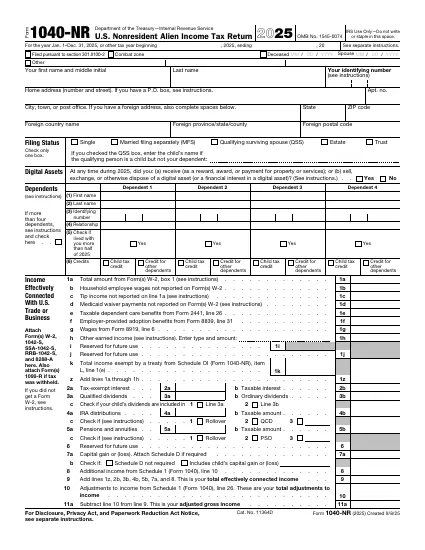
The form opens in our PDF editor with its own fields ready to type into. To download it, the filled PDF is sent to GuruPDF to prepare the file and is deleted from our servers one hour later. You can fill it in without an account; downloading the filled PDF needs a free account. A free account gets 15 credits a day, enough for one form a day.
- Country
- United States
- Edition
- Tax year 2025
- Pages
- 2
- Fillable fields
- 171
- Last checked at the source
- November 13, 2026
GuruPDF is an independent PDF editor, not a government agency, and is not affiliated with any government. This page explains the form in plain words; it is not legal or tax advice. Always check the official instructions before you file. This is the tax year 2025 version; the IRS keeps forms for earlier years.
Who uses Form 1040-NR
- Nonresident aliens who were engaged in a trade or business in the United States during 2025, for example as employees, even if their income is exempt under a tax treaty
- Nonresident aliens with U.S.-source income reportable on Schedule NEC when not all of the tax they owe was withheld
- Nonresident students, scholars and other temporary visitors who want a refund of U.S. tax that was withheld
- Dual-resident taxpayers who want to be treated as nonresidents under a tax treaty's tie-breaker rule
- Personal representatives of a deceased nonresident who had to file, and people filing for a nonresident estate or trust
Before you start
- Your social security number or ITIN (an estate or trust uses its EIN)
- Forms W-2, 1042-S, 1099 and any other statements that show your income and the U.S. tax withheld
- Your visa type, the days you were present in the United States and your country of tax residence, which Schedule OI (Form 1040-NR) asks for
- The tax treaty article and the amount of any income you claim is exempt under a treaty
- Any schedules your return needs, such as Schedule OI, Schedule NEC, Schedule A (Form 1040-NR) and Schedules 1, 2 and 3 of Form 1040
- Records of 2025 estimated tax payments, your bank routing and account numbers for a direct deposit refund, and your Identity Protection PIN if the IRS sent you one
How to fill out Form 1040-NR
Top of page 1: tax year, name, identifying number and address
Fill in the tax year dates only if you use a fiscal year instead of the calendar year. The boxes for section 301.9100-2, Combat zone, Deceased (with the date of death) and Other are checked only in the situations the instructions describe. Enter your first name, middle initial and last name, and your identifying number: an SSN or ITIN, or an EIN for an estate or trust. Enter your home address, and complete the foreign country, province and postal code spaces if your address is outside the United States.
Filing Status and Digital Assets
Check one box: Single, Married filing separately (MFS), Qualifying surviving spouse (QSS), Estate or Trust. A person filing Form 1040-NR cannot file a joint return, so a married nonresident generally checks MFS even if not separated. The exceptions are narrow and apply only to residents of Canada, Mexico or South Korea, U.S. nationals and students or business apprentices covered by Article 21(2) of the U.S.–India tax treaty: some of them may check Single if they meet five tests, such as living apart from their spouse for the last 6 months of 2025, and only they can check QSS. Then answer the Digital Assets question by checking Yes or No.
Dependents
The four columns ask for each dependent's first and last name, identifying number, relationship, whether they lived with you more than half of 2025, and which credit applies: the child tax credit or the credit for other dependents. The instructions say only U.S. nationals and residents of Canada and Mexico can claim dependents on the same terms as U.S. citizens; residents of South Korea and Indian students or business apprentices eligible under Article 21(2) of the treaty can do so on more limited terms, and no other Form 1040-NR filer can claim a dependent. If you have more than four, check the box and see the instructions.
Income Effectively Connected With U.S. Trade or Business: lines 1a to 11a
Line 1a is the total from box 1 of your Forms W-2, and lines 1b to 1h cover other wages and earned income, such as unreported tips or wages from Form 8919. Line 1k is income exempt by a treaty, taken from item L of Schedule OI; it is not added into line 1z and is not reported on any other line. Lines 2b to 8 cover taxable interest, dividends, IRA distributions, pensions, capital gains and other income from Schedule 1. Line 9 is your total effectively connected income, line 10 your adjustments from Schedule 1, and line 11a your adjusted gross income. Attach Forms W-2, 1042-S, SSA-1042-S, RRB-1042-S and 8288-A to page 1, and Form 1099-R if tax was withheld.
Tax and Credits: lines 11b to 24
Line 11b repeats your adjusted gross income. Line 12 is your itemized deductions from Schedule A (Form 1040-NR); only certain residents of India can enter a standard deduction there. Lines 13a to 13c are the qualified business income deduction, exemptions for estates and trusts, and additional deductions from Schedule 1-A, line 38. Line 15 is your taxable income and line 16 your tax. Lines 17 to 22 bring in amounts from Schedules 2, 3 and 8812. Line 23a is the tax on income not effectively connected with a U.S. trade or business, from Schedule NEC, line 15; line 23b is other taxes, including self-employment tax; line 23c is transportation tax. Line 24 is your total tax.
Payments and Refundable Credits: lines 25a to 33
Lines 25a to 25c are federal income tax withheld on Forms W-2, 1099 and other forms, and line 25d adds them. Lines 25e, 25f and 25g are tax withheld as shown on Forms 8805, 8288-A and 1042-S. Line 26 is your 2025 estimated tax payments plus any amount applied from your 2024 return. Lines 28 to 31 are the additional child tax credit, credit for tax paid with Form 1040-C, the refundable adoption credit and the amount from Schedule 3, line 15. Line 33 is your total payments.
Refund and Amount You Owe: lines 34 to 38
If line 33 is more than line 24, line 34 shows your overpayment. Enter on line 35a the part you want refunded, and give your routing number, account type and account number on lines 35b to 35d for direct deposit. Line 35e is for a mailing address outside the United States for a refund check, if it is not the address on page 1. Line 36 is the part you want applied to your 2026 estimated tax. If you owe, enter the amount on line 37; line 38 is the estimated tax penalty.
Third Party Designee and Sign Here
Check Yes in Third Party Designee if you want to let someone discuss this return with the IRS, and enter their name, phone number and a personal identification number they choose. The instructions say the designee's phone number must be a U.S. number. Sign and date the return, enter your occupation and, if the IRS sent you one, your Identity Protection PIN. Phone and email are optional. A paid preparer completes the Paid Preparer Use Only section.
After you fill it out
Form 1040-NR can be e-filed through tax software or a tax professional, or mailed. A printed form is a paper return: sign it by hand and send it to the IRS address in the Where To File section of the instructions; the address depends on whether you file for an individual or for an estate or trust and whether you enclose a payment. Attach the forms that show your income and withholding, such as Forms W-2 and 1042-S, and the schedules you used. An individual who received wages subject to U.S. income tax withholding files by the 15th day of the 4th month after the tax year ends; otherwise the return is due by the 15th day of the 6th month. Keep a copy for your records.
Signing: The Form 1040-NR instructions apply the Form 1040 rules for signing, and those say you must handwrite your signature on a return filed on paper; digital, electronic or typed signatures are not valid on a paper return. Print the completed form and sign and date it in ink. The instructions also allow an agent in the United States to sign for you if you were ill or injured, or were not in the United States at any time during the 60 days before the return was due.
Watch out for
- Form 1040-NR is for nonresident aliens. The instructions explain that you are generally a resident alien, who files Form 1040 instead, if you meet the green card test or the substantial presence test for 2025.
- A person filing Form 1040-NR cannot file a joint return, and most filers cannot claim dependents. Check the filing status and dependent rules in the instructions before you fill those sections.
- To claim a treaty exemption, report the exempt income on line 1k only, complete item L of Schedule OI and attach any Form 1042-S you received; attach Form 8833 if it is required.
- If you claim a refund of tax withheld, the instructions say you must attach proof of the withholding, such as Form 1042-S or Form 1099, to the left margin of page 1.
Questions about Form 1040-NR
Do I file Form 1040-NR or Form 1040?
It depends on whether you are a resident or nonresident alien for tax purposes. You are generally a resident if you meet the green card test or the substantial presence test for the year. Days spent in the United States as an exempt individual, such as a student on an F or J visa, do not count toward the substantial presence test. Publication 519, U.S. Tax Guide for Aliens, explains the tests.
I am an F-1 student with no U.S. income. Do I have to file?
The instructions say a nonresident student, teacher or trainee on an F, J, M or Q visa does not need to file Form 1040-NR if they have no income subject to U.S. tax. Students who exclude days of presence still file Form 8843 to explain why, by itself if no tax return is required.
When is Form 1040-NR due?
If you were an employee and received wages subject to U.S. income tax withholding, it is due by the 15th day of the 4th month after your tax year ends. If you did not receive such wages, it is due by the 15th day of the 6th month. For a calendar year return the instructions give the exact dates, moved to the next business day when the date falls on a weekend or legal holiday.
Can I take the standard deduction?
Generally no. Line 12 is for itemized deductions from Schedule A (Form 1040-NR). The instructions allow students and business apprentices eligible for benefits under Article 21(2) of the U.S.–India income tax treaty to enter the standard deduction instead.
How do I correct a Form 1040-NR I already filed?
File Form 1040-X, Amended U.S. Individual Income Tax Return. The instructions say it must be filed within 3 years after the date the original return was filed or within 2 years after the date the tax was paid, whichever is later.
Official information
- About Form 1040-NR (IRS)
- Instructions for Form 1040-NR
- Publication 519, U.S. Tax Guide for Aliens
- Substantial presence test (IRS)
Page text last reviewed November 13, 2026.
Related forms
- Form 8843Statement for Exempt Individuals and Individuals With a Medical ConditionIRSFill online
- Form 1040U.S. Individual Income Tax ReturnIRSFill online
- Form W-8BENCertificate of Foreign Status of Beneficial Owner for United States Tax Withholding and Reporting (Individuals)IRSFill online
- Form W-7Application for IRS Individual Taxpayer Identification NumberIRSFill online
- Form 1040-XAmended U.S. Individual Income Tax ReturnIRSFill online
- Form 4868Application for Automatic Extension of Time To File U.S. Individual Income Tax ReturnIRSFill online