Internal Revenue Service
Fill out Form 2441 online
Child and Dependent Care Expenses
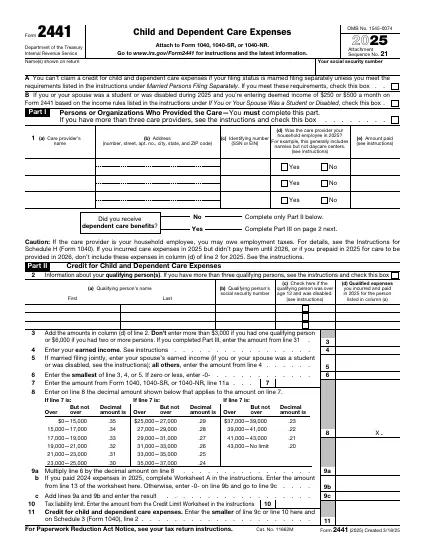
Form 2441 is the form you attach to Form 1040, 1040-SR or 1040-NR to claim the credit for child and dependent care expenses: care you paid for a child under 13 or another qualifying person so you (and your spouse, if filing jointly) could work or look for work. You also use it to figure how much of any dependent care benefits from your employer, such as a dependent care flexible spending account, you can exclude from income. This edition is for tax year 2025.
The form opens in our PDF editor with its own fields ready to type into. To download it, the filled PDF is sent to GuruPDF to prepare the file and is deleted from our servers one hour later. You can fill it in without an account; downloading the filled PDF needs a free account. A free account gets 15 credits a day, enough for one form a day.
- Country
- United States
- Edition
- Tax year 2025
- Pages
- 2
- Fillable fields
- 72
- Last checked at the source
- November 13, 2026
GuruPDF is an independent PDF editor, not a government agency, and is not affiliated with any government. This page explains the form in plain words; it is not legal or tax advice. Always check the official instructions before you file. This is the tax year 2025 version; the IRS keeps forms for earlier years.
Who uses Form 2441
- Working parents who paid for daycare, a babysitter, a nanny or day camp for a child under age 13
- People who paid for the care of a disabled spouse or dependent who could not care for themselves and lived with them for more than half the year
- Employees who received dependent care benefits, shown in box 10 of Form W-2, including a dependent care FSA
- Self-employed people and partners who received benefits under a dependent care assistance program of their own business
- Parents who look for work or are full-time students or disabled, under the special earned income rules
Before you start
- Each care provider's name, address and SSN, ITIN or EIN (Form W-10 can be used to ask for them)
- The total you paid each provider in 2025
- Each qualifying person's name and social security number, exactly as on the social security card
- Your Forms W-2, especially box 10 (dependent care benefits)
- Your earned income and, if filing jointly, your spouse's
- Your Form 1040, 1040-SR or 1040-NR figures for line 11a (adjusted gross income) and line 18
- Your 2024 Form 2441, if you paid 2024 care expenses in 2025
How to fill out Form 2441
Top of page 1: name, SSN and lines A and B
Enter the name(s) shown on your return and your social security number. Check line A only if your filing status is married filing separately and you meet the requirements to be treated as unmarried for the credit: you lived apart from your spouse for the last 6 months of 2025, your home was the qualifying person's main home for more than half of 2025, and you paid more than half the cost of keeping it up. Check line B if you or your spouse was a student or disabled and you enter deemed income of $250 or $500 a month.
Part I, line 1: who provided the care
Everyone completes Part I. For each care provider, enter the name in column (a), the address in column (b) and the SSN or EIN in column (c), or "Tax-Exempt" for a tax-exempt organization. In column (d), check Yes if the provider was your household employee (nannies usually are, daycare centers are not) or No. Column (e) is the total you paid in 2025. If you had more than three providers, check the box, list the three highest paid and attach a statement for the rest. Then answer whether you received dependent care benefits: No means you complete only Part II; Yes means you complete Part III on page 2 first.
Part III, lines 12 to 26: dependent care benefits
Line 12 is the total dependent care benefits for 2025, usually box 10 of your Forms W-2. Line 13 is any amount carried over from 2024 and used during a grace period, and line 14 any amount forfeited or carried forward to 2026, in parentheses. Lines 16 to 20 compare the benefits with your qualified expenses and earned income, and line 21 is the plan limit printed on the form ($5,000, or $2,500 in some married filing separately cases), or less if your plan allows less. Line 24 is deductible benefits for self-employed people and partners, line 25 excluded benefits, and line 26 taxable benefits, which also go on Form 1040, 1040-SR or 1040-NR, line 1e.
Part III, lines 27 to 31: carrying benefits into the credit
If you received benefits and also want the credit, complete lines 27 to 31. Line 27 is $3,000, or $6,000 with two or more qualifying persons, and line 28 adds lines 24 and 25. Line 29 subtracts line 28 from line 27; if the result is zero or less you can't take the credit (with an exception for 2024 expenses paid in 2025). Line 30 totals column (d) of line 2 on page 1, leaving out benefits shown on line 28, and line 31, the smaller of lines 29 and 30, goes on line 3.
Part II, line 2: qualifying persons
List each qualifying person with first and last name in column (a) and social security number in column (b). Check column (c) only if the person was over age 12 when the care was provided and was disabled. Column (d) is the qualified expenses you incurred and paid in 2025 for that person; do not include 2025 expenses paid in 2026 or care prepaid for 2026. If you have more than three qualifying persons, check the box and attach a statement.
Part II, lines 3 to 9c: figure the credit
Line 3 adds column (d) but is capped at $3,000 for one qualifying person or $6,000 for two or more; if you completed Part III, enter line 31 instead. Line 4 is your earned income and line 5 your spouse's if filing jointly (otherwise the line 4 amount), and line 6 is the smallest of lines 3, 4 and 5. Line 7 is your adjusted gross income from Form 1040, 1040-SR or 1040-NR, line 11a, and line 8 the decimal from the table on the form, from .35 down to .20. Line 9a multiplies line 6 by line 8, line 9b is the amount from Worksheet A in the instructions if you paid 2024 expenses in 2025, and line 9c adds them.
Lines 10 and 11: the credit
Line 10 is your tax liability limit from the Credit Limit Worksheet in the instructions. Line 11, the smaller of line 9c or line 10, is your credit for child and dependent care expenses; also enter it on Schedule 3 (Form 1040), line 2.
After you fill it out
Attach Form 2441 to your Form 1040, 1040-SR or 1040-NR (Attachment Sequence No. 21), with Schedule 3 carrying the credit, and file it with your return on paper or electronically. It is never sent to the IRS on its own. Keep the care providers' details, receipts and any Forms W-10, because the IRS can ask you to show the information you reported.
Signing: Form 2441 has no signature line. It is part of your Form 1040, 1040-SR or 1040-NR, and that return is signed as its instructions require.
Watch out for
- The name and SSN of each qualifying person must agree with their social security card, or the IRS may reduce or disallow the credit when it processes your return.
- If you give incorrect or incomplete care provider information, the credit (and the exclusion) may be disallowed unless you can show you used due diligence, for example by getting a completed Form W-10.
- No credit is allowed for amounts paid to your spouse, to the parent of your qualifying child, to someone you can claim as a dependent, or to your own child who was under 19 at the end of the year.
- If the care provider was your household employee, you may owe employment taxes and need Schedule H (Form 1040).
- This edition uses the 2025 rules and amounts. The IRS says that starting with tax year 2026 the credit can be up to 50% of qualifying expenses (instead of 35%) and the dependent care benefit exclusion rises from $5,000 to $7,500 ($3,750 if married filing separately), so a 2026 return needs the 2026 form.
Questions about Form 2441
Who is a qualifying person?
A qualifying child under age 13 whom you can claim as a dependent; a spouse who was not physically or mentally able to care for themselves and lived with you for more than half the year; or another person in that situation who lived with you for more than half the year and is, or could be, your dependent under the rules in the instructions. For divorced or separated parents, generally only the custodial parent can treat the child as a qualifying person.
Which expenses count?
Amounts paid for care, and for household services partly for the qualifying person's care, while you worked or looked for work. A day camp counts, even one that specializes in an activity; an overnight camp, summer school, tutoring and schooling from kindergarten up do not. Food, lodging, clothing, education and entertainment are not care expenses, and child support payments are not qualified expenses.
Can I claim the credit if I am married filing separately?
Generally married couples must file jointly to claim the credit. You can claim it on a separate return only if you meet all the requirements to be treated as unmarried (lived apart for the last 6 months of the year, your home was the qualifying person's main home for more than half the year, and you paid more than half its upkeep), and you check line A.
Is the credit refundable?
No. The IRS says the credit is nonrefundable: it can reduce the federal income tax you owe, but any part above your tax is not paid out. Line 10 limits it to your tax liability.
I paid some 2024 care expenses in 2025. Where do they go?
Not in column (d) of line 2. If you did not claim the credit on the maximum amount of qualified expenses for 2024, complete Worksheet A in the instructions and enter the amount from its line 13 on line 9b.
Official information
- About Form 2441 (IRS)
- Instructions for Form 2441
- Child and dependent care credit information (IRS)
- Publication 503, Child and Dependent Care Expenses
Page text last reviewed November 13, 2026.
Related forms
- Form 1040U.S. Individual Income Tax ReturnIRSFill online
- Form 1040-SRU.S. Income Tax Return for SeniorsIRSFill online
- Form W-10Dependent Care Provider’s Identification and CertificationIRSFill online
- Schedule 8812Credits for Qualifying Children and Other DependentsIRSFill online
- Form W-2Wage and Tax StatementIRSFill online