Internal Revenue Service
Fill out Form 8995 online
Qualified Business Income Deduction Simplified Computation
Form 8995 is the simplified worksheet for the qualified business income (QBI) deduction, also called the section 199A deduction. It lets eligible individuals, and some estates and trusts, deduct up to 20% of their qualified business income from sole proprietorships, partnerships and S corporations, plus 20% of qualified REIT dividends and publicly traded partnership income, limited to 20% of taxable income minus net capital gain. This edition is for tax year 2025 and is attached to the tax return, such as Form 1040.
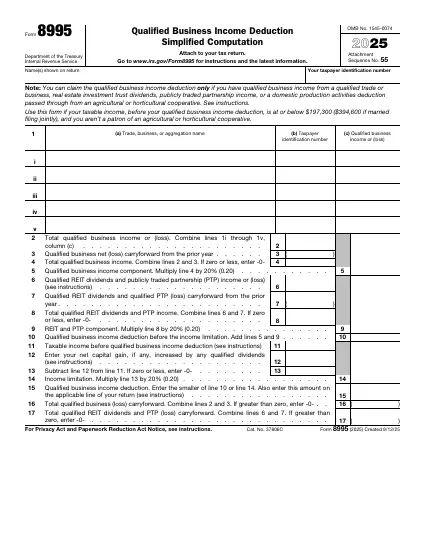
The form opens in our PDF editor with its own fields ready to type into. To download it, the filled PDF is sent to GuruPDF to prepare the file and is deleted from our servers one hour later. You can fill it in without an account; downloading the filled PDF needs a free account. A free account gets 15 credits a day, enough for one form a day.
- Country
- United States
- Edition
- Tax year 2025
- Pages
- 1
- Fillable fields
- 33
- Last checked at the source
- November 13, 2026
GuruPDF is an independent PDF editor, not a government agency, and is not affiliated with any government. This page explains the form in plain words; it is not legal or tax advice. Always check the official instructions before you file. This is the tax year 2025 version; the IRS keeps forms for earlier years.
Who uses Form 8995
- Sole proprietors and self-employed people who report business income on Schedule C (Form 1040)
- Owners of rental real estate that counts as a trade or business, including under the safe harbor in Rev. Proc. 2019-38
- Partners and S corporation shareholders who receive section 199A information with their Schedule K-1
- People who receive qualified REIT dividends or qualified publicly traded partnership (PTP) income
- Estates and trusts that claim the deduction themselves
Before you start
- Your Schedule C, E or F results and any Schedules K-1 with section 199A (QBI) information
- The EIN of each business, or your SSN or ITIN if a business has no EIN
- Forms 1099-DIV showing qualified REIT dividends in box 5, and PTP statements
- Last year's Form 8995 or 8995-A, for any qualified business loss or REIT/PTP loss carried forward
- From your 2025 return: adjusted gross income, the standard or itemized deduction, qualified dividends and net capital gain
- Details of deductions that reduce QBI, such as the deductible part of self-employment tax, self-employed health insurance and retirement plan contributions
How to fill out Form 8995
Top of the form: name, TIN and the eligibility note
Enter the name(s) shown on your return and your taxpayer identification number. Then read the note: this form is for taxpayers whose taxable income before the QBI deduction is at or below the amount printed on the form for 2025 ($197,300, or $394,600 if married filing jointly) and who are not patrons of an agricultural or horticultural cooperative. If either is not true for you, the instructions point you to Form 8995-A instead.
Line 1: each trade, business or aggregation
Rows i to v list up to five trades or businesses. Column (a) is the business name, or an aggregation name such as Aggregation 1 if you aggregated businesses (leave column (b) blank then), or Enterprise 1 if you rely on the rental real estate safe harbor. Column (b) is the business's EIN, or your SSN or ITIN if it has none; a single-member LLC uses the EIN given to the LLC. Column (c) is the net qualified business income or loss for that row, without losses that are suspended this year. With more than five businesses, attach a statement and include the extra amounts in the total on line 2.
Lines 2 to 5: qualified business income component
Line 2 combines column (c) of rows i to v. Line 3 is the qualified business net loss carryforward from the prior year, entered in parentheses, and line 4 combines lines 2 and 3; if the result is zero or less, enter -0-. Line 5 is 20% of line 4.
Lines 6 to 9: REIT and PTP component
Line 6 is your qualified REIT dividends and qualified PTP income or loss; enter income as a positive number and a loss as a negative number. Line 7 is any qualified REIT dividends and PTP loss carried forward from the prior year, in parentheses. Line 8 combines lines 6 and 7 (enter -0- if zero or less), and line 9 is 20% of line 8.
Lines 10 to 14: income limitation
Line 10 adds lines 5 and 9. Line 11 is your taxable income before the QBI deduction; for Form 1040 or 1040-SR filers the instructions figure it as line 11a minus lines 12e and 13b. Line 12 is your net capital gain increased by qualified dividends, as the instructions explain. Line 13 subtracts line 12 from line 11 (enter -0- if zero or less), and line 14 is 20% of line 13.
Line 15 and the carryforwards on lines 16 and 17
Line 15, your qualified business income deduction, is the smaller of line 10 or line 14. Enter it on the applicable line of your return: Form 1040, 1040-SR or 1040-NR, line 13a. Lines 16 and 17 show any qualified business loss and any REIT/PTP loss to carry forward to next year, in parentheses; keep them for next year's form.
After you fill it out
Attach Form 8995 to your tax return, such as Form 1040, 1040-SR or 1040-NR (Attachment Sequence No. 55), and enter the amount from line 15 on the line of the return the instructions name. It is filed with that return, on paper or electronically; it is not sent to the IRS on its own. Keep a copy, because lines 16 and 17 carry losses into next year's form.
Signing: Form 8995 has no signature line. It is part of the tax return it is attached to, and that return is signed as its own instructions require.
Watch out for
- Use Form 8995-A instead if your taxable income before the QBI deduction is above the amount printed on this form, or if you are a patron of a specified agricultural or horticultural cooperative.
- Wages, reasonable compensation from an S corporation, guaranteed payments from a partnership, capital gains, dividends and interest not properly allocable to a trade or business are not qualified business income.
- Losses or deductions suspended this year by other rules, such as the at-risk or passive activity rules, are left out of line 1. They are tracked and enter the computation in the year they are allowed.
- If you printed the 2025 instructions before January 27, 2026, the IRS corrected how line 11 is figured: for Form 1040 or 1040-SR filers it is line 11a minus lines 12e and 13b.
- This edition is for tax year 2025. The IRS says that for tax years beginning after 2025 a minimum deduction for active qualified business income can apply, so a 2026 return needs the 2026 form.
Questions about Form 8995
Should I use Form 8995 or Form 8995-A?
Use Form 8995 if you have qualified business income, qualified REIT dividends or qualified PTP income, your 2025 taxable income before the deduction is at or below the amount printed on the form, and you are not a patron of a specified agricultural or horticultural cooperative. Otherwise, use Form 8995-A.
Can I claim the QBI deduction if I take the standard deduction?
Yes. The IRS says the deduction is available whether you itemize on Schedule A or take the standard deduction.
Can an S corporation or a partnership claim the deduction?
No. S corporations and partnerships are not eligible; they pass the information through to their shareholders or partners on an attachment to Schedule K-1, and the owners claim the deduction on their own returns.
Does my rental property count as a business?
It can, if the rental is a trade or business. Rev. Proc. 2019-38 gives a safe harbor under which a rental real estate enterprise is treated as a trade or business; if you rely on it, list each enterprise on line 1 as on the statement the safe harbor requires, such as Enterprise 1. A rental that does not meet the safe harbor may still qualify if it is a section 162 trade or business.
What if my businesses had a loss?
If line 4 is zero or less, there is no QBI component this year, and the loss is shown on line 16 and carried forward to reduce qualified business income in later years. A REIT/PTP loss is carried forward the same way on line 17.
Official information
- About Form 8995 (IRS)
- Instructions for Form 8995
- Qualified business income deduction (IRS)
- About Form 8995-A (IRS)
Page text last reviewed November 13, 2026.
Related forms
- Form 1040U.S. Individual Income Tax ReturnIRSFill online
- Schedule CProfit or Loss From Business (Sole Proprietorship)IRSFill online
- Schedule ESupplemental Income and LossIRSFill online
- Schedule SESelf-Employment TaxIRSFill online
- Form 1065U.S. Return of Partnership IncomeIRSFill online
- Form 1120-SU.S. Income Tax Return for an S CorporationIRSFill online