California Franchise Tax Board
Fill out California Form 540 online
California Resident Income Tax Return
Form 540 is the California Resident Income Tax Return, filed with the Franchise Tax Board (FTB). This edition is for taxable year 2025. You start from your federal Form 1040 or 1040-SR, make California adjustments, figure your California tax and credits, and report withholding and payments to arrive at a refund or an amount you owe. It is for people who were California residents for the whole year; part-year residents and nonresidents use Form 540NR, and simpler returns may qualify for Form 540 2EZ.
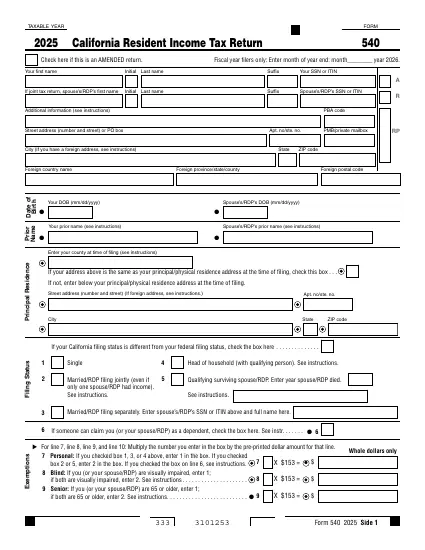
The form opens in our PDF editor with its own fields ready to type into. To download it, the filled PDF is sent to GuruPDF to prepare the file and is deleted from our servers one hour later. You can fill it in without an account; downloading the filled PDF needs a free account. A free account gets 15 credits a day, enough for one form a day.
- Country
- United States
- Edition
- Tax year 2025
- Pages
- 6
- Fillable fields
- 184
- Last checked at the source
- November 13, 2026
GuruPDF is an independent PDF editor, not a government agency, and is not affiliated with any government. This page explains the form in plain words; it is not legal or tax advice. Always check the official instructions before you file.
Who uses California Form 540
- People who were California residents for all of 2025 and must file a state return
- Residents with any filing status, any amount of income, itemized deductions or credits beyond what Form 540 2EZ allows
- Married couples and registered domestic partners (RDPs) filing jointly or separately
- Taxpayers filing an amended 2025 return, who check the AMENDED box at the top
Before you start
- Your completed 2025 federal Form 1040 or 1040-SR
- Social Security numbers or ITINs, dates of birth and any prior names for you and your spouse/RDP
- Names, SSNs and relationship of your dependents
- Forms W-2 (state wages in box 16, California withholding) and any Forms 592-B or 593
- Schedule CA (540) if you have California adjustments or itemize, and any credit forms
- Your bank routing and account numbers if you want a direct deposit refund
How to fill out California Form 540
Side 1: name, address and filing status
Enter your name and SSN or ITIN, and your spouse's/RDP's if filing jointly, your mailing address, dates of birth, any prior names and your county at the time of filing. Check the box if your principal residence is the same as your mailing address, or enter it. Choose a filing status 1 to 5 (single, married/RDP filing jointly or separately, head of household, qualifying surviving spouse/RDP), and check the box if your California status differs from your federal one. Check line 6 if someone can claim you as a dependent.
Lines 7 to 11: exemptions
Enter the number of personal, blind and senior exemptions on lines 7 to 9 and multiply each by the dollar amount printed on the form. On line 10, list your dependents (name, SSN and relationship) and multiply the number by the dependent amount. Line 11 is the total, which you carry to line 32.
Lines 12 to 19: taxable income
Enter state wages from W-2 box 16 (line 12) and federal adjusted gross income from Form 1040 or 1040-SR, line 11b (line 13). Apply California subtractions and additions from Schedule CA (540) on lines 14 and 16 to get California AGI on line 17. On line 18 enter the larger of your California itemized deductions or the standard deduction printed for your filing status; line 19 is your taxable income.
Lines 31 to 48: tax and special credits
Figure your tax on line 31 from the tax table or tax rate schedule (or check the box for FTB 3800 or FTB 3803), subtract exemption credits (line 32), and add any tax from Schedule G-1 or form FTB 5870A on line 34. On lines 40 to 46 claim nonrefundable credits, such as the child and dependent care expenses credit and the renter's credit, with credit codes on lines 43 and 44 (Schedule P for more than two). Line 48 is tax after credits.
Lines 61 to 78: other taxes and payments
Add alternative minimum tax, behavioral health services tax and other taxes to reach total tax on line 64. Then enter California income tax withheld, estimated payments, Form 592-B/593 withholding and refundable credits such as the California Earned Income Tax Credit, Young Child Tax Credit and Foster Youth Tax Credit; line 78 is your total payments.
Lines 91 to 117: use tax, health coverage, refund or amount due
Line 91 is use tax and must not be left blank; if it is zero, check one of the two boxes. Check line 92 if your household had full-year health care coverage, or enter the Individual Shared Responsibility penalty. Lines 93 to 100 work out your overpayment or tax due, codes 400 to 449 are optional voluntary contributions, and lines 111 to 115 give the amount you owe or your refund. Lines 116 and 117 split a direct deposit refund between one or two accounts.
Side 5 and 6: elections and signature
Optionally check boxes for voter registration information, health care coverage information (shared with Covered California) and organ donor registration. On Side 6, sign and date, with your spouse/RDP if filing jointly, add an email and phone number, and complete the paid preparer and third party designee sections if they apply.
After you fill it out
Mail the signed return to the Franchise Tax Board. The form prints two different FTB mailing addresses on line 111 (amount you owe) and line 115 (refund or no amount due), so use the one that matches your result. Enclose, but do not staple, any payment, or pay online through the FTB's payment page. The instructions explain which forms and schedules to attach and when to attach a copy of your federal return. The FTB encourages e-file and its free CalFile for those who qualify, which you can use instead of a paper return. For deadlines, see the Important Dates in the 2025 booklet.
Signing: The instructions say you must sign the return on Side 6, and your spouse/RDP must also sign a joint return; the form warns it is unlawful to forge a spouse's/RDP's signature. For a paper return, print the completed form and sign Side 6 before mailing. A paid preparer also signs and gives their PTIN.
Watch out for
- Form 540 is for full-year California residents only; part-year residents and nonresidents use Form 540NR.
- Form 540 has six sides: the instructions say you must send all six sides to the FTB and Side 6 must be signed.
- Do not leave line 91 (use tax) blank. If you owe no use tax, enter zero and check the matching box.
- If you are married/RDP filing separately or can be claimed as someone's dependent (line 6 box), the form says to stop at line 18 and see the instructions before claiming a deduction.
- On a joint return, both spouses/RDPs are generally responsible for the tax, interest and penalties, according to the instructions.
Questions about California Form 540
Should I use Form 540 or Form 540 2EZ?
Form 540 works for every filing status, income level and credit. Form 540 2EZ is limited to certain filing statuses, up to three dependents, an income cap and specific income types, with no itemized deductions. The FTB booklet has a chart comparing the two, and e-file software picks the right form for you.
Which tax year is this form for?
This edition is for taxable year 2025, the return filed in 2026. Use the form for the year you are reporting; the FTB publishes a new Form 540 each year.
Can I file Form 540 online instead?
Yes. The FTB offers e-file through software and CalFile, its free direct filing service, for people who qualify. A paper Form 540 is mailed.
How do I amend my California return?
Check the box at the top of Form 540 that says this is an AMENDED return. The FTB instructions explain what else to include.
Do I have to attach my federal return?
Sometimes. Side 6 says to see the instructions to find out whether you should attach a copy of your complete federal tax return, and the line instructions list the forms and schedules to attach.
Official information
- 2025 Form 540 instructions (FTB)
- 2025 Personal Income Tax Booklet (FTB)
- Ways to file (FTB)
- Pay your California taxes (FTB)
Page text last reviewed November 13, 2026.