California Department of Motor Vehicles
Fill out California Form REG 227 online
Application for Replacement or Transfer of Title
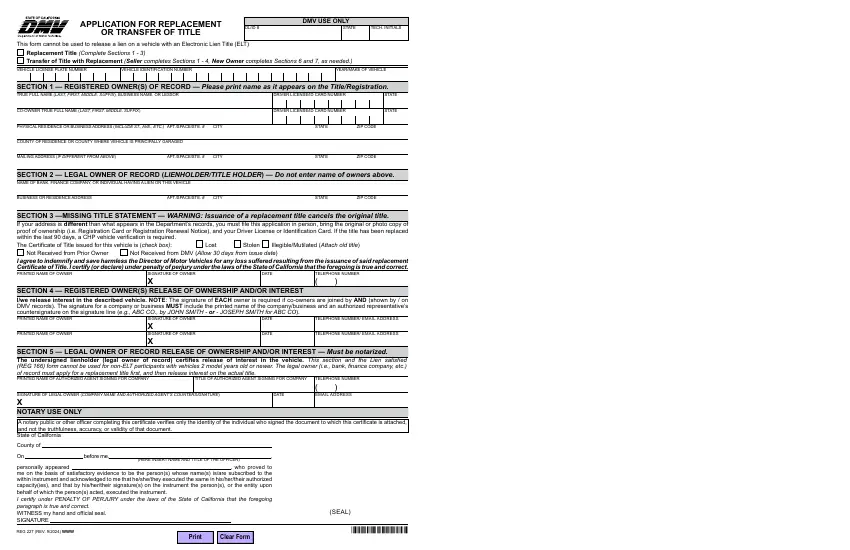
Form REG 227 is the California DMV Application for Replacement or Transfer of Title. A registered owner uses it to get a replacement Certificate of Title when the original is lost, stolen, damaged or was never received, and a seller who no longer has the title uses it to transfer the vehicle to a new owner on the same form. Page 1 is for the owners and lienholder of record; page 2 is for the new owners. The completed form goes to the California DMV at an office or by mail, with the fee.
The form opens in our PDF editor with its own fields ready to type into. To download it, the filled PDF is sent to GuruPDF to prepare the file and is deleted from our servers one hour later. You can fill it in without an account; downloading the filled PDF needs a free account. A free account gets 15 credits a day, enough for one form a day.
- Country
- United States
- Edition
- REG 227 (REV. 9/2024)
- Pages
- 3
- Fillable fields
- 129
- Last checked at the source
- November 13, 2026
GuruPDF is an independent PDF editor, not a government agency, and is not affiliated with any government. This page explains the form in plain words; it is not legal or tax advice. Always check the official instructions before you file.
Who uses California Form REG 227
- California vehicle owners whose title was lost, stolen, damaged, illegible or never received
- Sellers who no longer have the title and need to transfer the vehicle to a buyer
- Buyers completing a transfer of ownership when the seller does not have the original title
- Lienholders (legal owners of record) releasing their interest in the vehicle, or applying for the replacement title
- Dealers releasing a vehicle they acquired (Section 8)
Before you start
- The vehicle license plate number, the vehicle identification number (VIN) and the year and make
- Each registered owner’s true full name as it appears on the title or registration, and their driver license or ID card number and state
- Your physical residence or business address, a mailing address if different, and the county where you live or the vehicle is mainly garaged
- The name and address of any lienholder (legal owner) on record
- For a transfer: the date of purchase and the price, or the market value if it was a gift or trade, and each new owner’s name and driver license or ID card number
- What is left of a damaged or illegible title, which the form asks you to attach
How to fill out California Form REG 227
Choose the application type and describe the vehicle
At the top of page 1, check Replacement Title if you only need a new title; you then complete Sections 1 to 3. Check Transfer of Title with Replacement if the vehicle is changing hands: the seller completes Sections 1 to 4 and the new owner Sections 6 and 7, as needed. Enter the vehicle license plate number, the vehicle identification number and the year and make of the vehicle. Leave the DMV USE ONLY box blank.
Section 1 – Registered Owner(s) of Record
Print each registered owner’s name exactly as it appears on the title or registration: true full name (last, first, middle, suffix), business name or lessor, with the driver license or ID card number and state, and the same for a co-owner. Enter the physical residence or business address, the county of residence or where the vehicle is principally garaged, and a mailing address if it is different.
Section 2 – Legal Owner of Record (Lienholder/Title Holder)
If a bank, finance company or individual has a lien on the vehicle, enter its name and its business or residence address. Do not repeat the registered owners’ names here. Leave this section empty if there is no lienholder on record.
Section 3 – Missing Title Statement
Check why the title is missing: Lost, Stolen, Illegible/Mutilated (attach the old title), Not Received from Prior Owner, or Not Received from DMV (the form says to allow 30 days from the issue date). By signing, the owner agrees to indemnify the Director of Motor Vehicles for any loss caused by issuing the replacement and certifies the statement under penalty of perjury. Print your name, sign, date and add a telephone number.
Section 4 – Registered Owner(s) Release of Ownership and/or Interest
Complete this section only when the vehicle is being transferred. Each registered owner prints their name, signs, dates and gives a telephone number or email address to release interest. If co-owners are joined by AND (shown by / on DMV records), every owner must sign. A company signature must include the printed company name and an authorized representative’s countersignature, for example “ABC CO., by JOHN SMITH”.
Section 5 – Legal Owner of Record Release (must be notarized)
The lienholder of record uses this section to release its interest: the authorized agent prints their name and title, signs with the company name, and adds the date, telephone number and email address. It must be notarized; the notary completes the NOTARY USE ONLY block. The form says this section and the Lien Satisfied (REG 166) form cannot be used for non-ELT participants with vehicles 2 model years old or newer: the legal owner must first apply for a replacement title and then release interest on the actual title.
Section 6 – New Registered Owner(s) (page 2)
The new owner repeats the vehicle information, enters the date purchased or acquired and the purchase price, or checks Gift or Trade and writes the market value. Enter each new owner’s true full name as shown on their driver license or ID card, with the license number and state, and check AND or OR between co-owners. Add the physical address, the county, an optional equipment number, and a mailing or lessee address if different. Every new owner signs and dates, with a telephone number and email address; by signing you confirm the mailing address and consent to receive service of process there.
Sections 7 and 8 – New Legal Owner and Dealer’s Release
In Section 7 enter the new lienholder’s name and addresses, or write “None” if there is none. An electronic (ELT) lienholder must show its ELT number, and its name and address exactly as on the ELT listing. Section 8 is only for a dealership releasing a vehicle it acquired: the dealership and buyer names, date sold, R/S number, the dealer agent’s signature and printed name, the dealer number and the salesperson number.
After you fill it out
Submit the signed REG 227 to the California DMV at a DMV office or by mail, with the fee; for a transfer, add the other documents and fees the DMV’s Title Transfers and Changes page lists (it also gives the mailing address and checklists). If your address is different from the DMV’s records, the form says you must file the application in person and bring proof of ownership, such as the registration card or renewal notice (original or photocopy), and your driver license or ID card. If the vehicle came from a qualified relative, a Statement of Facts (REG 256) must also be submitted. The DMV mails the new title.
Signing: Owners sign on the X lines in Sections 3, 4 and 6 (each co-owner where the form requires it, and companies with an authorized representative’s countersignature). The lienholder’s release in Section 5 must be signed before a notary public, who completes the notary block. The DMV takes the form at a DMV office or by mail.
Watch out for
- Issuing a replacement title cancels the original title.
- This form cannot be used to release a lien on a vehicle with an Electronic Lien Title (ELT).
- If the title was replaced within the last 90 days, the form says a California Highway Patrol (CHP) vehicle verification is required.
- The form asks the new owner to complete the transfer within 10 days of taking possession; the DMV says any change of ownership or lienholder must be reported within 10 days.
- The DMV says the form cannot be used when the registration card reads “Nontransferable/No California Title Issued”: a title must come from the state where the vehicle was last titled.
Questions about California Form REG 227
Do I need a notary for REG 227?
Only for Section 5. The DMV says that if the vehicle has a legal owner (lienholder), Section 5 must be notarized; if the registration does not show a lienholder, notarization is not required.
Can I sell my car in California without the title?
The DMV’s title transfer page says that if the title is missing you must complete REG 227 first. With Transfer of Title with Replacement checked, the seller completes Sections 1 to 4 and the buyer Sections 6 and 7, so the replacement and the transfer are handled on one form.
Can I mail REG 227 or do I have to go in person?
The DMV accepts a replacement title application in person or by mail. The form says you must apply in person, with proof of ownership and your driver license or ID card, if your address is different from the DMV’s records.
The car was a gift from a relative. What else is needed?
The form says that if the vehicle was purchased or received from a qualified relative (parent or child, grandparent or grandchild, spouse, domestic partner, or siblings who are minors related by blood or adoption), a Statement of Facts (REG 256) for the use tax exemption must also be submitted.
What happens to the old title?
Issuing a replacement cancels the original. If the old title is damaged or illegible, attach it to the application.
Official information
- Title Transfers and Changes (California DMV)
- Application for Replacement or Transfer of Title (REG 227), DMV PDF
- DMV forms
Page text last reviewed November 13, 2026.