U.S. Department of State
Fill out Form DS-3053 online
Statement of Consent: U.S. Passport Issuance to a Child
Form DS-3053 is the State Department statement a parent or legal guardian signs to consent to a U.S. passport for a child when they cannot appear in person with the child. It goes with the child's Form DS-11, which is always submitted in person. Both parents can also use it to let a third party, such as a grandparent, apply on their behalf. The non-applying parent fills in Sections 1 to 3, then signs Section 4 in front of a notary or passport authorizing officer, and the consent is valid for 90 days from that signature.
This form has no fillable fields, so it opens in our PDF editor with the Text tool ready: click where an answer goes and type. To download it, the filled PDF is sent to GuruPDF to prepare the file and is deleted from our servers one hour later. You can fill it in without an account; downloading the filled PDF needs a free account. A free account gets 15 credits a day, enough for one form a day.
- Country
- United States
- Edition
- 10-2024
- Pages
- 2
- Fillable fields
- Type anywhere
- Last checked at the source
- November 13, 2026
GuruPDF is an independent PDF editor, not a government agency, and is not affiliated with any government. This page explains the form in plain words; it is not legal or tax advice. Always check the official instructions before you file.
Who uses Form DS-3053
- A parent or legal guardian who cannot go to a child's passport appointment (children under 16 need both parents' consent)
- Both parents who authorize a third party, such as a grandparent or relative, to apply with the child
- A parent asked for written consent for a child aged 16 or 17 (the form says the officer may ask for it)
- A parent who lives abroad while the child applies in the United States
- Institutions or agencies granted guardianship of a child, together with the documents the form lists
Before you start
- The child's full name exactly as it appears on the child's Form DS-11, and the child's date of birth
- The name of the adult who will appear in person with the child, and whether they are a legal parent, legal guardian or third party
- Each non-applying parent's or guardian's street address, phone number and email
- A valid government-issued photo ID (such as a driver's license, passport or military ID) to show the notary
- A clear photocopy of the front and back of that ID, to attach to the form
- Access to a notary public, or a passport authorizing officer, who is not related to you
How to fill out Form DS-3053
Read page 1 first
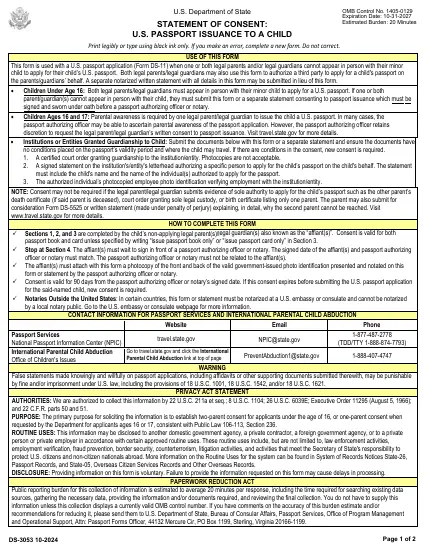
Page 1 explains when the form is used and how to complete it; it is not filled in. It says Sections 1, 2 and 3 are completed by the non-applying parent(s) or guardian(s), called the affiant(s), and that you must stop at Section 4 and sign only in front of a passport authorizing officer or notary. It also says that a separate notarized written statement with all the same details may be submitted instead of this form.
Section 1: the child
This flat form has no fields, so you type each answer on its printed line. In 1a, enter the child's name (LAST, FIRST MIDDLE) as it appears on the child's DS-11, for example SMITH, JOHN ROBERT. In 1b, enter the child's birthdate (MM-DD-YYYY), and tick the box if the child is 16 or 17.
Section 2: the adult applying in person
Enter the name of the adult who will appear in person with the child to apply (LAST, FIRST MIDDLE). Then check one box for that adult's relationship to the child: Legal Parent, Legal Guardian or Third Party. The heading says this section is for a child under age 16.
Section 3: the statement of consent
In blank space 1 (and space 2 if two parents or guardians cannot attend), write the full name of each non-applying legal parent or guardian. The consent covers both the passport book and the passport card unless you write a limit on the line provided, such as "Issue passport book only" or "Issue passport card only". Then fill in each person's street address, city, state or country and ZIP code, phone and email; for person 2, there is a box to check if the address is the same as person 1.
Section 4: oath and signature before a notary
Do not sign yet. Take the printed form and your photo ID to a notary or passport authorizing officer who is not related to you. You sign and date the oath there, and the officer or notary records your identifying document (driver's license, passport, military or other, with name, ID number, place of issue, and issue and expiry dates), then signs, dates, adds the location and applies the seal. The form says the affiant's date and the officer's or notary's date must match.
Attach the ID photocopy
Attach a clear photocopy of the front and back of the valid government-issued photo ID you showed the notary. Give the signed, notarized form and the photocopy to the adult who will apply with the child.
After you fill it out
The adult named in Section 2 brings the notarized DS-3053 and the ID photocopy to the child's in-person appointment with Form DS-11, the child's proof of citizenship and relationship documents, the photo and the fees. The State Department says the form must be submitted within 90 days after it is notarized; if the consent expires first, a new one is needed. It accepts electronically notarized statements of consent where state law allows them, as a printed copy. If a parent is abroad, the form says that in certain countries it must be notarized at a U.S. embassy or consulate rather than by a local notary; check the webpage of the U.S. embassy or consulate in that country.
Signing: Each non-applying parent or guardian signs Section 4 only in front of a notary or passport authorizing officer, who then signs and seals it. The form says not to sign before that. The State Department also accepts electronic notarization where state law permits it, submitted as a printed copy.
Watch out for
- Do not sign Section 4 until the notary or passport authorizing officer asks you to; the signing dates must match.
- The consent is valid for 90 days from the notary's or officer's signature date. Submit the child's application before then.
- The notary or passport authorizing officer must not be related to you.
- The form says if you make an error, complete a new form: do not correct it. Use black ink.
- The consent must be unconditional regarding passport validity and travel; the only limit the form allows is book only or card only.
Questions about Form DS-3053
When is Form DS-3053 needed?
When a child under 16 applies for a passport and one or both parents or guardians cannot appear in person. Both parents normally must be present; a parent who cannot come gives consent with this form, notarized. It is not needed if the applying parent has sole authority, for example a court order granting sole custody or a birth certificate listing only one parent.
Does DS-3053 have to be notarized?
Yes. Section 4 is signed under oath before a notary or passport authorizing officer, who signs and seals it. A separate notarized statement with all the same details is accepted instead of the form.
How long is the consent valid?
90 days from the date the notary or passport authorizing officer signed it. If the child's application is not submitted by then, a new consent is required.
Can grandparents apply for a child's passport?
Yes, with consent. Both parents can name a third party in Section 2 and give consent in Section 3, or provide a notarized statement. If only one parent signs, proof that the parent has sole custody is also needed, along with photocopies of the parents' IDs.
What if the other parent cannot be found?
Then this form cannot be used for that parent. The State Department says to submit Form DS-5525, Statement of Special Family Circumstances, and it may ask for more evidence.
Official information
- Apply for a child's passport under 16 (U.S. Department of State)
- Form DS-3053 PDF
- Passport forms (U.S. Department of State)
Page text last reviewed November 13, 2026.