Office of the Public Guardian
Fill out Form LP1F online
Lasting power of attorney – Financial decisions
Form LP1F is the paper form for making a lasting power of attorney (LPA) for property and financial affairs in England and Wales. The person making it (the 'donor') appoints one or more 'attorneys' to deal with things like bank accounts, bills, investments and selling a home. The same 20-page form is used both to make the LPA (sections 1 to 11) and to apply to register it with the Office of the Public Guardian (sections 12 to 15). An LPA cannot be used until the Office of the Public Guardian has registered it.
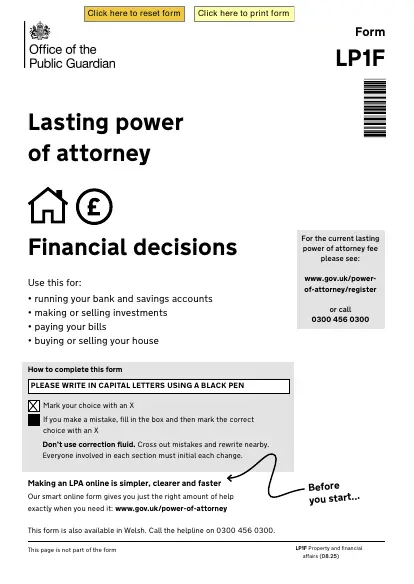
The form opens in our PDF editor with its own fields ready to type into. To download it, the filled PDF is sent to GuruPDF to prepare the file and is deleted from our servers one hour later. You can fill it in without an account; downloading the filled PDF needs a free account. A free account gets 15 credits a day, enough for one form a day.
- Country
- United Kingdom
- Edition
- LP1F (08.25)
- Pages
- 24
- Fillable fields
- 272
- Last checked at the source
- November 13, 2026
GuruPDF is an independent PDF editor, not a government agency, and is not affiliated with any government. This page explains the form in plain words; it is not legal or tax advice. Always check the official instructions before you file.
Who uses Form LP1F
- Adults aged 18 or over who have mental capacity and want to choose who can manage their money and property
- People planning ahead for illness, an accident or old age, or who want help with banking and bills now
- Family members, friends or solicitors filling in the form for a donor who makes all the choices themselves
- Attorneys who are applying to register an LPA that the donor has already signed
Before you start
- Full names (as on identity documents), dates of birth and addresses of the donor, each attorney and any replacement attorneys
- The name and address of a certificate provider who meets the rules in part A10 of the LP12 guide
- Witnesses aged 18 or over for the donor's and the attorneys' signatures
- Names and addresses of up to 5 'people to notify', if you want any
- The LP12 guide, the continuation sheets (LPC) and form LP3 from the same GOV.UK page
- Form LPA120 and evidence of the donor's income or benefits if you are asking for a reduced fee
How to fill out Form LP1F
Section 1: The donor
Enter the donor's title, first names, last name, any other names they are known by, date of birth and address. The email address is optional. The donor must be at least 18 and able to make their own decisions. The box marked 'For OPG office use only' is left blank.
Section 2: The attorneys
Enter each attorney's title, names, date of birth and address; there is room for four, and more go on Continuation sheet 1. Attorneys must be 18 or over, have mental capacity and must not be bankrupt or subject to a debt relief order. To appoint a trust corporation, put it in the first attorney space and tick 'This attorney is a trust corporation'; it signs Continuation sheet 4 instead of section 11.
Section 3: How should your attorneys make decisions?
With one attorney, tick 'I only appointed one attorney'. Otherwise tick one option: 'Jointly and severally' (they can act alone or together), 'Jointly' (they must all agree on every decision) or 'Jointly for some decisions, jointly and severally for other decisions'. The last option needs the joint decisions listed on Continuation sheet 2. The form warns that with 'Jointly', if one attorney dies or can no longer act, the LPA stops working unless there is a replacement attorney.
Section 4: Replacement attorneys
This section is optional. Enter up to two replacement attorneys, who step in if an original attorney can no longer act; more go on Continuation sheet 1. Tick the box and use Continuation sheet 2 only if you want to change when or how the replacements act. Part A4 of the guide explains the options.
Section 5: When can your attorneys make decisions?
Mark one option: 'As soon as my LPA has been registered (and also when I don't have mental capacity)', or 'Only when I don't have mental capacity'. The form says most people choose the first, and that while the donor has capacity the attorneys can only act with the donor's consent. It warns that the second option can make the LPA a lot less useful.
Sections 6 and 7: People to notify, preferences and instructions
Section 6 is optional: list up to four people (a fifth goes on Continuation sheet 1) who will be told when the LPA is registered and can raise concerns. Attorneys and replacement attorneys cannot be listed here. Section 7 is also optional: 'Preferences' use words like 'prefer', and 'Instructions', which attorneys must follow, use words like 'must'. Instructions that are not legally correct have to be removed before the LPA can be registered.
Sections 8 to 11: Rights, signatures and witnesses
Everyone signing reads section 8, 'Your legal rights and responsibilities'. The donor signs section 9 first, with a witness who is 18 or over and is not an attorney or replacement attorney, and signs any Continuation sheets 1 and 2 before section 9. The certificate provider then signs section 10, and finally every attorney and replacement attorney signs a copy of section 11 in front of a witness (not the donor). The checklist says sections 9, 10 and 11 must be signed in that order, on the same day or later days.
Sections 12 to 15: Register your LPA
Section 12 says who is applying: the donor, or the attorney(s), never both together; attorneys write their names and dates of birth. Section 13 names who should receive the registered LPA and how they prefer to be contacted. Section 14 is the fee: tick 'Card' and give a phone number (do not write card details), or 'Cheque', and tick the boxes for a reduced fee (with form LPA120) or a repeat application. Section 15 is signed by the applicant only after sections 9, 10 and 11, and confirms that any people to notify have been sent form LP3.
After you fill it out
Print the form, have everyone sign the same printed original in the right order, and send all pages 1 to 20 (even blank ones), any continuation sheets and the fee or form LPA120 to the Office of the Public Guardian at the address printed on the form's checklist page. OPG's guidance asks you not to staple or bind the pages. If you listed people to notify, send each of them form LP3 before you apply; they have a set period to object, and OPG cannot register the LPA until that has passed. When it is registered, OPG stamps the original form and posts it back; that stamped document is the one attorneys show to banks. OPG also offers an online 'Make a lasting power of attorney' service that guides you through the same questions, but the result still has to be printed and signed on paper.
Signing: GOV.UK says everyone must sign the same original document and cannot sign copies or use digital signatures. The donor signs section 9 (and Continuation sheets 1 and 2 if used) first, then the certificate provider signs section 10, then each attorney and replacement attorney signs section 11, each signature apart from the certificate provider's witnessed. The applicant signs section 15 last. A donor who cannot sign may make a mark, or direct someone to sign for them using Continuation sheet 3.
Watch out for
- Signing out of order makes the LPA impossible to register: the donor first, then the certificate provider, then the attorneys, then the applicant.
- Do not use correction fluid or stickers. Cross out a mistake, write the correction next to it and have the person who made it initial it.
- Send every page 1 to 20, all from the LP1F form. OPG warns that mixing LP1F pages with LP1H pages may mean making a new LPA and paying again.
- The certificate provider cannot be an attorney, a family member of the donor or an attorney, a partner, a business partner, an employee, or someone who runs or works at the donor's care home.
- OPG says typed text must print on the correct page and must not run on to the next page, and the printed form must look like the official one.
Questions about Form LP1F
What is the difference between LP1F and LP1H?
LP1F covers property and financial affairs, such as bank accounts, bills, pensions and selling a home, and can be used as soon as it is registered if the donor chooses that in section 5. LP1H covers health and welfare decisions, such as medical care and where the donor lives, and can only be used when the donor cannot make the decision themselves. You can make one or both.
Should I use the paper form or the online service?
Either is accepted. OPG's online service lets you save your answers, guides you through each step and can create the LP3 forms for you, and GOV.UK says it is usually quicker if you make the LPA and pay online. With either route the LPA is printed and signed on paper by everyone involved.
Who can be the certificate provider and the witnesses?
The certificate provider must be 18 or over and either have known the donor personally for at least two years or have relevant professional skills, such as the donor's GP or a solicitor. Witnesses must be 18 or over. The donor's witness cannot be an attorney or replacement attorney, the donor cannot witness the attorneys, and attorneys may witness each other. The certificate provider can also act as a witness.
Do I have to register the LPA straight away?
No, but the form and guide recommend it. If the LPA is checked while the donor still has mental capacity, some mistakes can be fixed or a new LPA made. If it is only sent after the donor has lost capacity, errors cannot be corrected and the LPA may never be usable.
Does an LPA made on this form work in Scotland or Northern Ireland?
No. GOV.UK says an LPA is legally binding only in England and Wales, and a property and financial affairs LPA can only be used for property and assets there. Scotland and Northern Ireland have their own powers of attorney.
Official information
- Lasting power of attorney forms (GOV.UK)
- LP12: Make and register your lasting power of attorney – a guide
- Make, register or end a lasting power of attorney
- Avoiding errors when completing an LPA form
- Make a lasting power of attorney online (OPG service)
Page text last reviewed November 13, 2026.