U.S. Citizenship and Immigration Services
Fill out Form I-589 online
Application for Asylum and for Withholding of Removal
Form I-589 is the application for asylum and for withholding of removal in the United States, including withholding of removal under the Convention Against Torture. A person who is physically present in the United States and is not a U.S. citizen may file it: with USCIS (affirmative asylum) if they are not in immigration court proceedings, or with the immigration court (defensive asylum) if they are. The applicant may include a spouse and unmarried children under 21 who are in the United States.
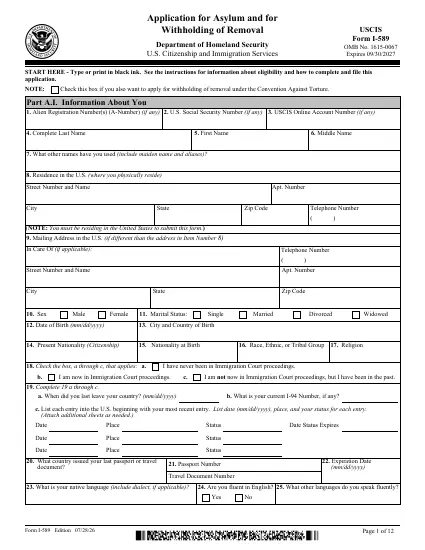
The form opens in our PDF editor with its own fields ready to type into. To download it, the filled PDF is sent to GuruPDF to prepare the file and is deleted from our servers one hour later. You can fill it in without an account; downloading the filled PDF needs a free account. A free account gets 15 credits a day, enough for one form a day.
- Country
- United States
- Edition
- Edition 07/28/26
- Pages
- 12
- Fillable fields
- 460
- Last checked at the source
- November 13, 2026
GuruPDF is an independent PDF editor, not a government agency, and is not affiliated with any government. This page explains the form in plain words; it is not legal or tax advice. Always check the official instructions before you file.
Who uses Form I-589
- People in the United States who are not in proceedings before an immigration judge or the Board of Immigration Appeals, filing affirmatively with USCIS
- People in removal proceedings, who file with the immigration court (EOIR), except unaccompanied alien children, who may file with USCIS
- Applicants including their spouse and unmarried children under 21 who are physically present in the United States
- Children 21 or older and married children, who must file their own application
- Preparers other than a spouse, parent or child, who complete and sign Part E
Before you start
- Your A-Number if you have one, Social Security number and USCIS Online Account Number if any, and your U.S. residential address (you must live in the United States to file)
- Your entry details: when you last left your country, your I-94 number, and each entry into the United States with date, place and status
- Passports or travel documents for you and each family member you include, to copy cover to cover
- Details about your spouse and all your children, wherever they live, and marriage and birth certificates for the family members you include
- Your addresses, education and employment for the past five years, and information about your parents and siblings
- Documents about conditions in your country and about the facts of your claim, or an explanation of why they are not available, and English translations with translator certifications for any document in another language
How to fill out Form I-589
Part A.I. Information About You
At the top, select the box if you also want to apply for withholding of removal under the Convention Against Torture. Items 1-17 ask for your numbers, full name and other names, residence and mailing address in the United States, sex, marital status, date and place of birth, nationality, race, ethnic or tribal group, and religion. Item 18 says whether you have ever been in Immigration Court proceedings, and Items 19-25 cover your departure and entries into the United States, your passport, and the languages you speak. The instructions say to write "None" if you did not receive an I-94, and "No Inspection" for status if you entered without being inspected.
Part A.II. Information About Your Spouse and Children
Give your spouse's details, or select that you are not married. Then list all of your children, regardless of age, location or marital status, with their numbers, names, birth details, nationality and current location. For each spouse or child in the United States, answer the entry and status questions and say whether they are included in this application. The form has space for four children; use Supplement A for each additional child.
Part A.III. Information About Your Background
List your last address before coming to the United States (and your last address in the country where you fear persecution, if different), your residences and employment for the past five years starting with the present, your education starting with the most recent school, and your parents and siblings, marking anyone who has died. Use Supplement B or extra sheets if you need more space.
Part B. Information About Your Application
In Item 1 select the grounds you are applying on (race, religion, nationality, political opinion, membership in a particular social group, or the Torture Convention), then answer A (past harm, mistreatment or threats) and B (fear of harm if you return). Items 2-4 ask about arrests or detention outside the United States, membership in organizations, and fear of torture. The form asks for a detailed and specific account with dates, places and descriptions, and says the application and evidence you provide may be your only opportunity to meet your burden of proof before USCIS.
Part C. Additional Information About Your Application
Answer each question Yes or No and explain any Yes in detail: earlier applications for refugee status, asylum or withholding by you or your family (Item 1), travel through or status in other countries (Items 2.A-2.B), any part in causing harm to others (Item 3), returns to the country where you fear harm (Item 4), whether you are filing more than one year after your last arrival and why (Item 5), and any crimes or arrests in the United States (Item 6).
Parts D and E. Your signature and the preparer
In Part D, print your complete name and write it in your native alphabet, say whether your spouse, parent or children helped you (with their names and relationship), whether someone else prepared the application, and whether you received a list of people who may help at little or no cost. Sign within the brackets and date it after you have completed and reviewed the application. Anyone else who prepared the form completes and signs Part E.
Parts F and G, and the supplements
Leave Parts F and G blank: you complete Part F at an asylum interview with an asylum officer, or Part G at a hearing before an immigration judge. Supplement A is for additional children, and Supplement B is for additional space; put your A-Number, name as in Part A.I, signature and date on each supplemental sheet.
After you fill it out
Where you file depends on your situation. If you are in proceedings before an immigration judge or the Board of Immigration Appeals, you file with the immigration court, not USCIS. Otherwise you file with USCIS online or by mail; USCIS's Form I-589 Filing Instructions Tool tells you which, and some applicants must file by mail (for example unaccompanied alien children, or people whose removal proceedings were dismissed or terminated) or with the USCIS Asylum Intake Unit. Check the Where to File section and the USCIS Fee Schedule (Form G-1055) on the USCIS Form I-589 page before sending, and use the edition shown there, with all pages from the same edition. After filing, USCIS schedules biometrics for you and each family member included, and may schedule an interview.
Signing: On a paper application, sign Part D by hand so the whole signature is inside the brackets, after you have completed and reviewed the form. Parts F and G are signed later, in front of an asylum officer or immigration judge. Put your signature and date on each supplement and extra sheet too.
Watch out for
- You must generally file within one year of arriving in the United States. Part C, Item 5 asks you to explain a later filing, and the form says this written explanation may be your only opportunity to have an asylum officer consider your reasons.
- Answers must be in English, including explanations. USCIS returns forms completed in another language, and accepts only the English form (translations on its site are for information only).
- The form warns that knowingly filing a frivolous application, one with deliberately fabricated material elements, makes a person permanently ineligible for any benefits under the Immigration and Nationality Act.
- Do not file a second Form I-589 while one is pending. To add a spouse or child to a pending application, USCIS says to write to the asylum office handling your case instead.
- The principal applicant must pay an Annual Asylum Fee for each year the application is pending, in addition to any other fee. USCIS sends a notice with the amount and how to pay it online; the fee cannot be waived, and USCIS cannot approve the application while it remains unpaid.
Questions about Form I-589
Do I file Form I-589 with USCIS or the immigration court?
If you are in proceedings before an immigration judge or the Board of Immigration Appeals, you file with the immigration court, unless you are or were determined to be an unaccompanied alien child. If you have an A-Number, USCIS explains how to check this with the EOIR Automated Case Information system. Otherwise you file with USCIS.
Can I include my family in my application?
You may include your spouse and unmarried children under 21 who are physically present in the United States, with proof of the relationship. Children who are 21 or older or married must file their own applications.
Can I fill out Form I-589 in my own language?
No. USCIS publishes translations of the form and instructions in 12 languages for information only, but only the English form completed in English is accepted. Supporting documents in another language need a certified English translation.
Does the government of my country learn that I applied?
The instructions say no information indicating that you applied for asylum will be given to any government or country from which you claim a fear of persecution, and that regulations protect the confidentiality of asylum claims.
Can I work while my asylum application is pending?
Permission to work is a separate application on Form I-765. The Form I-589 instructions explain when it may be requested, and each family member who wants permission to work files their own Form I-765.
Official information
- USCIS: Form I-589, Application for Asylum and for Withholding of Removal
- Instructions for Form I-589 (PDF)
- USCIS Form I-589 Filing Instructions Tool
- USCIS: Obtaining Asylum in the United States
- EOIR Automated Case Information
Page text last reviewed November 13, 2026.
Related forms
- Form I-765Application For Employment AuthorizationUSCISFill online
- Form G-28Notice of Entry of Appearance as Attorney or Accredited RepresentativeUSCISFill online
- Form I-131Application for Travel Documents, Parole Documents, and Arrival/Departure RecordsUSCISFill online
- Form I-485Application to Register Permanent Residence or Adjust StatusUSCISFill online