Texas Comptroller of Public Accounts
Fill out Form 50-114 online
Residence Homestead Exemption Application
Form 50-114 is the Texas application for a residence homestead exemption from property tax. Homeowners who live in their home as their principal residence use it to claim the general homestead exemption, and the additional exemptions for people age 65 or older, disabled people, disabled veterans and certain surviving spouses. The Texas Comptroller publishes the form, but you file it with the appraisal district in the county where the property is located, not with the Comptroller. Once granted, the exemption generally does not have to be renewed each year.
The form opens in our PDF editor with its own fields ready to type into. To download it, the filled PDF is sent to GuruPDF to prepare the file and is deleted from our servers one hour later. You can fill it in without an account; downloading the filled PDF needs a free account. A free account gets 15 credits a day, enough for one form a day.
- Country
- United States
- Edition
- Rev. 02-26/39
- Pages
- 4
- Fillable fields
- 80
- Last checked at the source
- November 13, 2026
GuruPDF is an independent PDF editor, not a government agency, and is not affiliated with any government. This page explains the form in plain words; it is not legal or tax advice. Always check the official instructions before you file.
Who uses Form 50-114
- Texas homeowners who live in the home as their principal residence, usually in the first year after buying it
- Owners who turn 65 or become disabled and qualify for the additional exemption
- Disabled veterans, and surviving spouses of disabled veterans, of armed services members or first responders killed in the line of duty, or of certain veterans who died of a qualifying condition
- Heirs who live in a home they inherited (heir property)
- Owners of a manufactured home, or of stock in a cooperative housing corporation, that is their residence
Before you start
- A copy of each owner’s Texas driver’s license or state-issued ID card, showing the address of the property
- The appraisal district account number of the property, if you know it, and its legal description
- The date you acquired the property and the date you began living in it as your principal residence
- The deed or other recorded instrument naming you, and its court record or filing number if available
- Each owner’s birth date and percentage of ownership
- Proof for any special exemption, such as a disability determination or a VA disability rating, and Form 50-114-A affidavits if you are not named on the deed
How to fill out Form 50-114
Appraisal district and late application
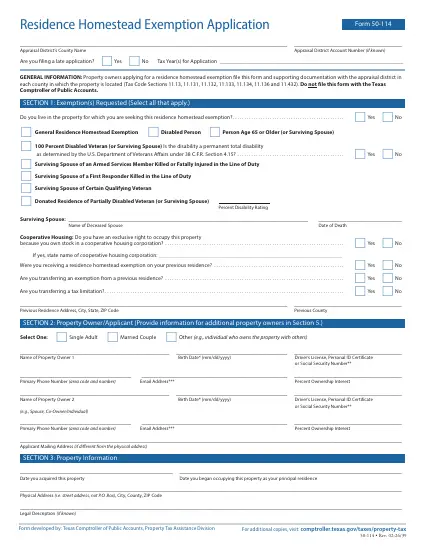
At the top of page 1, enter the name of the county appraisal district and the property’s appraisal district account number if you know it. Answer whether you are filing a late application, and enter the tax year or years the application is for.
Section 1: Exemption(s) Requested
Answer whether you live in the property. Then select every exemption that applies: General Residence Homestead Exemption, Disabled Person, Person Age 65 or Older (or Surviving Spouse), 100 Percent Disabled Veteran (or Surviving Spouse) with the question about permanent total disability, one of the surviving spouse exemptions, or Donated Residence of Partially Disabled Veteran with the percent disability rating. A surviving spouse enters the deceased spouse’s name and date of death. Finish with the questions on cooperative housing, an exemption on your previous residence, and transferring an exemption or a tax limitation, and give the previous address and county.
Section 2: Property Owner/Applicant
Select Single Adult, Married Couple or Other (for example an individual who owns the property with others). For Property Owner 1 and Property Owner 2, enter the name, birth date, driver’s license, personal ID certificate or Social Security number, primary phone number, email address and percent ownership interest. Add a mailing address if it differs from the property address. More owners can be listed in Section 5.
Section 3: Property Information
Enter the date you acquired the property, the date you began occupying it as your principal residence, the physical address (not a P.O. box), city, county and ZIP code, and the legal description if known. Answer whether you are named on the deed or other recorded instrument; if not, you must provide the documents described on page 3. Answer the heir property questions, give the make, model and ID number of a manufactured home, the percentage of the property that is income producing if any, and the number of acres you own and occupy, up to 20.
Section 4: Waiver of Required Documentation
Check a box if you are exempt from providing a copy of your driver’s license or ID because you live in a facility that provides services related to health, infirmity or aging (give its name and address) or are in the Attorney General’s address confidentiality program. You can also ask the chief appraiser to waive the rule that your license address match the property if you are an active duty armed services member or spouse, or hold a driver’s license issued under the Transportation Code sections named on the form (attach a copy of that license application).
Section 5: Additional information
Use this space for anything else, such as additional owners, and list the counties of any other residential property you own in Texas.
Section 6: Affirmation and Signature
Enter the name of the property owner or authorized representative and their title or authorization. You swear or affirm that the facts are true, that you meet the legal qualifications for the exemption, and that you do not claim a homestead exemption on another residence in or outside Texas. The owner or authorized representative signs and dates, and an additional owner signs on the second line.
After you fill it out
File the form and its supporting documents with the appraisal district in each county where the property is located. Do not send it to the Texas Comptroller; the Comptroller’s website has a directory of appraisal district offices, which can tell you how they accept applications. The form says to file generally between January 1 and April 30 of the year you are applying for. The chief appraiser may ask for more information, which you must provide within 30 days or the application is denied. If the exemption is granted, you generally do not need to reapply each year unless the chief appraiser asks.
Signing: The property owner or an authorized representative signs and dates Section 6, and an additional owner signs on the second line. The form does not say how it must be signed; ask your appraisal district whether it accepts the form online or by email or needs a signed paper copy.
Watch out for
- Do not file this form with the Texas Comptroller. It goes to the county appraisal district.
- Attach a copy of each owner’s driver’s license or state ID card. The address on it must match the property address unless a waiver in Section 4 applies.
- You must notify the chief appraiser in writing before May 1 of the year after your right to the exemption ends, for example when you move.
- A false statement on the form can be a Class A misdemeanor or a state jail felony.
- Some exemptions need more than this form: owners not named on the deed, heir property owners and manufactured home owners must provide the documents listed on page 3, often including Form 50-114-A.
Questions about Form 50-114
When is the deadline for the Texas homestead exemption?
The form says the application is generally due no later than April 30 of the year you are applying for. You may file a late application up to two years after the deadline, and disabled veterans (not their surviving spouses) may file a late application for the disabled veteran exemptions up to five years after the delinquency date.
I bought my home after January 1. Can I apply this year?
Yes. The form says an owner who acquires property after January 1 may receive the general homestead exemption for the applicable portion of that tax year immediately on qualifying, if the previous owner did not receive the same exemption for that year.
Do I have to reapply every year?
No. If the chief appraiser grants the exemption, you do not need to reapply annually unless the chief appraiser requires it, or unless you want the exemption on a property not listed in the application.
Do I need to file again when I turn 65?
Not always. The form says owners who already receive a general homestead exemption and turn 65 do not have to apply for the age 65 or older exemption if the appraisal district has accurate birthdate information, either in its records or from the Texas Department of Public Safety.
Can I get the exemption on an inherited home?
Yes, as heir property, if you live there as your principal residence. If you are not named on the deed, you must provide an affidavit of ownership (Form 50-114-A), a copy of the prior owner’s death certificate, a recent utility bill and any court record citation, and other heirs who live there must sign affidavits authorizing the application.
Official information
- Property Tax Exemptions (Texas Comptroller)
- Property tax forms (Texas Comptroller)
- Appraisal district directory
- Form 50-114-A, Residence Homestead Exemption Affidavits
Page text last reviewed November 13, 2026.