Internal Revenue Service
Fill out Form W-4R online
Withholding Certificate for Nonperiodic Payments and Eligible Rollover Distributions
Form W-4R is the withholding certificate you give to the payer of a one-time or lump-sum payment from an employer retirement plan, an annuity or an IRA. It tells the payer what rate of federal income tax to withhold from a nonperiodic payment, or from an eligible rollover distribution paid to you rather than rolled over. This is the 2026 form, and it includes the 2026 Marginal Rate Tables to help you choose a rate. You give it to the payer, not to the IRS.
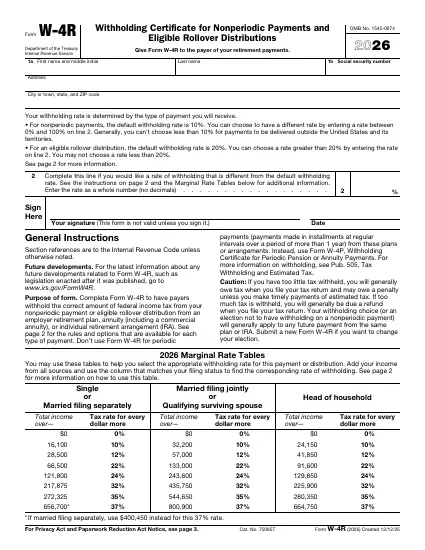
The form opens in our PDF editor with its own fields ready to type into. To download it, the filled PDF is sent to GuruPDF to prepare the file and is deleted from our servers one hour later. You can fill it in without an account; downloading the filled PDF needs a free account. A free account gets 15 credits a day, enough for one form a day.
- Country
- United States
- Edition
- Tax year 2026
- Pages
- 3
- Fillable fields
- 6
- Last checked at the source
- November 13, 2026
GuruPDF is an independent PDF editor, not a government agency, and is not affiliated with any government. This page explains the form in plain words; it is not legal or tax advice. Always check the official instructions before you file. This is the tax year 2026 version; the IRS keeps forms for earlier years.
Who uses Form W-4R
- People taking a withdrawal from an IRA, including IRA distributions payable on demand
- People receiving a lump-sum or other nonperiodic payment from a pension plan, annuity or commercial annuity
- People receiving an eligible rollover distribution from a 401(k), governmental 457(b) plan or tax-sheltered annuity who want more than 20% withheld
- People who want no federal income tax withheld from a nonperiodic payment, where that is allowed
- An estate receiving such a payment, which enters its EIN instead of a social security number
Before you start
- Your name, address and social security number (an estate uses its employer identification number)
- The type of payment you will receive: a nonperiodic payment or an eligible rollover distribution
- The expected taxable amount of the payment
- An estimate of your total income for the year from all other sources, and your filing status, to use the Marginal Rate Tables
- Whether tax on your other income is already covered by withholding or estimated tax payments
- Whether the payment will be delivered outside the United States and its territories
How to fill out Form W-4R
Line 1a and line 1b: name, SSN and address
Enter your first name and middle initial, last name, address, and city or town, state and ZIP code on line 1a. Enter your social security number on line 1b. For an estate, enter the estate's employer identification number in the space for the social security number. If you do not provide an SSN, the payer must withhold 10% and cannot honor a request for a lower rate or no withholding.
Know your default rate
The form explains that the default rate depends on the type of payment. For a nonperiodic payment, it is 10% of the taxable amount, and you may choose any rate from 0% to 100%, but generally not less than 10% for payments delivered outside the United States and its territories. For an eligible rollover distribution paid to you, it is 20%, and you may only choose a higher rate. The form says not to give a Form W-4R for an eligible rollover distribution unless you want more than 20% withheld.
Line 2: the rate you choose
Complete line 2 only if you want a rate different from the default. Enter the rate as a whole number with no decimals. To have no federal income tax withheld from a nonperiodic payment, enter "-0-". Page 2 explains how to use the 2026 Marginal Rate Tables on page 1: find the rate for your total income without the payment and with the payment; if they are the same, enter that rate, and if they differ, follow the worked calculation in the instructions (Examples 1 and 2 show both cases).
Sign here
Sign and date the form. The form states that it is not valid unless you sign it. Then give it to the payer of your retirement payment.
After you fill it out
Give Form W-4R to the payer of your retirement payment, such as your IRA custodian, plan administrator or annuity company; do not send it to the IRS. Many payers have their own electronic or paper substitute version, or take elections by phone, which the IRS permits, so check how your payer wants to receive your election. Your choice generally applies to future payments from the same plan or IRA, so submit a new Form W-4R if you want to change it.
Signing: The form must be signed and dated by the person receiving the payment; it says it is not valid unless signed. Payers may instead accept the election through their own electronic substitute form or by phone, as IRS guidance allows, in which case follow the payer's own process.
Watch out for
- Do not use Form W-4R for periodic pension or annuity payments (installments at regular intervals over more than 1 year). Those use Form W-4P.
- You cannot choose less than 20% (or "-0-") on an eligible rollover distribution. Hardship distributions, required minimum distributions and the other payments listed on page 2 are not eligible rollover distributions for these rules.
- The form cautions that if too little tax is withheld, you will generally owe tax when you file your return and may owe a penalty unless you make timely estimated tax payments.
- Nonresident aliens and foreign estates do not use Form W-4R; the form points them to Pub. 515 and Pub. 519.
- This is the 2026 form. Its Marginal Rate Tables are for 2026 income; use the form for the year of the payment.
Questions about Form W-4R
What is the difference between Form W-4R and Form W-4P?
Form W-4R is for nonperiodic payments and eligible rollover distributions, such as a one-time IRA withdrawal or a lump sum from a plan. Form W-4P is for periodic pension or annuity payments made in installments at regular intervals over more than 1 year.
Can I have no tax withheld from my IRA withdrawal?
For a nonperiodic payment, including an IRA distribution payable on demand, you may enter "-0-" on line 2, unless the payment is delivered outside the United States and its territories, where you generally cannot choose less than 10%. The IRS notes you may still owe the tax when you file your return.
Can I lower the 20% withholding on a 401(k) distribution?
No. For an eligible rollover distribution paid to you, the form says you may not choose a rate less than 20%; you can only choose a higher rate on line 2.
What happens if I do not submit Form W-4R?
The payer withholds at the default rate: 10% for a nonperiodic payment or 20% for an eligible rollover distribution. For payments that began before 2026, your current election or the default rate generally stays in effect unless you submit a new Form W-4R.
Do I send Form W-4R to the IRS?
No. The form says to give it to the payer of your retirement payments.
Official information
- About Form W-4R (IRS)
- Publication 505, Tax Withholding and Estimated Tax
- Guidance on substitute and telephonic Forms W-4P and W-4R
Page text last reviewed November 13, 2026.
Related forms
- Form W-4PWithholding Certificate for Periodic Pension or Annuity PaymentsIRSFill online
- Form W-4Employee’s Withholding CertificateIRSFill online
- Form W-4VVoluntary Withholding RequestIRSFill online
- Form 1040-ESEstimated Tax for IndividualsIRSFill online
- Form 5329Additional Taxes on Qualified Plans (Including IRAs) and Other Tax-Favored AccountsIRSFill online