Internal Revenue Service
Fill out Form 1120 online
U.S. Corporation Income Tax Return
Form 1120 is the yearly federal income tax return of a domestic corporation. The corporation uses it to report its income, gains, losses, deductions and credits and to figure its income tax, and it must file even in a year with no taxable income unless it is exempt. This edition is for tax year 2025: calendar year 2025, or a fiscal year that begins in 2025. It is filed with the IRS, on paper or by IRS e-file.
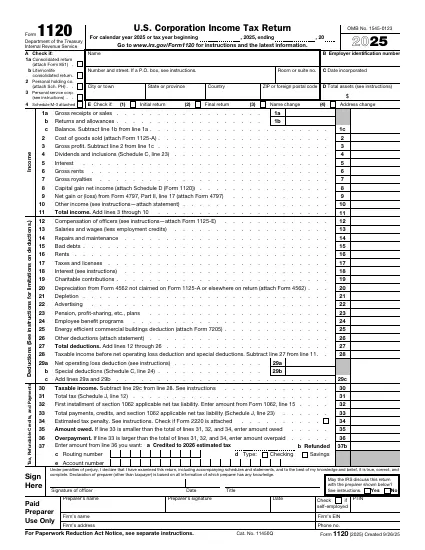
The form opens in our PDF editor with its own fields ready to type into. To download it, the filled PDF is sent to GuruPDF to prepare the file and is deleted from our servers one hour later. You can fill it in without an account; downloading the filled PDF needs a free account. A free account gets 15 credits a day, enough for one form a day.
- Country
- United States
- Edition
- Tax year 2025
- Pages
- 6
- Fillable fields
- 481
- Last checked at the source
- November 13, 2026
GuruPDF is an independent PDF editor, not a government agency, and is not affiliated with any government. This page explains the form in plain words; it is not legal or tax advice. Always check the official instructions before you file. This is the tax year 2025 version; the IRS keeps forms for earlier years.
Who uses Form 1120
- Domestic corporations (C corporations), including corporations in bankruptcy, unless they are exempt under section 501 or must file a special return
- Limited liability companies and other domestic entities that elected on Form 8832 to be taxed as a corporation
- Corporations engaged in farming, other than subchapter T cooperatives
- Corporations that intend to self-certify as a qualified opportunity fund, even with no income or expenses
- U.S. disregarded entities wholly owned by one foreign person, which file a pro forma Form 1120 with Form 5472 attached
Before you start
- The corporation's employer identification number (EIN), date of incorporation and principal business address
- The income statement and balance sheet per books for the tax year, with beginning and end-of-year balances
- The business activity code, which the instructions list
- Supporting forms the return needs, such as Form 1125-A (cost of goods sold), Form 1125-E (compensation of officers), Form 4562 (depreciation) and Schedule D (Form 1120)
- Records of estimated tax payments, any overpayment credited from the prior year and any tax deposited with Form 7004
- Ownership details: shareholders who own 20% or more of the voting stock, foreign owners of 25% or more, and the corporation's own interests in other corporations and partnerships
- The corporation's bank routing and account numbers if it wants a refund by direct deposit
How to fill out Form 1120
Top of page 1: tax year, name, address and items A to E
Fill in the tax year dates only for a fiscal or short tax year. Enter the corporation's name, street address (or P.O. box if the post office does not deliver to the street address), city, state or province, country and ZIP or foreign postal code. Item A has check boxes for a consolidated return (attach Form 851), a life/nonlife consolidated return, a personal holding company (attach Schedule PH), a personal service corporation and an attached Schedule M-3. Item B is the EIN, C the date incorporated and D total assets, taken from Schedule L, line 15, column (d), when Schedule L is completed. Item E is for an initial return, final return, name change or address change.
Income and deductions: lines 1a to 27
Line 1a is gross receipts or sales, 1b returns and allowances and 1c the balance. Line 2 is cost of goods sold from Form 1125-A, and line 3 gross profit. Lines 4 to 10 add dividends and inclusions from Schedule C, line 23, interest, rents, royalties, capital gain net income (Schedule D), the net gain or loss from Form 4797 and other income with a statement; line 11 is total income. Deductions run from compensation of officers on line 12 (with Form 1125-E when total receipts are $500,000 or more) and salaries and wages on line 13 to other deductions on line 26, with depreciation from Form 4562 on line 20 and the energy efficient commercial buildings deduction (Form 7205) on line 25. Line 27 is total deductions.
Taxable income, tax and payments: lines 28 to 37
Line 28 is taxable income before the net operating loss deduction and special deductions. Line 29a is the NOL deduction, 29b the special deductions from Schedule C, line 24, and line 30 taxable income. Line 31 is total tax from Schedule J, line 12, line 32 the first installment of a section 1062 liability from Form 1062, and line 33 total payments, credits and section 1062 applicable net tax liability from Schedule J, line 23. Line 34 is the estimated tax penalty (check the box if Form 2220 is attached). Line 35 shows an amount owed and line 36 an overpayment, which line 37a credits to 2026 estimated tax and line 37b refunds; lines 37c to 37e take the routing number, account type and account number for direct deposit.
Sign Here and Paid Preparer Use Only
An authorized officer signs and dates the return and enters their title. Check Yes or No to say whether the IRS may discuss the return with the preparer shown; Yes covers only that individual preparer, not the firm. A paid preparer fills in their name, signature, date, PTIN and firm details. Leave that section blank if an employee of the corporation prepared the return, or if the preparer did not charge for it.
Schedule C: Dividends, Inclusions, and Special Deductions
On page 2, enter dividends and inclusions in column (a) by type, from less-than-20%-owned and 20%-or-more-owned domestic corporations on lines 1 and 2 to subpart F and GILTI inclusions on lines 16a to 17 and other dividends on line 20. Column (b) shows the percentage for each line, and column (c) is the special deduction, column (a) times column (b), where one applies. Line 23 is total dividends and inclusions, which also goes on page 1, line 4. Line 24 is total special deductions, which also goes on page 1, line 29b.
Schedule J: Tax Computation and Payment
Lines 1a to 12 on page 3 figure the tax. Line 1a is the income tax, which the instructions figure as 21% of taxable income on page 1, line 30; lines 1b to 1z add other chapter 1 taxes, line 2 is total income tax and line 3 the corporate alternative minimum tax from Form 4626. Credits go on lines 5a to 5f, such as the foreign tax credit (Form 1118) and the general business credit (Form 3800), and other taxes such as the personal holding company tax and recapture amounts on lines 8 to 10. Line 12, total tax, goes to page 1, line 31. Lines 13 to 23 list payments: the prior year's overpayment, estimated tax payments, tax deposited with Form 7004, withholding and refundable credits, with the total on line 23 carried to page 1, line 33.
Schedule K: Other Information, questions 1 to 32
Schedule K, on pages 4 and 5, starts with the accounting method (cash, accrual or other) and the business activity code, business activity and product or service. The questions that follow ask, among other things, whether the corporation belongs to an affiliated or controlled group, who owns 20% or more of its voting stock (attach Schedule G if Yes), which corporations and partnerships it owns interests in, and whether one foreign person owned at least 25% of it, in which case it may have to attach Form 5472. Later questions cover tax-exempt interest, the number of shareholders, NOL carryovers, Forms 1099, digital assets, controlled group membership (Schedule O) and the corporate alternative minimum tax. Question 13 asks whether total receipts and total assets at the end of the year are both less than $250,000.
Schedules L, M-1 and M-2
Schedule L on page 6 is the balance sheet per books, with assets on lines 1 to 15 and liabilities and shareholders' equity on lines 16 to 28, at the beginning and end of the tax year. Schedule M-1 reconciles net income or loss per books with income on page 1, line 28. Schedule M-2 analyzes unappropriated retained earnings from the start to the end of the year, including distributions. If the answer to Schedule K, question 13, is Yes, these three schedules are not required. A corporation with total assets of $10 million or more on the last day of the tax year files Schedule M-3 (Form 1120) instead of Schedule M-1.
After you fill it out
Attach the schedules and forms the return needs after page 6, in the order the instructions list, and put the corporation's name and EIN on every supporting statement. File the return with the IRS by its due date, generally the 15th day of the 4th month after the tax year ends. A corporation that files 10 or more returns of any type in the calendar year must e-file unless it has a waiver; a paper return goes to an IRS address that depends on where the corporation's principal business is and on its total assets, so check Where To File in the instructions. Any tax due is paid electronically, for example through EFTPS or the corporation's IRS business tax account; see the IRS payments page.
Signing: The instructions say the return must be signed and dated by the president, vice president, treasurer, assistant treasurer, chief accounting officer or another corporate officer authorized to sign, or by the receiver, trustee or assignee filing for the corporation. A paid preparer also signs and may use a rubber stamp, mechanical device or software; for the officer's signature, follow the IRS instructions for the way the return is filed.
Watch out for
- For returns filed on or after January 1, 2024, a corporation that files 10 or more returns of any type during the calendar year, counting income tax, employment tax, excise tax and information returns, must e-file Form 1120 unless the IRS grants a waiver or an exemption applies.
- This PDF holds pages 1 to 6 of Form 1120 only. Forms and schedules such as Form 1125-A, Form 1125-E, Form 851, Form 4562, Schedule D, Schedule G and Schedule M-3 are separate and must be attached when they apply.
- Complete every applicable entry space. The instructions say not to write "See Attached" or "Available Upon Request" in place of an entry.
- Tax due must generally be paid in full by the original due date, and payment must be made electronically. An extension of time to file on Form 7004 does not extend the time to pay.
- This is the 2025 form, for calendar year 2025 and for fiscal years that begin in 2025. Forms for other years are listed under All Form 1120 revisions on the IRS About Form 1120 page.
Questions about Form 1120
Who has to file Form 1120?
Unless exempt under section 501, every domestic corporation, including one in bankruptcy, must file an income tax return whether or not it has taxable income. It files Form 1120 unless it must or elects to file a special return: an S corporation files Form 1120-S, for example, and an LLC files Form 1120 only if it elected on Form 8832 to be taxed as a corporation.
When is Form 1120 due, and how do I get more time?
Generally by the 15th day of the 4th month after the end of the tax year. A corporation with a fiscal year ending June 30 files by the 15th day of the 3rd month after its year ends. To get more time, file Form 7004 by the regular due date; the extension is for filing only, not for paying the tax.
What is a pro forma Form 1120?
A U.S. disregarded entity wholly owned by one foreign person, such as a single-member LLC, has no income tax return to file but must attach Form 5472 to a pro forma Form 1120. The Form 5472 instructions say only the entity's name and address and items B and E on page 1 are completed, that "Foreign-owned U.S. DE" is written across the top, and that it is faxed or mailed to the dedicated fax number or address in those instructions, not the regular Form 1120 addresses.
Do small corporations have to fill in the balance sheet?
Not always. If the corporation's total receipts (page 1, line 1a, plus lines 4 through 10) and its total assets at the end of the year are both less than $250,000, answer Yes to Schedule K, question 13. It then does not have to complete Schedules L, M-1 and M-2, but enters its cash and property distributions for the year on that question instead.
How do I correct a Form 1120 that was already filed?
Use Form 1120-X, Amended U.S. Corporation Income Tax Return, to correct a previously filed Form 1120.
Official information
- About Form 1120 (IRS)
- Instructions for Form 1120
- E-file for business and self-employed taxpayers (IRS)
- Pay your federal taxes (IRS)
Page text last reviewed November 13, 2026.
Related forms
- Form 7004Application for Automatic Extension of Time To File Certain Business Income Tax, Information, and Other ReturnsIRSFill online
- Form 1120-SU.S. Income Tax Return for an S CorporationIRSFill online
- Form 5472Information Return of a 25% Foreign-Owned U.S. Corporation or a Foreign Corporation Engaged in a U.S. Trade or BusinessIRSFill online
- Form 8832Entity Classification ElectionIRSFill online
- Form 4562Depreciation and Amortization (Including Information on Listed Property)IRSFill online
- Form SS-4Application for Employer Identification NumberIRSFill online