Internal Revenue Service
Fill out Form 3520 online
Annual Return To Report Transactions With Foreign Trusts and Receipt of Certain Foreign Gifts
Form 3520 is the annual return U.S. persons, and executors of estates of U.S. decedents, file with the IRS to report certain transactions with foreign trusts, ownership of foreign trusts, and the receipt of large gifts or bequests from foreign persons. Part IV covers the foreign gifts most individuals ask about: a U.S. person who received more than $100,000 in a year, treated as gifts or bequests, from a nonresident alien or a foreign estate. It is filed separately from your income tax return. This December 2023 revision is a continuous-use form, used for tax year 2025 and later years until the IRS replaces it.
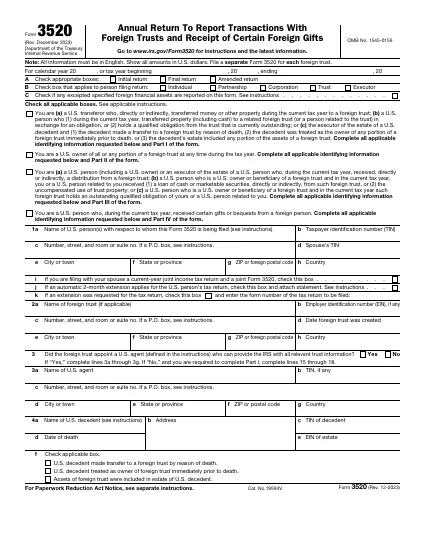
The form opens in our PDF editor with its own fields ready to type into. To download it, the filled PDF is sent to GuruPDF to prepare the file and is deleted from our servers one hour later. You can fill it in without an account; downloading the filled PDF needs a free account. A free account gets 15 credits a day, enough for one form a day.
- Country
- United States
- Edition
- Rev. December 2023
- Pages
- 6
- Fillable fields
- 462
- Last checked at the source
- November 13, 2026
GuruPDF is an independent PDF editor, not a government agency, and is not affiliated with any government. This page explains the form in plain words; it is not legal or tax advice. Always check the official instructions before you file.
Who uses Form 3520
- U.S. citizens and residents who received more than $100,000 in a year as gifts or bequests from a nonresident alien or a foreign estate, for example from family members abroad
- U.S. persons who received gifts from foreign corporations or foreign partnerships above the inflation-adjusted threshold the IRS publishes
- U.S. persons who transferred money or property to a foreign trust, or who are treated as owners of a foreign trust
- U.S. persons who received distributions, loans or the free use of property from a foreign trust
- Executors of the estate of a U.S. decedent with a foreign trust connection
Before you start
- Your name, taxpayer identification number and address, and your spouse's TIN if you file a joint Form 3520
- Whether you requested an extension for your income tax return, and its form number
- For gifts: the date, description and fair market value in U.S. dollars of each gift or bequest over $5,000
- For gifts from foreign corporations or partnerships: each donor's name, address and TIN, if any
- For a foreign trust: its name, address, EIN if any, country, date created, and whether it has a U.S. agent
- Trust documents and statements, such as the Foreign Grantor Trust Owner or Beneficiary Statement, if Parts I to III apply
How to fill out Form 3520
Page 1 header: tax year and items A to C
Enter the calendar year, or the beginning and ending dates of your tax year. In item A, check Initial, Final or Amended return if one applies. In item B, check whether the filer is an Individual, Partnership, Corporation, Trust or Executor. Check item C only if you also file Form 8938 for the same year and count this Form 3520 in Part IV of that form. Then check the box or boxes that describe why you are filing; each one tells you which part to complete. All information must be in English and all amounts in U.S. dollars.
Line 1: the U.S. person filing
Enter the name, TIN and address of the U.S. person the form is filed for on lines 1a to 1h, and your spouse's TIN on line 1d if you file jointly. Check line 1i if you and your spouse file a joint income tax return and a joint Form 3520. Check line 1j if an automatic 2-month extension applies to your tax return, and attach the statement the instructions describe. Check line 1k if you requested an extension for your tax return and enter that return's form number.
Lines 2 to 4: the foreign trust, U.S. agent and decedent
If a foreign trust is involved, enter its name, EIN if any, address and the date it was created on lines 2a to 2h. Line 3 asks whether the trust appointed a U.S. agent who can give the IRS all relevant trust information; if Yes, complete lines 3a to 3g. Lines 4a to 4f are completed only by an executor for a U.S. decedent, with the decedent's details and the box that describes the trust connection. A person reporting only foreign gifts leaves lines 2 to 4 blank.
Part I: Transfers by U.S. Persons to a Foreign Trust
Complete Part I if you transferred money or property to a foreign trust during the year. Lines 5 to 9 identify the trust creator, the countries where the trust was created and whose law governs it, and any person treated as owner. Schedule A (lines 11 and 12) covers transfers in exchange for obligations, Schedule B (lines 13 to 18) gratuitous transfers and, when there is no U.S. agent, the beneficiaries, trustees and trust documents, and Schedule C (line 19) qualified obligations outstanding during the year.
Parts II and III: owners of and distributions from a foreign trust
Part II (lines 20 to 23) is for a U.S. owner of a foreign trust; it asks whether the trust filed Form 3520-A and for the gross value of the portion you own, and the instructions say to complete it even if there were no transactions that year. Part III (lines 24 to 53) reports distributions, loans and the free use of trust property received from a foreign trust. Lines 29 and 30 ask whether you received a Foreign Grantor or Nongrantor Trust Beneficiary Statement; depending on the answers you attach the statement, complete Schedule A (default calculation) or Schedule B (actual calculation), and Schedule C calculates the interest charge on accumulation distributions.
Part IV: gifts or bequests from foreign persons, lines 54 to 56
On line 54, check Yes if you received more than $100,000 during the year that you treated as gifts or bequests from a nonresident alien or a foreign estate, adding together gifts from people you know are related to each other. List each gift over $5,000 with its date, description and fair market value; if none is over $5,000, enter "No gifts or bequests exceed $5,000" in column (b) of the first line. Line 55 is for gifts from foreign corporations or partnerships above the yearly threshold, with each donor's details. On line 56, say whether you believe a donor acted as a nominee or intermediary for someone else.
Sign Here and paid preparer
Sign and date at the bottom of page 6 under penalties of perjury, with your title if you sign for an entity. An individual or fiduciary signs for themselves; a partner or LLC member signs for a partnership, and an authorized officer for a corporation. A paid preparer completes and signs the Paid Preparer Use Only section, including their PTIN.
After you fill it out
Form 3520 is filed separately from your income tax return, by mail to the IRS address given in the instructions and on the IRS's foreign gifts page. For a calendar-year individual, it is generally due April 15 of the following year; June 15 if you live and work outside the United States and Puerto Rico, or are on military duty outside them, with a statement attached; and October 15 if you were granted an extension for your income tax return. Only a complete Form 3520 with all required attachments counts as timely filed. Keep a copy for your records.
Signing: The filer signs and dates the form under penalties of perjury: the individual or fiduciary, a partner or LLC member for a partnership, or an authorized officer for a corporation. The IRS instructions state that e-signatures are accepted. A paid preparer also signs in the preparer section.
Watch out for
- Penalties can apply when Form 3520 is late, incomplete or incorrect. For unreported foreign gifts, the IRS says the penalty is 5% of the gift's value for each month it is not reported, up to 25%, unless there is reasonable cause.
- Gifts from related donors are added together to test the $100,000 limit. For example, gifts from two related nonresident aliens of $75,000 and $40,000 must be reported.
- If you extended your income tax return, check box 1k and enter the return's form number, or the IRS may treat your Form 3520 as filed late. The Form 3520 deadline can never be later than October 15 for calendar-year filers.
- File a separate Form 3520 for each foreign trust. A distribution from a foreign trust is reported in Part III, not as a gift in Part IV.
- Form 3520 does not replace other foreign reporting. You may also need to file FinCEN Form 114 (FBAR) or Form 8938.
Questions about Form 3520
Do I have to file Form 3520 for money my parents sent me from abroad?
If you are a U.S. person and, during the year, you received more than $100,000 that you treated as gifts or bequests from a nonresident alien or a foreign estate, counting together gifts from people you know are related, you report them in Part IV. Amounts paid directly for your qualified tuition or medical care are not counted as gifts.
Can I file Form 3520 with my tax return or electronically?
The IRS says to file Form 3520 separately from your income tax return, following the directions in its instructions, which give a mailing address for it. E-signatures are accepted on the form.
When is Form 3520 due?
Generally by the 15th day of the 4th month after your tax year ends (April 15 for a calendar-year individual), the 15th day of the 6th month if you live and work outside the United States and Puerto Rico, and no later than the 15th day of the 10th month (October 15) if you were granted an extension for your income tax return.
Is the December 2023 revision still the current form?
Yes. The IRS lists Rev. December 2023 as the current revision, and the instructions say they are used for tax year 2025 and later years until a superseding revision is issued. The IRS corrected only the catalog number on page 1 shortly after release.
Can my spouse and I file one Form 3520?
Yes, if you file a joint income tax return for the year and you are both transferors, grantors or beneficiaries of the same foreign trust. Check the box on line 1i and enter your names and TINs in the same order as on your Form 1040.
Official information
Page text last reviewed November 13, 2026.
Related forms
- Form 709United States Gift (and Generation-Skipping Transfer) Tax ReturnIRSFill online
- Form 1040U.S. Individual Income Tax ReturnIRSFill online
- Form 4868Application for Automatic Extension of Time To File U.S. Individual Income Tax ReturnIRSFill online
- Form 8843Statement for Exempt Individuals and Individuals With a Medical ConditionIRSFill online
- Form 1040-NRU.S. Nonresident Alien Income Tax ReturnIRSFill online