Department of Home Affairs
Fill out Form 1300t online
Application for Australian citizenship General eligibility
Form 1300t is the paper application for Australian citizenship by conferral under the general eligibility rules: for permanent residents (including eligible New Zealand citizens) aged 18 or over and under 60 who meet the residence requirement, are likely to keep living in or closely associated with Australia, and are of good character. Children under 16 can be included on a responsible parent's form. Home Affairs says online lodgement through ImmiAccount is its preferred method and processes faster; the paper form remains in use, and Home Affairs asks for a paper application in cases such as a fee concession or exemption, Australian Defence Force service, statelessness, having no passport, or not having travelled in or out of Australia since July 1990. Most applicants then sit the citizenship test and, once approved, attend a ceremony and make the pledge.
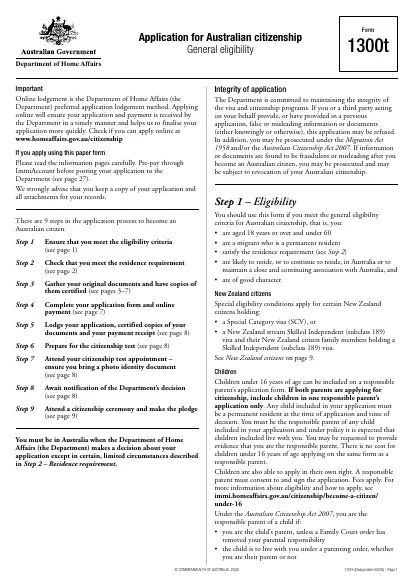
The form opens in our PDF editor with its own fields ready to type into. To download it, the filled PDF is sent to GuruPDF to prepare the file and is deleted from our servers one hour later. You can fill it in without an account; downloading the filled PDF needs a free account. A free account gets 15 credits a day, enough for one form a day.
- Country
- Australia
- Edition
- Design date 09/26
- Pages
- 28
- Fillable fields
- 684
- Last checked at the source
- November 13, 2026
GuruPDF is an independent PDF editor, not a government agency, and is not affiliated with any government. This page explains the form in plain words; it is not legal or tax advice. Always check the official instructions before you file.
Who uses Form 1300t
- Permanent residents aged 18 to 59 who meet the general residence requirement and apply on paper
- Applicants eligible for a fee concession or exemption, or claiming the defence service residence exemption
- Stateless applicants, and those without a passport or who have not travelled in or out of Australia since July 1990
- New Zealand citizens holding a Special Category visa (SCV) or a New Zealand stream Skilled Independent (subclass 189) visa
- Responsible parents including their children under 16 in the same application
Before you start
- Proof you meet the residence requirement; the Residence Requirement Calculator on the Home Affairs website helps check it
- Certified copies of three identity documents that together show your photograph, signature, current address, and birth name, date of birth and sex, plus proof of any name change
- Your passports or travel documents, details of every Australian visa you have held and the date you first entered Australia as a permanent resident
- Residential addresses for the last 5 years and every overseas trip in the last 10 years since you turned 18
- Overseas penal clearance certificates where the form's rules require them, and court documents for any conviction
- A passport-sized colour photo for each applicant, no more than 6 months old, with the full name written on the back
- Details of your parents, children and other immediate family members
- A payment receipt from the 'Pre-Pay Paper Service' in ImmiAccount, or evidence of a fee concession or exemption
How to fill out Form 1300t
Part A: Your details (questions 1 to 27)
Give your title, full name (as it will appear on your citizenship certificate), other names, sex, date and place of birth, residential addresses for the last 5 years, postal address, phone and email. Questions 14 to 16 ask whether you were previously a citizen, have already passed the citizenship test, or need help with it. Questions 17 to 26 cover other citizenships and permanent residence, occupation, passport, Chinese Commercial Code Numbers, national identity documents, the date you first entered Australia as a permanent visa holder (or were granted one, whichever is later), previous visas, and Australian driver and firearms licences. At question 27 say whether you seek a residence exemption or discretion, and attach a statement and evidence if so.
Parts B to D: Children, parents and family (questions 28 to 34)
List children under 16 you have responsibility for and are including (they must be permanent residents), say how many, and also list all your other children, including adult children. Children aged 16 or 17 cannot be included and must make their own application; Home Affairs' paper form for them is Form 1290 Application for Australian citizenship Other situations, not this form. Part C gives both parents' names, other names, dates and places of birth, citizenship and country of residence, and Part D any other immediate family members not already listed.
Part E: Identity documents (question 35)
List the identity documents you are providing: a current document with your photo and signature, evidence of your current address, evidence of your birth name, date of birth and sex, any change of name, and your photograph. Attach certified copies, not originals, with English translations of any documents not in English, and attach the photo in a plastic sleeve or envelope stapled to the form rather than stapling the photo itself.
Part F: Travel, good character and criminal offences (questions 36 to 39)
At question 36 list, in date order, every country you lived in or travelled to in the last 10 years (only periods when you were 18 or over), with dates and reasons. Question 37 asks whether you have spent 12 months or more in total outside Australia since 18, and which countries you spent 90 days or more in, for which you attach penal clearance certificates. Question 38 is a list of character questions for you and any children included, covering convictions (including spent convictions and traffic offences that went to court), protection orders, pending charges, deportation, and military or intelligence service; question 39 is your consent to a national police check.
Parts G to J: Supporting documents, representative, ceremony and travel (questions 40 to 47)
Part G lists the supporting documents you attach, for example for a residence discretion, a fee concession or children. In Part H you can nominate a person to make enquiries about your application and sign the authority to disclose information to them. In Part I choose pledge 1 or 2, give your local council, any fellow applicant you want to attend the ceremony with, and whether you would rather avoid a ceremony that may attract media attention. Part J asks about travel outside Australia planned in the next 12 months.
Parts K and L: Payment and declaration (questions 48 to 51)
Say whether you are eligible for a fee concession or exemption, and attach the evidence form 1298i Citizenship application fees asks for. Pay through 'My Payments' in ImmiAccount (Manage Payments, then Pre-Pay Paper Service), write the receipt number on the form and attach a copy of the printed receipt; never write card details on the form. Then read and sign the declaration at question 51, and sign the responsible parent's declaration for any children under 16.
After you fill it out
Home Affairs prefers online applications, so check first whether you can apply online in ImmiAccount. If you lodge on paper, post the form with certified copies of your documents (never originals), photos and your payment receipt to the postal address of the Home Affairs office closest to you, as listed on page 12 of the form; applicants outside Australia post it to the overseas address given there. Home Affairs then sends you a citizenship appointment, where most people sit the citizenship test (bring an original photo ID). You must tell the Department about changes in your circumstances while you wait, and you must be in Australia when the decision is made, apart from limited exceptions. If approved, you attend a ceremony and make the pledge; check current fees and processing times on the Home Affairs website.
Signing: The main applicant signs and dates the declaration at question 51; a responsible parent signs the declaration for children under 16, and you sign Part H only if you nominate someone to make enquiries. The form can be typed or handwritten in block letters; it does not say whether a typed or electronic signature is accepted on a posted application.
Watch out for
- Home Affairs will not consider the application without the correct fee or, for a concession or exemption, the evidence for it; pay through ImmiAccount's Pre-Pay Paper Service before posting.
- Do not post original documents. Send certified copies, certified by a person on the list of professions in the form, with English translations where needed.
- Your application cannot be approved if you are outside Australia at the time of decision, except in limited circumstances described on the form.
- You must declare spent convictions, and the form warns that false or misleading information is an offence and can lead to refusal or later loss of citizenship.
- Corrections made with liquid paper are not accepted.
Questions about Form 1300t
Can I still apply for citizenship on paper?
Yes. The 2026 edition of Form 1300t is current, but Home Affairs says online lodgement in ImmiAccount is preferred and faster. Its website says adults aged 18 to 59 can apply online if they are not eligible for a concession, and should post a paper application if they are eligible for a fee concession, are part of the Australian Defence Force, are stateless, do not have a passport, or have not travelled in or out of Australia since July 1990.
What is the general residence requirement?
The form says you must have lived in Australia on a valid visa for the 4 years before you apply, including the last 12 months as a permanent resident, and not been absent for more than 12 months in those 4 years, including no more than 90 days in the last 12 months. The Residence Requirement Calculator on the Home Affairs website helps you check.
Can I include my children?
Children under 16 who are permanent residents can be included on one responsible parent's form at no extra cost. Children aged 16 or 17 cannot be included; they make their own application, and the paper form for them is Form 1290 (Other situations), not Form 1300t.
Do I need overseas police certificates?
Possibly. The form says permanent residents should provide them if, since turning 18 and in the last 10 years or since their first permanent visa (whichever is more recent), they spent 12 months or more in total outside Australia and 90 days or more in any one country. Do not get a New Zealand certificate yourself; the Department requests it.
What happens after I apply?
You are given a citizenship appointment, where your identity is confirmed and most people sit the citizenship test, which is in English and based on 'Australian Citizenship: Our Common Bond'. You are notified of the decision in writing and, if approved, must attend a ceremony and make the pledge within 12 months.
Official information
- Form 1300t (Home Affairs PDF)
- Citizenship for permanent residents: eligibility and how to apply
- Residence Requirement Calculator
- Citizenship test and interview
Page text last reviewed November 13, 2026.