Department of Home Affairs
Fill out Form 80 online
Personal particulars for assessment including character assessment
Form 80 is the Department of Home Affairs' detailed questionnaire about your identity, history and background, used to assess you against the character requirements and other criteria for an Australian visa or citizenship. It is completed in English by applicants aged 16 or over when the office processing the application asks for it, and many visa pages, such as the Partner visa, list it among the documents to attach. It covers your names, citizenships, passports, 10 years of addresses and travel, your full employment history, education, family members, personal contacts in Australia and a list of character questions. The completed form goes to Home Affairs as part of your application, not to anyone else.
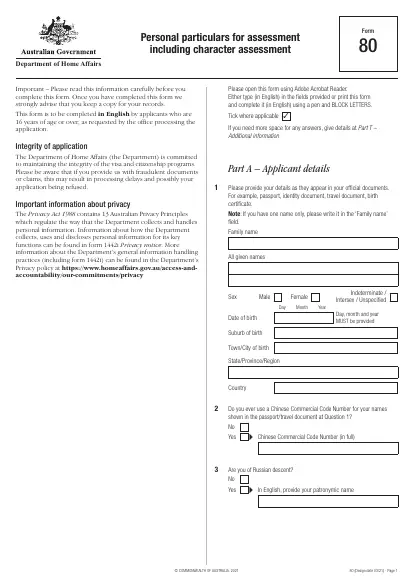
The form opens in our PDF editor with its own fields ready to type into. To download it, the filled PDF is sent to GuruPDF to prepare the file and is deleted from our servers one hour later. You can fill it in without an account; downloading the filled PDF needs a free account. A free account gets 15 credits a day, enough for one form a day.
- Country
- Australia
- Edition
- Design date 03/21
- Pages
- 19
- Fillable fields
- 836
- Last checked at the source
- November 13, 2026
GuruPDF is an independent PDF editor, not a government agency, and is not affiliated with any government. This page explains the form in plain words; it is not legal or tax advice. Always check the official instructions before you file.
Who uses Form 80
- Visa applicants aged 16 or over whose visa page or case officer asks for Form 80, for example Partner visa applicants
- Dependent family members aged 16 or 17 included in an application, when character documents are requested for them
- Citizenship applicants asked by Home Affairs to provide Form 80
- Refugee and humanitarian visa applicants, who must cover a longer history (30 years of addresses and travel)
- Applicants responding to a request for more information from the office processing their application
Before you start
- Your current passport and any other or previous passports or travel documents, with their numbers and issue and expiry dates
- National identity documents or numbers you have ever had (for example identity cards, birth registration or social security numbers)
- Your addresses for the last 10 years, with month and year dates and no gaps
- Dates and countries of every trip outside Australia in the last 10 years
- Your full employment and unemployment history, with business names and addresses, and your tertiary education history
- Names, dates and places of birth, citizenships and countries of residence of your partner, children, parents and siblings
- Details of previous Australian visas, any visa or citizenship refusals, military service and any criminal charges or convictions (with court documents)
- Your Transaction Reference Number (TRN) or file details, so you can attach the form to the right application
How to fill out Form 80
Part A: Applicant details (questions 1 to 8)
Give your family name, all given names, sex, date of birth and place of birth exactly as they appear in your passport or other official document; if you have only one name, write it in the Family name field. Question 2 asks whether you use a Chinese Commercial Code Number for your names, and question 3 asks for your patronymic name if you are of Russian descent. Question 4 covers every other name you have been known by (name at birth, married name, aliases, other spellings), question 5 any different date of birth, and questions 6 to 8 your current and previous citizenships and any permanent residency rights in other countries.
Parts B and C: Passports and identity documents (questions 9 to 14)
Questions 9 and 10 ask for the number, country, issue and expiry dates, nationality, issuing authority and name of your current passport or travel document and any other current one. Questions 11 to 13 cover previous passports, including expired, lost or stolen ones, and what happened to them. Question 14 lists any national identity documents or numbers you have now or have ever had, with their country of issue.
Parts D and E: Contact details, address history and travel (questions 15 to 18)
List all your personal, student and work email addresses (not your migration agent's) and your telephone numbers. Question 17 is your address history for the last 10 years, inside and outside Australia, in date order and with no gaps; refugee and humanitarian applicants give 30 years. Question 18 lists every trip to a country other than Australia in the last 10 years, with dates, reason and country, including holidays, business, study and visits back to your own country.
Parts F and G: Employment and education (questions 19 and 20)
Question 19 is your employment and unemployment history with no gaps: paid, self-employed, unpaid and volunteer work, internships, and the periods in between, with dates, the full name and address of the business, type of business and your duties. If you are retired write 'CURRENTLY RETIRED', and if you have never worked write your date of birth in 'Date from' and 'NEVER WORKED' as the business name. Question 20 covers all tertiary education and qualifications, with the institution, course, course status and campus address.
Parts H to J: Travel plans, addresses in Australia and visa history (questions 21 to 35)
If you are outside Australia, say why you are travelling, any booked dates and flights, and the places you will visit; if you are already in Australia, give your reason for remaining and your arrival details. Part I asks where you will stay or have stayed in Australia (no post office boxes). Part J lists your current Australian visa, if you are in Australia, and every previous visa, with arrival and departure dates and the name you used on entry.
Parts K to P: Character, military service and refusals (questions 36 to 41)
Question 36 asks a series of yes/no questions about you and anyone else included in the application: pending charges, convictions anywhere (including ones removed from records), domestic violence offences or orders, arrest warrants, sexual offences involving a child, national security, war crimes, criminal associations, military or weapons training, people smuggling, deportation, overstaying a visa and debts to the Australian Government. For any 'Yes', give the dates, outcome and penalty and attach court documents. Questions 37 to 41 cover military service (or why you have none), work for an intelligence or security agency, visa refusals, deportations or removals, and citizenship refusals or renunciations.
Parts Q and R: Associated people and sponsoring employer (questions 42 to 52)
Give details of your partner (including a deceased partner if you are widowed), all your children including step-children and deceased children, your parents, your siblings and any other family members included in the visa application, with names, dates and places of birth, citizenships, country of residence and whether each is migrating with you. Questions 47 and 48 ask for your personal contacts in Australia, such as sponsors, relatives and friends. Part R asks whether you are sponsored by or associated with a business or organisation in Australia, and for its name, description, addresses, email and telephone numbers.
Parts S and T: Declaration and additional information (questions 53 and 54)
Read the declaration in question 53, then sign and date it. Part T (question 54) is where you continue any answer that did not fit, giving the question number each time; this is also where you explain any gaps in your address or employment history. If you still need more room, attach a separate statement to the form.
After you fill it out
Attach the completed form to the application it was requested for. Home Affairs says that for applications lodged online, documents are uploaded through ImmiAccount and must not be emailed; for a paper application, follow the instructions of the office processing it. Keep your own copy, because you cannot download the documents you upload back from ImmiAccount. Home Affairs may contact you if it needs more information.
Signing: The applicant signs and dates the declaration in Part S (question 53). The form can be typed or printed and completed by pen in block letters; it does not say whether a typed or electronic signature is accepted, so follow the instructions you were given for your application.
Watch out for
- The form must be completed in English, and every date of birth must include the day, month and year.
- Address and employment histories must run in date order with no gaps; any gap must be explained in Part T.
- Home Affairs warns that fraudulent documents or claims may delay processing and can lead to the application being refused, and the declaration states that giving false or misleading information is a serious offence.
- Character questions apply to you and to any other person included in the application, and convictions must be declared even if they were later removed from official records.
- Form 80 does not replace police certificates: visa pages such as the Partner visa ask for police certificates separately.
Questions about Form 80
Who has to complete Form 80?
The form says it is completed in English by applicants who are 16 years of age or over, as requested by the office processing the application. Some visa pages, such as the Partner visa, tell you to complete and attach it when you apply; otherwise Home Affairs asks for it during processing.
How do I submit Form 80?
If you applied online, attach it to your application in ImmiAccount. Home Affairs says not to email documents. For other applications, follow the request you received from the processing office.
What if I run out of space?
Use Part T – Additional information at the end of the form, writing the question number next to each answer. If that is not enough, attach a separate statement with the further details.
Do I need to list short holidays and every job?
Yes. Question 18 asks for all travel outside Australia in the last 10 years, including holidays, business trips and visits to your own country. Question 19 asks for all employment and unemployment, including volunteer work, internships and the gaps between jobs and study.
Can I fill in Form 80 on a computer?
Yes. Home Affairs' instructions say you can either type in the fields provided, in English, or print the form and complete it with a pen in block letters.
Official information
- Form 80 (Home Affairs PDF)
- Character requirements for visas
- Attach documents to your application (ImmiAccount)
- Departmental PDF forms
Page text last reviewed November 13, 2026.
Related forms
- Form 888Supporting statement in relation to a Partner or Prospective Marriage visa applicationHome AffairsFill online
- Form 1229Consent to grant an Australian visa to a child under the age of 18 yearsHome AffairsFill online
- Statutory DeclarationCommonwealth of Australia Statutory DeclarationAGDFill online