Department of Home Affairs
Fill out Form 956 online
Appointment of a registered migration agent, legal practitioner or exempt person
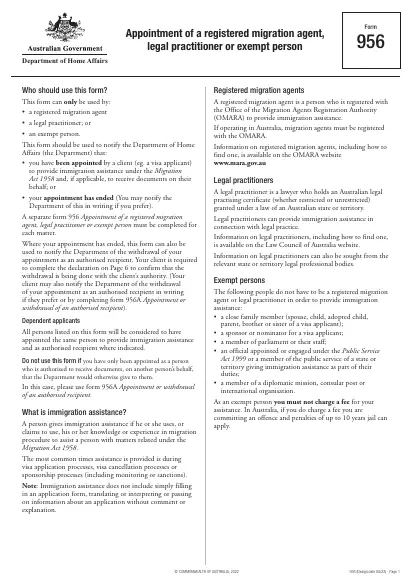
Form 956 tells the Department of Home Affairs that a registered migration agent (RMA), an Australian legal practitioner or an exempt person (such as a close family member or sponsor) has been appointed to give immigration assistance to a client, for example a visa applicant, sponsor or nominator, or that the appointment has ended. It can also appoint that person as the client's authorised recipient, so the Department sends all written communication about the matter to them. Home Affairs says that when you appoint an RMA, the agent must tell the Department using this form and you must sign it. A separate form is needed for each matter.
The form opens in our PDF editor with its own fields ready to type into. To download it, the filled PDF is sent to GuruPDF to prepare the file and is deleted from our servers one hour later. You can fill it in without an account; downloading the filled PDF needs a free account. A free account gets 15 credits a day, enough for one form a day.
- Country
- Australia
- Edition
- Design date 08/22
- Pages
- 6
- Fillable fields
- 129
- Last checked at the source
- November 13, 2026
GuruPDF is an independent PDF editor, not a government agency, and is not affiliated with any government. This page explains the form in plain words; it is not legal or tax advice. Always check the official instructions before you file.
Who uses Form 956
- Registered migration agents and Australian legal practitioners taking on a client's visa, sponsorship or cancellation matter
- Exempt persons giving free help: a close family member, a sponsor or nominator, a member of parliament or their staff, certain public servants, or diplomatic and international organisation staff
- Visa applicants, sponsors and nominators appointing someone to act for them (they sign the client declaration)
- Clients and agents notifying the Department that an appointment, or an authorised recipient appointment, has ended
Before you start
- The agent's Migration Agent Registration Number (MARN) or the lawyer's Legal Practitioner Number (LPN)
- The appointed person's name, organisation, business and correspondence addresses, phone numbers and email
- The client's full name, date of birth, address and phone numbers, and any Home Affairs client ID
- Names of other clients in the same matter, such as dependent applicants
- The type of application, visa subclass or matter, and the date lodged if already lodged
- The Request ID (RID) or Transaction Reference Number (TRN), if known
How to fill out Form 956
Question 1: New appointment or appointment ended
Tick 'New appointment' to complete Part A and Part C, or 'Appointment has ended' to complete Part B and Part C. The form says you can type in English in the fields or print it and complete it in English with a pen and block letters.
Part A, questions 2 to 11: The person appointed
Give the appointed person's title and name (and date of birth if an exempt person), organisation, business or residential address, correspondence address and phone numbers. Question 7 asks whether they agree to communication by email or other electronic means. At question 8 tick registered migration agent, legal practitioner or exempt person; agents and lawyers give their MARN or LPN at question 9 and may name a colleague the Department can talk to at question 10, while exempt persons give the reason they are exempt at question 11.
Part A, questions 12 to 14: The client
At question 12 tick what the client is: visa applicant, sponsor or sponsor applicant, nominator, proposer, a visa holder facing or after cancellation, or a person requesting ministerial intervention. Question 13 gives the client's name (or a contact person for an organisation), date of birth, organisation, address, phone numbers and client ID. Question 14 lists up to five other clients in the same matter, such as dependent applicants.
Part A, questions 15 to 17: Type of assistance and authorised recipient
At question 15 tick an application process (type of application and date lodged, or 'Not yet lodged'), a cancellation process (visa subclass and grant date) or a specific matter such as sponsorship monitoring or ministerial intervention. Question 16 asks for the RID or TRN if known. At question 17 say whether the person has also been authorised to receive written communication on the client's behalf.
Part B, questions 18 to 22: Ending an appointment
Give the details of the agent, legal practitioner or exempt person whose appointment has ended, with any MARN or LPN. Question 19 asks whether they were also the authorised recipient and whether the client is ending that appointment too. Give the client's details and contact preferences at questions 20 and 21, and the RID or TRN at question 22.
Part C: Declarations
At question 23 the agent, legal practitioner or exempt person ticks each declaration that applies (appointment, authorised recipient, ending appointment, withdrawal as authorised recipient), signs and dates. At question 24 the client ticks the matching declarations, signs and dates; where an authorised recipient appointment is withdrawn, the client's declaration confirms it is done with their authority.
After you fill it out
Home Affairs says that if you appoint a registered migration agent, the agent must tell the Department by completing Form 956, and you must sign it; when you change agents, your new agent signs a new Form 956 and should send it for you. For applications lodged online, Home Affairs says documents are attached in ImmiAccount rather than emailed. Once the agent is appointed, the Department may discuss your application with them and ask them for more information, and if they are also your authorised recipient, written communication goes to them and is treated as received by you. You remain responsible for the accuracy of your application.
Signing: Both the appointed registered migration agent, legal practitioner or exempt person (question 23) and the client (question 24) sign and date Part C. The form does not say whether an electronic signature is accepted.
Watch out for
- Do not use Form 956 if the person is only being appointed to receive documents for you; use Form 956A Appointment or withdrawal of an authorised recipient.
- If your agent is also your authorised recipient, ending the agent's appointment does not end the authorised recipient appointment unless you also withdraw it (Part B question 19, or Form 956A); otherwise they keep receiving your correspondence.
- In Australia, only registered migration agents and legal practitioners can lawfully charge for immigration assistance. An exempt person who charges a fee in Australia commits an offence.
- Home Affairs warns that anyone who says they can fast-track or guarantee a visa may be trying to scam you.
- Complete a separate Form 956 for each matter.
Questions about Form 956
Who submits Form 956, the agent or me?
Home Affairs says the agent must tell the Department about the appointment by completing Form 956, and you must sign it. When you change agents, your new agent signs a new form; Home Affairs says to get them to send it for you.
What is the difference between Form 956 and Form 956A?
Form 956 appoints a registered migration agent, legal practitioner or exempt person to give immigration assistance, and can also make them your authorised recipient. Form 956A only appoints or withdraws an authorised recipient, someone who receives documents for you but does not give immigration assistance.
Can a family member help me without being a registered agent?
Yes, as an exempt person, if they are a close family member (spouse, child, parent, brother or sister), your sponsor or nominator, or another exempt category on the form. They must not charge a fee.
How do I find a registered migration agent?
Search the Register of Migration Agents kept by the Office of the Migration Agents Registration Authority (OMARA), by location, name or MARN. The register includes agents working outside Australia.
Can I type the form?
Yes. The form says to type in English in the fields provided, or print it and complete it in English using a pen and block letters.
Official information
- Form 956 (Home Affairs PDF)
- Using a registered migration agent
- Form 956A: appointment or withdrawal of an authorised recipient
- Find a registered migration agent (OMARA)
Page text last reviewed November 13, 2026.