Attorney-General's Department
Fill out Statutory Declaration online
Commonwealth of Australia Statutory Declaration
A Commonwealth statutory declaration, often called a stat dec, is a legal document in which you set out facts and declare them to be true under the Statutory Declarations Act 1959. Government agencies, insurers, super funds, employers and others ask for one, for example for visa applications, insurance and superannuation claims, leave applications and legal evidence. This is the approved form published by the Attorney-General's Department for a declaration made with an approved witness, who can watch you sign either in person or over a video call. The completed declaration goes to whoever asked you for it, never to the Attorney-General's Department.
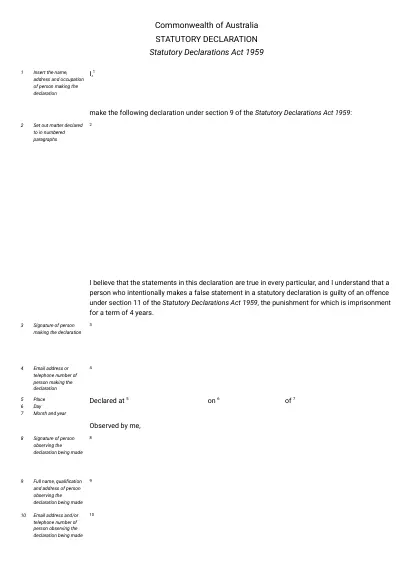
The form opens in our PDF editor with its own fields ready to type into. To download it, the filled PDF is sent to GuruPDF to prepare the file and is deleted from our servers one hour later. You can fill it in without an account; downloading the filled PDF needs a free account. A free account gets 15 credits a day, enough for one form a day.
- Country
- Australia
- Edition
- Approved form, January 2024
- Pages
- 2
- Fillable fields
- 10
- Last checked at the source
- November 13, 2026
GuruPDF is an independent PDF editor, not a government agency, and is not affiliated with any government. This page explains the form in plain words; it is not legal or tax advice. Always check the official instructions before you file.
Who uses Statutory Declaration
- Anyone asked by a Commonwealth agency, such as Home Affairs, to provide a statutory declaration
- People supporting an insurance, superannuation or employment claim
- People making a declaration under the law of the Australian Capital Territory or the smaller territories, which follow the Commonwealth requirements
- People overseas who need a Commonwealth statutory declaration witnessed
- Directors or officers making a declaration for a company (a company itself cannot make one)
Before you start
- Check that you were asked for a Commonwealth declaration: a form headed with a state or territory name may be a different, state declaration with different rules
- Your full name, address and occupation
- The facts you need to declare, ideally in the wording or order the requesting organisation asked for
- Your email address or telephone number
- An approved witness who has agreed to observe you sign, in person or by video link, unless you will make a digital declaration in myGov instead
- If you will sign electronically over video: a saved copy of the completed form to share with the witness
How to fill out Statutory Declaration
Section 1: Your name, address and occupation
After 'I,' write your full name, address and occupation. Fill in this section, section 2 and section 4 before you meet your witness.
Section 2: The matter declared
Set out the facts you are declaring in numbered paragraphs. If you need more room than the PDF allows, the Attorney-General's Department says you can use the Word (DOCX) version or the online-generated version of the form instead, or attach extra pages to a handwritten form. Each extra page or attachment must also be signed.
Section 4: Your contact details
Enter your email address or telephone number. Do not sign the form, date it or fill in the witness details until you are with your witness.
Section 3: Sign in front of the approved witness
Meet the witness in person, or connect by a video call that lets them see you sign. Sign section 3 while the witness watches, by pen or electronically, and sign every page, including any extra pages or attachments. Over video, position the camera so the witness can see you signing.
Sections 5 to 7: Where and when you declared
After signing, complete 'Declared at' (the place), 'on' (the day) and 'of' (the month and year).
Sections 8 to 10: The witness
The witness signs section 8 ('Observed by me'), gives their full name, qualification and address in section 9, and their email address and/or telephone number in section 10. They sign and date every page. They may sign the same document or a genuine copy you send them, for example by email, as long as the pages, your name and the number of paragraphs match, and they should do this during the same visit or video call.
After you fill it out
Once the witness has signed and returned the declaration to you, give or send it to the person or organisation that asked for it, following their instructions. Do not send it to the Attorney-General's Department: it does not accept, process or store statutory declarations. A Commonwealth statutory declaration does not expire, but the organisation that asked for it may have its own time limits.
Signing: You sign section 3 and every page while an approved witness watches, in person or over a video link. The Attorney-General's Department says both you and the witness may sign with a pen (wet ink) or electronically. Alternatively, a digital Commonwealth statutory declaration can be made in myGov with your Digital ID and no witness; it can only be made in English.
Watch out for
- Intentionally making a false statement in a statutory declaration is an offence under section 11 of the Statutory Declarations Act 1959, punishable by imprisonment for up to 4 years.
- The witness must be on the approved list in Schedule 1 of the Statutory Declarations Regulations 2023 at the time of witnessing, and must hold the Australian registration or position (an overseas-registered nurse, for example, does not qualify; notaries public are the exception); page 2 of the form lists them.
- You must use the approved form; you cannot make up your own Commonwealth statutory declaration form.
- To change a declaration after the witness has signed, both of you must initial every change in front of the same witness; with many changes, make a new declaration. A declaration cannot be revoked.
- State and territory statutory declarations have different requirements; this form is the Commonwealth one.
Questions about Statutory Declaration
Who can witness a Commonwealth statutory declaration?
Only an approved witness listed in Schedule 1 of the Statutory Declarations Regulations 2023, such as a Justice of the Peace, a legal practitioner, a medical practitioner, nurse, pharmacist or other listed registered professional, a police officer, a bank officer with 5 or more years of continuous service, or an Australian consular officer. The full list is printed on page 2 of the form. Justices of the Peace are a commonly accessible witness.
Can my statutory declaration be witnessed over video?
Yes. You and the approved witness can be anywhere, using any video program with sound and picture, as long as you sign at the same time and the witness sees you sign. The witness then completes their sections and returns the declaration to you.
Can I sign a statutory declaration electronically?
Yes. The Attorney-General's Department says the declarant and the witness can sign by pen or electronically, whether the witnessing is in person or by video. A digital declaration made in myGov is signed electronically and needs no witness.
Can I make a statutory declaration without a witness?
Only as a digital Commonwealth statutory declaration in myGov, which verifies you with your Digital ID. It is equally valid but can only be written in English. The paper or PDF form always needs an approved witness.
Where do I send my statutory declaration?
To the person or organisation that asked for it, in the way they tell you. The Attorney-General's Department does not process declarations, and visa-related questions go to the Department of Home Affairs.
Can I write it in a language other than English?
Only on the form made with a witness, and only if the organisation that asked for it accepts it. Ask them whether they need a translation by a NAATI-accredited translator.
Official information
- Commonwealth statutory declaration form (AGD)
- Making a statutory declaration with a witness
- Who can witness a Commonwealth statutory declaration
- Digital Commonwealth statutory declarations (myGov)
- Statutory declarations overview
Page text last reviewed November 13, 2026.
Related forms
- Form 888Supporting statement in relation to a Partner or Prospective Marriage visa applicationHome AffairsFill online
- Form 1229Consent to grant an Australian visa to a child under the age of 18 yearsHome AffairsFill online
- Form 80Personal particulars for assessment including character assessmentHome AffairsFill online