Department for Work and Pensions
Fill out Form AA1 online
Attendance Allowance for people of State Pension age or over
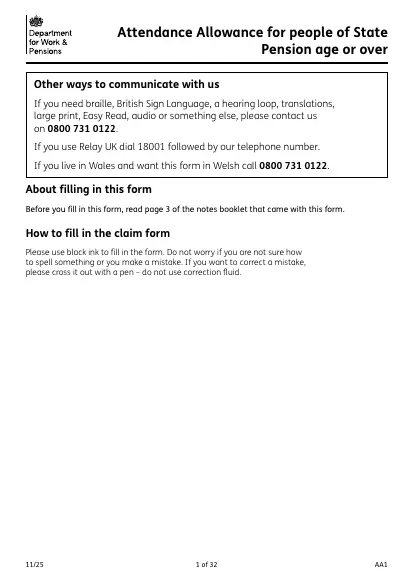
Form AA1 is the Department for Work and Pensions claim form for Attendance Allowance, a benefit for people who have reached State Pension age and have a physical or mental disability or health condition severe enough that they need help with personal care or someone to supervise them. It is not means-tested, so income and savings do not affect it, and you do not need to have a carer to claim. Most of the form asks you to describe, day and night, the help you need or the difficulty you have. There are special rules for people nearing the end of life. People living in Scotland apply for Pension Age Disability Payment instead.
The form opens in our PDF editor with its own fields ready to type into. To download it, the filled PDF is sent to GuruPDF to prepare the file and is deleted from our servers one hour later. You can fill it in without an account; downloading the filled PDF needs a free account. A free account gets 15 credits a day, enough for one form a day.
- Country
- United Kingdom
- Edition
- 11/25 (Version 7.0)
- Pages
- 32
- Fillable fields
- 428
- Last checked at the source
- November 13, 2026
GuruPDF is an independent PDF editor, not a government agency, and is not affiliated with any government. This page explains the form in plain words; it is not legal or tax advice. Always check the official instructions before you file.
Who uses Form AA1
- People of State Pension age or over who need help with things like washing, dressing, eating, getting to the toilet or taking medicines
- Older people who need someone to keep an eye on them for their own or someone else's safety, by day or at night
- People nearing the end of life claiming under the special rules
- Family members, appointees, deputies or attorneys for property and finance filling in the form for someone else
Before you start
- The claimant's National Insurance number
- Your GP's name and the address and phone number of the surgery
- A list of illnesses or disabilities and medicines with doses, or an up-to-date printed prescription list
- Details of anyone else seen about the conditions in the last 12 months (consultant, nurse, therapist, social worker) and any hospital record number
- Dates and addresses of any stays in hospital, a care home or a hospice
- Bank or building society details: account holder's name, sort code, account number and any roll or reference number
- An SR1 form from a doctor or specialist if claiming under the special rules
How to fill out Form AA1
Question 1 and About you (questions 2 to 14)
Question 1 asks whether you are claiming under the special rules for people not expected to live longer than another 12 months; if 'Yes', you skip the care questions 21 to 46 and send an SR1 form from your doctor or specialist. Questions 2 to 8 cover your name, National Insurance number, date of birth, sex, address, phone numbers and nationality. Questions 9 to 14 ask whether you normally live in Great Britain, time abroad in the last 3 years, pensions, benefits or insurance from an EEA state or Switzerland, a move from Scotland, and any claim for Pension Age Disability Payment.
Question 15: Signing the form for someone else
If you are filling in the form for someone else, they must still sign it themselves unless you are a benefit appointee, a deputy, hold a registered Power of Attorney for Property and Finance (not Health and Welfare), are claiming under the special rules, want to be appointed because the person cannot manage their own affairs, or are completing it in their absence. Tick the reason, give your own details, and send the power of attorney or appointment documents (original or certified copy) unless DWP has already seen them.
Questions 16 to 23: Illnesses, the people who treat you, consent
At question 16 list each illness or disability, how long you have had it, the medicines or treatments, and the dosage; a printed prescription list can replace the medicines detail. Questions 17 to 19 ask about professionals you have seen in the last 12 months, anyone else who helps you, and your GP. At question 20 tick whether you agree to DWP contacting these people, then sign and date it. Questions 21 to 23 ask about reports, surgery waiting lists and tests.
Questions 24 to 28: Your home, aids and when your needs started
Say what type of accommodation you live in, where the toilet is and where you sleep. Question 27 lists aids and adaptations (for example a magnifier or stairlift), whether a health professional prescribed them, how they help and any difficulty you have using them. Question 28 asks the date your care needs started; the form says you normally need to have had difficulty or needed help for 6 months, so give a rough date if you cannot remember.
Questions 29 to 41: Care needs during the day
For each activity tick the boxes that apply and say how often and for how long: getting in and out of bed (29), toilet needs (30), washing, bathing and appearance (31), dressing (32), moving around indoors (33), falls and stumbles (34), eating and drinking (35), medicines and treatment (36) and communicating (37). Question 38 asks how many days a week you need this help. Question 39 covers help to take part in hobbies, social or religious activities, and 40 and 41 whether someone needs to keep an eye on you.
Questions 42 to 46: Care needs at night
Questions 42 and 43 ask about difficulty or help needed at night, such as settling, turning, using the toilet or taking medicines, how often each night, for how many minutes and on how many nights a week. Questions 44 and 45 ask whether someone needs to be awake to watch over you and why, for example because you may wander or get confused. Question 46 is for anything else about the help you need.
Questions 47 to 65: Hospital, payment, statement and declaration
Questions 47 to 49 cover stays in hospital, a care home or a similar place and any Constant Attendance Allowance. Questions 50 to 54 are the account details for payment. Questions 55 to 62 are an optional statement from someone who knows you, such as a carer or health professional; if you are signing for the claimant, get someone else to fill it in. Use question 63 for extra information, sign and date the declaration at question 64, and list the documents you are sending at question 65.
After you fill it out
Print the form, sign the consent at question 20 and the declaration at question 64, and post it with copies of any reports, prescription list or care plan to the freepost address on DWP's form page; no stamp is needed, and DWP says to send copies because it cannot return documents. GOV.UK says a posted claim starts on the date DWP receives it, or on the date you called the helpline for a form if you return it within 6 weeks. You can also claim online. DWP will contact you, and you may be asked to attend an assessment only if it is unclear how your condition affects you.
Signing: The claimant signs and dates both the consent at question 20 and the declaration at question 64. Someone else may sign instead only in the cases listed at question 15, such as an appointee, deputy, attorney for property and finance, or a person claiming under the special rules. DWP says it cannot pay any benefit until the declaration is signed and the form returned. DWP's paper route is to print, sign and post the form.
Watch out for
- This form is for England and Wales. If you live in Scotland, apply for Pension Age Disability Payment instead; Northern Ireland has its own way to claim.
- You cannot get Attendance Allowance at the same time as Disability Living Allowance, Personal Independence Payment, Adult Disability Payment or similar benefits listed on GOV.UK.
- Sign both question 20 and question 64. DWP says it cannot pay until the declaration is signed.
- Do not use correction fluid on the printed form; cross out a mistake with a pen.
- DWP's instructions for filling in the form on screen are written for desktop PDF readers, and any automatic guidance between questions may not work here: follow the 'Go to question' instructions printed on the form.
Questions about Form AA1
Who can get Attendance Allowance?
GOV.UK says you must have reached State Pension age, have a physical or mental disability or health condition severe enough that you need help caring for yourself or someone to supervise you, and have needed that help for at least 6 months (unless claiming under the special rules). There are also residence conditions, and you cannot already get certain other disability benefits.
Does my income or savings affect it?
No. Attendance Allowance is not means-tested. GOV.UK says getting it may mean you get extra Pension Credit, Housing Benefit or Council Tax Reduction, so check with the office that pays those.
Do I need a carer to claim?
No. You do not need to have someone caring for you, and the notes say you can still get Attendance Allowance even if you are not actually getting the help you need. Describe the help you need.
What are the special rules for end of life?
If a doctor or medical professional has said you might have 12 months or less to live, answer 'Yes' at question 1 and send an SR1 form from your doctor or specialist. You skip the care questions, are paid the higher rate and do not need a face-to-face assessment. Someone else can claim for you without your permission, and letters will not mention the special rules.
Can I claim online instead?
Yes. GOV.UK offers an online claim, and a claim made online starts on the date you make it. You can also call the Attendance Allowance helpline to ask for a paper form.
Official information
- Attendance Allowance claim form (GOV.UK)
- Attendance Allowance: eligibility and how to claim
- Claiming if you're nearing the end of life
Page text last reviewed November 13, 2026.