Department for Work and Pensions
Fill out Form PC1 online
Pension Credit Application form
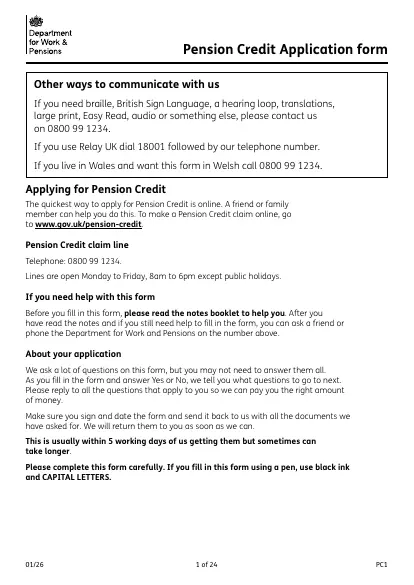
Form PC1 is the Department for Work and Pensions' paper application for Pension Credit, extra money for people who have reached State Pension age and live in England, Scotland or Wales and whose income is low. It asks about you and any partner, children you claim for, your home and housing costs, savings, benefits, pensions, work, other income and residence, and the date you want the claim to start from. You do not need to answer every question: the 'Go to question' instructions tell you which ones apply. DWP says the quickest way to apply is online, and claims can also be made by phone.
The form opens in our PDF editor with its own fields ready to type into. To download it, the filled PDF is sent to GuruPDF to prepare the file and is deleted from our servers one hour later. You can fill it in without an account; downloading the filled PDF needs a free account. A free account gets 15 credits a day, enough for one form a day.
- Country
- United Kingdom
- Edition
- 01/26
- Pages
- 24
- Fillable fields
- 418
- Last checked at the source
- November 13, 2026
GuruPDF is an independent PDF editor, not a government agency, and is not affiliated with any government. This page explains the form in plain words; it is not legal or tax advice. Always check the official instructions before you file.
Who uses Form PC1
- People who have reached State Pension age with a low weekly income
- Couples where both have reached State Pension age, or where one gets Housing Benefit for people over State Pension age
- Pensioners with housing costs such as ground rent or service charges, or who are disabled or care for someone
- Pensioners responsible for children or qualifying young people
- Friends, family members or appointees filling in the form for someone else
Before you start
- National Insurance numbers for you and your partner
- Details of all income: State Pension, private or workplace pensions (with latest payslips), earnings and other money coming in
- The total of your money, savings and investments, and details of any property or land other than your home
- Housing details: your council's name, rent or ownership, service charges, ground rent and any mortgage
- Your circumstances on the date you want the claim to start from (it can be backdated up to 3 months)
- Bank or building society details for payment
- Child Benefit and other details for any children or qualifying young people you claim for
How to fill out Form PC1
About you and your partner (questions 1 to 24)
Give your title, names (including all previous surnames), date of birth, National Insurance number, address, phone number, whether you are registered blind or severely sight impaired, and the language you want DWP to use. Question 14 asks whether you have a partner; the form defines a partner as a husband, wife or civil partner, or someone you live with as a couple. Questions 15 to 17 ask whether your partner lives permanently in a care home, whether you are separated and whether your partner agrees to the application. Then give your partner's details.
Children and qualifying young people (questions 25 to 91)
Answer only if you want to claim for children or qualifying young people; otherwise go to question 92. For each child (there is room for two, with more described under Other information) give their name, sex, date of birth, the date you want to claim for them from, who they live with, Child Benefit, education, time away, disability benefits and any past Tax Credits claim.
About where you live (questions 92 to 104)
Say whether you live permanently in a care home, who else lives in your household, and whether you pay rent, Council Tax or both, with your council's name. Questions 97 and 98 ask about claims for Housing Benefit and a Council Tax reduction. Questions 99 to 104 cover service charges, whether you rent or own, ground rent (ground annual in Scotland), the length of the lease, sharing the rent or mortgage, and any mortgage or home loan.
Money, benefits and carers (questions 105 to 118)
Give the total of your and your partner's money, savings and investments. If it is more than the amount printed at question 106, also fill in form PC1H and send it with this form. Questions 107 and 108 ask about property or land other than your home. Questions 109 to 118 ask about benefits you are waiting to hear about, whether anyone gets Carer's Allowance, Carer Support Payment or a Universal Credit carer amount for looking after you or your partner, and whether either of you spends 35 hours a week or more caring for someone.
Pensions, work and other money (questions 119 to 165)
Questions 119 to 138 cover private pension schemes you have paid into and any private, workplace or other pension you get: who pays it, the type, how much and how often, when it is received and whether it increases each year. Send your latest pension payslip. Questions 139 to 142 ask about self-employment that ended in the last 3 months and any current paid work. Questions 143 to 165 cover any other money coming in and lump sums you expect.
Other things we need to know (questions 166 to 211)
Say whether you are in hospital or staying temporarily in a care home, whether you have the right to reside in the UK, and whether you have ever come to live or returned to live in the UK from abroad. If so, give your nationality, the country you came from, the date, your immigration status and any UKVI share code, and details of any sponsorship undertaking or asylum claim. The same questions follow for your partner.
Start date, payment and declaration (questions 212 to 224)
At question 212 tick 'The qualifying age' or 'Another date' and give the date; DWP considers the application from the date you choose. For a past date, say how your circumstances have changed since then, and at question 213 explain why you think you qualify from that date. Question 214 is for any other information. Questions 215 to 220 ask how often you want to be paid (4-weekly, fortnightly or weekly) and your account details. Then sign and date the declaration; if you are signing for someone else, answer questions 221 to 224 with your own contact details and National Insurance number.
After you fill it out
Print the form, sign and date the declaration, tick the original documents you are sending (such as proof of service charges, ground rent or a private pension) and post everything in the envelope that came with the form, if you have one. Otherwise check the freepost address on GOV.UK's Pension Credit 'How to claim' page before posting: it is not the same as the address printed on this edition of the form, so if in doubt ask the Pension Credit claim line. DWP says it will return original documents to you. Include form MI12 if one came with your form and form PC1H if your savings are above the amount at question 106. DWP will write to you with its decision. GOV.UK says you can also apply online or by phone, and that a claim can be backdated by up to 3 months if you were eligible during that time.
Signing: You sign and date the declaration on page 21 to confirm the information is complete and correct. If someone else signs the form for you, they also answer questions 221 to 224 with their contact address, phone number and National Insurance number. DWP's paper route is to print, sign and post the form.
Watch out for
- Include your partner if you have one: GOV.UK says you must include your partner on the application, and your incomes are worked out together.
- If your money, savings and investments total more than the amount at question 106, fill in form PC1H as well.
- Answer the questions about your circumstances on the date you want the claim to start from, not just today.
- Report changes straight away once you get Pension Credit; wrong information or unreported changes can lead to a penalty, prosecution or repaying money.
- DWP's on-screen version was designed for desktop PDF readers and its automatic guidance may not work here: follow the 'Go to question' instructions printed on the form.
Questions about Form PC1
Who can get Pension Credit?
You must live in England, Scotland or Wales and have reached State Pension age. If you have a partner, you are eligible if you have both reached State Pension age, or one of you gets Housing Benefit for people over State Pension age. Your income is worked out and, if it is below the level GOV.UK sets, Pension Credit tops it up. You may still qualify with a higher income if you are disabled, care for someone, have savings or have housing costs.
When can I apply, and can it be backdated?
GOV.UK says you can start your application up to 4 months before you reach State Pension age, and apply any time after. A claim can be backdated by up to 3 months if you were eligible during that time. Use question 212 to say which date you want to apply from.
Is it quicker to apply online?
DWP's form says the quickest way to apply is online, and a friend or family member can help. You can use the online service if you have already applied for your State Pension. You can also apply by phone on the Pension Credit claim line.
Do savings stop me getting Pension Credit?
Not by themselves. GOV.UK says savings up to a set amount do not affect Pension Credit, and above that a small weekly income is counted from them. Give the total at question 106, and if it is over the amount printed there, also fill in form PC1H.
Does Attendance Allowance count as income?
No. GOV.UK lists Attendance Allowance, Personal Independence Payment, Disability Living Allowance, Housing Benefit, Child Benefit and some other payments as not counted as income for Pension Credit. Getting Attendance Allowance may also increase the Pension Credit you get.
Official information
Page text last reviewed November 13, 2026.