HM Land Registry
Fill out Form AP1 online
Application to change the register
Form AP1 is the application to HM Land Registry to change the register of a registered property in England and Wales. It is the covering application for most changes: registering a transfer (with form TR1), an assent, a new mortgage or the removal of a paid-off one, updating an owner's name after marriage or civil partnership, transferring a deceased owner's property to a beneficiary with an assent (form AS1), or changing an address for service. It lists the title numbers, the applications in order of priority and their fees, the documents enclosed, the applicant and the person sending it, addresses for service and identity evidence. GOV.UK notes that you will normally need to send another form or evidence with it.
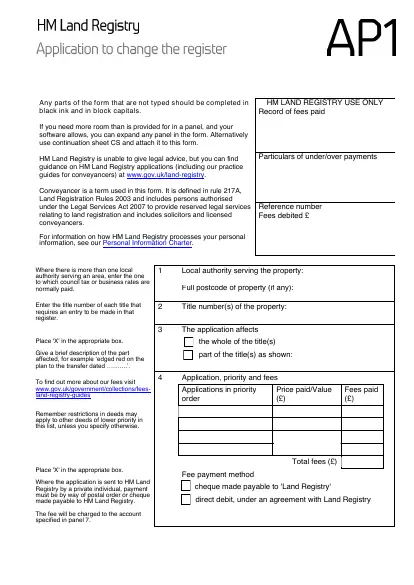
The form opens in our PDF editor with its own fields ready to type into. To download it, the filled PDF is sent to GuruPDF to prepare the file and is deleted from our servers one hour later. You can fill it in without an account; downloading the filled PDF needs a free account. A free account gets 15 credits a day, enough for one form a day.
- Country
- United Kingdom
- Edition
- 10/24
- Pages
- 7
- Fillable fields
- 112
- Last checked at the source
- November 13, 2026
GuruPDF is an independent PDF editor, not a government agency, and is not affiliated with any government. This page explains the form in plain words; it is not legal or tax advice. Always check the official instructions before you file.
Who uses Form AP1
- Buyers or people receiving a property who need a TR1 transfer or an assent registered
- Owners changing their name on the register after marriage or civil partnership
- Personal representatives transferring a deceased sole owner's property to a beneficiary with an assent (AS1)
- Owners updating their address for service, or registering the discharge of a mortgage
- Conveyancers lodging applications for clients
Before you start
- The title number(s) and the full postcode of the property
- The name of the council you pay council tax to
- The deed or evidence you are lodging, for example a TR1, an assent, a marriage certificate or a death certificate
- The price paid or, if no money changes hands, a good-faith estimate of the property's value
- The correct fee, payable by cheque or postal order made out to HM Land Registry
- Names and addresses for service of the owners to be shown on the register
- Evidence of identity for each applicant and each unrepresented party, if you are not a conveyancer
How to fill out Form AP1
Panels 1 to 3: Local authority, title numbers and extent
In panel 1 write the council you pay council tax to and the property's full postcode. In panel 2 list every title number that needs an entry. In panel 3 mark whether the application affects the whole of the title or only part of it; for a part, describe it, for example 'edged red on the plan to the transfer dated…', or attach a plan.
Panel 4: Applications, priority and fees
List each application on its own line in the order you want them dealt with, for example 'transfer', 'discharge of mortgage' or 'change of address for service', with the price paid or value and the fee for each, then the total. If no money changes hands, HM Land Registry says to enter how much the property is worth, and a good-faith valuation by anyone is accepted. A private individual pays by cheque or postal order; direct debit is only for those with an agreement with HM Land Registry.
Panels 5 and 6: Documents lodged and the applicant
List every document you are sending. HM Land Registry only needs certified copies; once scanned, documents are destroyed except 'cherished documents' such as birth, marriage and death certificates, passports and probate certificates, which are returned. In panel 6 give the full name of each person applying to change the register (the client, not the conveyancer), with company or overseas entity details if relevant.
Panels 7 and 8: Who is sending the application
Panel 7 must always be completed with the details of the person sending the application: a private individual gives their name, postal address, phone and email (a key number is for professional customers only). HM Land Registry deals only with the person named here and uses the email address where it can, and if you apply by post it acknowledges receipt only when an email address is given. Leave panel 8, third party notification, blank: HM Land Registry no longer sends those notifications.
Panels 9 to 11: Addresses for service, new charges and overriding interests
In panel 9 mark which address(es) for service should go on the register for each owner: the property address, the address in the transfer or assent, the current one in the register, or new addresses you write in (one postal address plus up to two more). Panel 10 is only for registering a new mortgage, giving the lender's name and address. Mark panel 11 and enclose form DI if the application is a registrable disposition affected by disclosable overriding interests, such as short leases or the rights of people in occupation.
Panels 12 to 15: Identity and signature
For a transfer, lease, charge, or a discharge on DS1 or release on DS3, mark in panel 12 whether you are a conveyancer (complete panel 13) or not (complete panel 14). In panel 14 list each party and their conveyancer, writing 'none' if they were not represented, and mark that evidence of identity is enclosed for each applicant and each unrepresented party. Finally, in panel 15, the conveyancer signs and dates, or, if no conveyancer is acting, each applicant signs and dates.
After you fill it out
Send the AP1 with the deed or evidence it relates to, the fee and any identity evidence to HM Land Registry; GOV.UK lists the address for applications and the current fees. There is no need for a covering letter. HM Land Registry may send requisitions (questions) to the person named in panel 7, by email where one is given. Land registration is complex and HM Land Registry cannot give legal advice; it suggests considering a conveyancer before applying without one. For a name change after marriage or civil partnership, read its specific guidance first.
Signing: Panel 15 is signed and dated by the conveyancer acting for the applicant or, if no conveyancer is acting, by the applicant (each of them if more than one). HM Land Registry's practice guide 82 accepts an applicant's simple electronic signature on a form like AP1 only when the application is made through its portal or Business Gateway, or is lodged by a conveyancer; a private applicant sending a paper application by post signs the printed form by hand. The deed sent with it, such as a TR1 or AS1, has its own signing and witnessing rules.
Watch out for
- AP1 alone rarely changes anything: send the deed or evidence it relates to, such as a TR1, an assent, a marriage certificate or a death certificate.
- If you are not a conveyancer, you must enclose evidence of identity for the applicants and for each party who was not represented.
- Send certified copies where you can: originals other than cherished documents such as certificates and passports are destroyed after scanning.
- The form warns that dishonestly giving untrue or misleading information may be fraud, and careless completion can cost you the protection of the Land Registration Act 2002.
- Most documents sent to HM Land Registry are open to public inspection; form EX1 lets you ask for prejudicial information to be made exempt.
Questions about Form AP1
What is form AP1 used for?
GOV.UK says it is used to register most transactions on a property and to change the register, including changing your name. You will normally need to submit another form or evidence with it, for example a TR1 for a transfer.
How much does it cost?
It depends on the application and, for transfers, on the price or value. HM Land Registry publishes its fees on GOV.UK and its customer support line can tell you the correct fee.
Do I need a solicitor or conveyancer?
No, a private individual can apply. The guidance on completing AP1 assumes the sender is not a conveyancer. If you apply without one, you must provide evidence of identity, and HM Land Registry recommends considering the benefits of using a conveyancer.
Do I use AP1 when an owner has died?
It depends. GOV.UK says that when a joint owner dies, you use form DJP with an official copy of the death certificate to remove their name. When a sole owner has died and the property goes to a beneficiary, you send AP1 with an assent (form AS1), the original or an official copy of the grant of probate or letters of administration, the fee, and identity verification on form ID1, which the beneficiary also completes.
Will my original documents be returned?
Only cherished documents such as birth, marriage and death certificates, passports and probate certificates. Other documents, originals and certified copies alike, are destroyed after scanning, so send certified copies.
Official information
- Change the register (AP1) (GOV.UK)
- Guidance: completing form AP1
- Guidance: change your name after marriage or civil partnership
- HM Land Registry: address for applications
- Update property records when someone dies
- Practice guide 82: electronic signatures accepted by HM Land Registry
Page text last reviewed November 13, 2026.