HM Land Registry
Fill out Form TR1 online
Transfer of whole of registered title(s)
Form TR1 is the HM Land Registry deed used to transfer the whole of the property in one or more registered titles in England and Wales, whether it is being sold, given away or moved between owners, for example adding a partner to the title. It can also transfer unregistered property that is to be registered for the first time. The deed names the title, the property, the person transferring it (the transferor) and the people receiving it (the transferee), records the price or that it is a gift, the title guarantee, and how joint owners will hold it. Once signed as a deed and witnessed, it is sent to HM Land Registry with form AP1 (or FR1 for unregistered land) so the register can be changed.
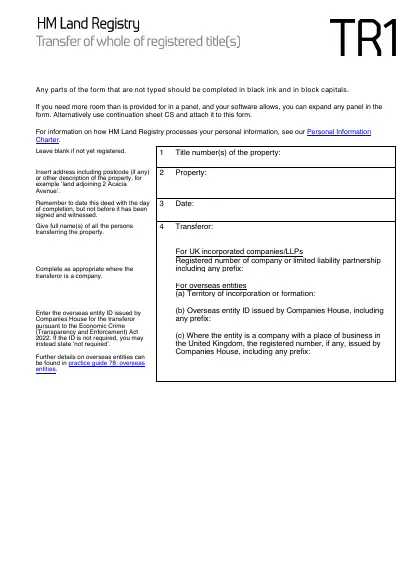
The form opens in our PDF editor with its own fields ready to type into. To download it, the filled PDF is sent to GuruPDF to prepare the file and is deleted from our servers one hour later. You can fill it in without an account; downloading the filled PDF needs a free account. A free account gets 15 credits a day, enough for one form a day.
- Country
- United Kingdom
- Edition
- 08/23
- Pages
- 4
- Fillable fields
- 28
- Last checked at the source
- November 13, 2026
GuruPDF is an independent PDF editor, not a government agency, and is not affiliated with any government. This page explains the form in plain words; it is not legal or tax advice. Always check the official instructions before you file.
Who uses Form TR1
- Sellers and buyers of a whole registered property, usually through a conveyancer
- Owners giving a property to a family member or transferring it between spouses or civil partners
- A sole owner adding someone, such as a partner, to the title (the owner is named as a transferee too)
- Executors or personal representatives transferring a property out of an estate
- Owners of unregistered land transferring it so it can be registered for the first time
Before you start
- An up-to-date copy of the register (official copy) showing the title number, property description and registered owners
- Full names of every transferor exactly as on the register, and evidence such as a marriage certificate or deed poll if a name has changed
- Full names of up to four transferees and an address for service for each (a postal address plus up to two more)
- The price paid, or confirmation that it is a gift
- The lender's consent or evidence a mortgage is being paid off, and anything else required by entries on the register
- An independent adult witness for each signature
- Form AP1, the fee and evidence of identity if you are not using a conveyancer
How to fill out Form TR1
Panels 1 to 3: Title number, property and date
Enter the title number or numbers from the official copy of the register; leave panel 1 blank if the property is not yet registered. In panel 2 give the property's address including postcode, or another description such as 'land adjoining 2 Acacia Avenue'. Leave the date in panel 3 until completion: the form says to date the deed with the day of completion, but not before it has been signed and witnessed.
Panels 4 to 6: Transferor, transferee and address for service
Panel 4 lists the full names, including middle names, of everyone transferring the property; they must match the registered owners or be someone entitled to act for them, such as an executor. Panel 5 lists everyone to be registered as the new owners (maximum four), without 'Mr' or 'Mrs'; companies and overseas entities complete the extra fields for registered numbers. Panel 6 gives each transferee's address for service: one must be a postal address, and up to two more can be postal, UK DX or email addresses.
Panels 7 and 8: Transfer and consideration
Panel 7 states that the transferor transfers the property and must not be changed. In panel 8 put an 'X' in the first box and write the price received in words and figures, or tick that the transfer is not for money or anything that has a monetary value (a gift), or describe another form of payment in the third box.
Panel 9: Title guarantee
Mark full title guarantee or limited title guarantee and add any modifications. HM Land Registry explains that with full title guarantee the transferor promises, to the best of their knowledge, that there are no charges or third-party rights other than those disclosed, while limited title guarantee only promises they have not created any themselves. It recommends advice if you are unsure.
Panel 10: Declaration of trust
Complete this if there is more than one transferee. Mark that they will hold the property as joint tenants, as tenants in common in equal shares, or on other trusts that you describe (for example unequal shares). If neither this panel nor a form JO makes clear they hold it for themselves alone as joint tenants, HM Land Registry will enter a Form A restriction on the register.
Panels 11 and 12: Additional provisions and execution
Use panel 11 for any agreed covenants, declarations or required statements. In panel 12 every transferor signs the deed in the presence of a witness, who signs and adds their name and address; if panels 10 or 11 are completed, the transferees must also sign. The witness should be independent, cannot be a party to the deed, and HM Land Registry says a spouse, civil partner or cohabitee of a party is best avoided. Practice guide 8 gives the wording for attorneys and companies.
After you fill it out
Send the signed and dated TR1 to HM Land Registry with form AP1 (or FR1 if the property is unregistered), the correct fee, any evidence required by the register (such as the lender's consent or a death certificate), evidence of identity if you are not a conveyancer, and a Stamp Duty Land Tax certificate if SDLT is payable. HM Land Registry lists where to send applications and how to pay on GOV.UK; it cannot give legal advice and suggests considering a conveyancer. If a mortgage is involved, the lender may insist that a solicitor or licensed conveyancer is used. Most documents sent to HM Land Registry, including this form, are open to public inspection.
Signing: TR1 must be executed as a deed: each transferor signs in the physical presence of a witness, who signs and adds their name and address, and the transferees sign too where panel 10 or 11 is completed. HM Land Registry's practice guide 8 says a handwritten signature ought to be in ink and that the witness must be physically present (not by video). Practice guide 82 sets out the electronic methods it accepts. For a transfer deed these are Mercury signing (still a wet-ink signature on a printed page) and conveyancer-certified electronic signatures, both of which need every party to be represented by a conveyancer; a separate route using qualified electronic signatures needs the document itself to be changed as set out in an HM Land Registry notice. A simple electronic signature, such as a typed name or a pasted image of a signature, is not accepted on a TR1. If you are acting without a conveyancer, print the completed form and sign it by hand in front of your witness.
Watch out for
- TR1 transfers the whole of a title. To transfer only part of it, use form TP1.
- Do not date the deed before it has been signed and witnessed.
- Transferors' names must match the register; otherwise send evidence of the change, such as a marriage certificate, deed poll, death certificate or grant of probate.
- One party to the transfer cannot witness another party's signature.
- The form warns that dishonestly entering untrue or misleading information may be fraud, and careless completion can cost you the protection of the Land Registration Act 2002.
Questions about Form TR1
Do I need a solicitor to use form TR1?
No. HM Land Registry says you do not have to use a solicitor or legal adviser, but the help it can give is limited and it cannot give legal advice. If a mortgage is involved, the lender may insist on a solicitor or licensed conveyancer.
Can I use TR1 to give a property away?
Yes. In panel 8 tick that the transfer is not for money or anything that has a monetary value. In panel 4 of form AP1 you then enter the property's value, which HM Land Registry says can be a good-faith estimate.
How do I add my partner to my property's title?
Name both yourself and your partner as transferees in panel 5; HM Land Registry says a sole owner cannot transfer just a share to someone else. Complete panel 10 to say how you will hold the property, and check with any lender first.
What else do I send with TR1?
Form AP1 (or FR1 for unregistered land), the fee, any evidence the register requires, evidence of identity if you are not a conveyancer, and an SDLT certificate if Stamp Duty Land Tax is payable.
Can I type the form?
Yes. HM Land Registry publishes TR1 as a fillable PDF and a Word document, and asks that any parts not typed are completed in black ink and block capitals. A panel can be expanded, or you can use continuation sheet CS. Typing the form does not change how it is signed: it is still executed as a deed in front of a witness.
Official information
- Registered title(s): whole transfer (TR1) (GOV.UK)
- Guidance: how to complete form TR1
- Practice guide 8: execution of deeds
- HM Land Registry: address for applications
- Practice guide 82: electronic signatures accepted by HM Land Registry
Page text last reviewed November 13, 2026.