HM Courts & Tribunals Service
Fill out Form C100 online
Application under section 8 of the Children Act 1989 for a child arrangements, prohibited steps, specific issue order or to vary or discharge or ask permission to make a section 8 order
Form C100 is the application to the family court in England and Wales for a 'section 8 order' under the Children Act 1989: a child arrangements order (where a child lives and who they spend time with), a prohibited steps order or a specific issue order. It is also used to vary or discharge such an order, to ask permission to apply where that is needed, and to ask the court to approve an agreed consent order. Before applying, most applicants must attend a Mediation Information and Assessment Meeting (MIAM) or claim a valid exemption. The form is shared with Cafcass or Cafcass Cymru for safeguarding checks before the first hearing.
The form opens in our PDF editor with its own fields ready to type into. To download it, the filled PDF is sent to GuruPDF to prepare the file and is deleted from our servers one hour later. You can fill it in without an account; downloading the filled PDF needs a free account. A free account gets 15 credits a day, enough for one form a day.
- Country
- United Kingdom
- Edition
- C100 (06.26)
- Pages
- 51
- Fillable fields
- 437
- Last checked at the source
- November 13, 2026
GuruPDF is an independent PDF editor, not a government agency, and is not affiliated with any government. This page explains the form in plain words; it is not legal or tax advice. Always check the official instructions before you file.
Who uses Form C100
- Separated parents who cannot agree where a child lives or how much time the child spends with each of them
- A parent who wants the court to stop the other from taking a step, such as removing a child from the country or a school
- Parents asking the court to decide a single issue, such as a child's school or a change of surname
- Grandparents and other relatives, who may first need the court's permission
- Parents who have agreed arrangements and want them made into a consent order
Before you start
- Full names, dates of birth and sex of each child, starting with the oldest
- Names, dates of birth, places of birth and addresses (with any addresses in the last 5 years) of you and each respondent
- Who has parental responsibility for each child and who the children live with now
- The authorised family mediator's details and signature in Section 4 if you attended a MIAM, or the evidence for any MIAM exemption you claim
- Case numbers and copies of any earlier or current court orders about the children
- Form C1A if you allege harm or domestic abuse, form C8 if your contact details must stay confidential, and form EX160 if you are applying for help with the fee
How to fill out Form C100
Pages 1 to 6: MIAM statements, names and the type of order
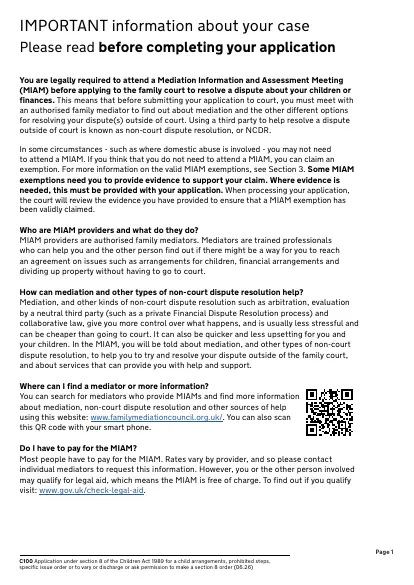
Pages 1 and 2 explain the MIAM requirement and have four statements to sign; the form says your application is not affected if you do not sign or return that page. On page 3 enter the applicants' and respondents' names, and your Help with Fees reference number if you have one. Under 'Nature of application' tick the order(s) you want and describe what you are asking for. Answer every 'Concerns about risk of harm' question; a 'Yes' to any of them means you must also fill in form C1A. Questions A1 to A8 tell you which later sections to complete.
Section 1: The child(ren)
At 1.1 list up to four children with first and last names, date of birth, sex, the orders applied for, and the applicants' and respondents' relationship to each child. Questions 1.2 to 1.6 ask whether any child is known to children's services or has a child protection plan, whether all the children have the same parents, who has parental responsibility and how, and who the children live with now. If the children's address must be kept from the respondent, leave it blank and use form C8.
Sections 2 to 4: MIAM attendance or exemption
Section 2 asks whether earlier cases were about emergency protection, care or supervision orders, whether you attended a MIAM, and whether you claim an exemption. If you attended, the authorised family mediator completes and signs Section 4. If you claim an exemption, tick the category in Section 3 (domestic abuse, child protection concerns, urgency, previous MIAM or non-court dispute resolution, or other) and the matching boxes in 3a to 3e. Use 3f for details and 3g to explain any evidence you cannot provide; domestic abuse and previous-attendance exemptions need evidence sent with the application.
Section 5: Why are you making this application?
Questions 5.1 to 5.3 deal with permission: whether you have applied for it, any order (such as a section 91(14) order or civil restraint order) that means you need it, and your reasons. At 5.4 give a brief summary of previous agreements or parenting plans and how they broke down, your reasons for applying, what you want the court to do, and the respondent's reasons. The form says not to give a full statement here. At 5.5 say whether you have a Parenting Plan and attach it if you do.
Sections 6 to 10: Urgency, other cases and attending court
Complete Section 6 only if you need an urgent or without-notice hearing, giving the orders sought, the reasons and any efforts to tell the respondent. Section 7 lists other court cases about the children, with court, case number and type of proceedings. Section 8 covers links to another country, Scotland or Northern Ireland, and Section 9 any factors affecting a person's ability to take part. Section 10 asks about Welsh, interpreters, intermediaries, disability needs and special measures such as a separate waiting room, a screen or joining by video link.
Sections 11 to 14: The people in the case
Section 11 gives each applicant's names, previous names, sex, date and place of birth, address, phone and email, and whether you have lived at the address for 5 years. Section 12 gives the same for up to two respondents, with 'Don't know' boxes where you lack the information. Section 13 names others who should be told about the application, such as someone caring for the child, and other children not part of the application. Section 14 gives your solicitor's details if you have one.
Sections 15 and 16: Checklist and statement of truth
Section 15 is a checklist of questions 15.1 to 15.9 confirming each section is complete and that any required MIAM exemption evidence is included. In Section 16 the applicant, or their legal representative, signs the statement of truth, dates it and gives their full name. Then answer whether you are paying the court fee by credit or debit card; if so, the court will contact you to take payment.
After you fill it out
GOV.UK recommends applying online to avoid delay; the online C100 service can be saved and finished later. If you cannot apply online, send the paper application to the family court for your child's area (the form says this is normally the Designated Family Centre), which you can find with the GOV.UK court finder. The form says a paper application must be sent with at least three copies, one each for the court, you and the respondent; GOV.UK asks for the original form and 3 copies. Include any C1A, C8 or EX160 forms, MIAM exemption evidence and copies of existing orders. A fee is payable unless you get help with fees; check the current amount on GOV.UK. After you apply, the court may list a first hearing and Cafcass (Cafcass Cymru in Wales) will carry out safeguarding checks and usually contact you.
Signing: Section 16, the statement of truth, is signed and dated by the applicant or the applicant's legal representative. If you attended a MIAM, Section 4 must be signed by the authorised family mediator. The MIAM statements on page 2 are optional. The form does not say whether an electronic signature is accepted on a paper application, so ask the court if you are unsure; the online service has its own declaration.
Watch out for
- Unless an exemption applies, the court cannot process the application without a MIAM. Where an exemption needs evidence, send it with the application or explain why in Section 3g.
- Answer every question or say it does not apply. The form says missing information can delay the case.
- If you answer 'Yes' to any 'Concerns about risk of harm' question, form C1A must be filed with the C100.
- To keep your or a child's address confidential, leave it blank and use form C8, and make sure no attached document reveals it.
- Use form C79 to enforce an existing order, and form C2 for an application within existing proceedings, not form C100.
Questions about Form C100
Do I have to attend mediation before applying?
You must attend a Mediation Information and Assessment Meeting (MIAM) with an authorised family mediator before applying, unless you are applying for a consent order, the child is already the subject of emergency, care or supervision proceedings or orders, or you can claim an exemption, for example for domestic abuse, child protection concerns or urgency. You do not have to go on to mediation after the MIAM, and if the other person does not attend you can still apply.
Who can apply using form C100?
Anyone with parental responsibility, such as a child's mother or father, can apply. Other relatives, such as grandparents, aunts or uncles, can also apply but may need the court's permission first; you ask for it in Section 5. Guide CB1 explains when permission is needed.
Is there a fee, and can I get help paying it?
Yes, there is a court fee for a C100 application, and GOV.UK lists the current amount. If you are on certain benefits or a low income you may get help with fees: apply with form EX160 or online and write the Help with Fees reference number on page 3 of the C100.
Can I apply online instead of using the paper form?
Yes. GOV.UK recommends the online service, which lets you save your application and come back to it. The paper C100 remains available for people who cannot apply online.
What happens after I send the application?
The court may arrange a first hearing, and a family court adviser from Cafcass or Cafcass Cymru usually attends after carrying out safeguarding checks. The judge or magistrate will try to find out what you agree on and whether the child is at risk, and will only make an order that is in the child's best interests.
Official information
- Form C100 (GOV.UK)
- Apply for a court order about child arrangements
- Making an application – children and the family courts (CB1)
- Guide for separated parents: children and the family courts (CB7)
- Find a court or tribunal
Page text last reviewed November 13, 2026.