HM Courts & Tribunals Service
Fill out Form EX160 online
Apply for help with fees
Form EX160 is the paper application for Help with Fees, the scheme that can cut or remove a court or tribunal fee in England and Wales for people with little or no savings who get certain benefits or have a low income. You give your personal details, your partner's if you have one, the court or tribunal form the fee is for, and your savings, benefits and income. You can also use it to ask for a refund of a fee paid in the last 3 months. The completed form goes to the court or tribunal with your application, not to a separate office.
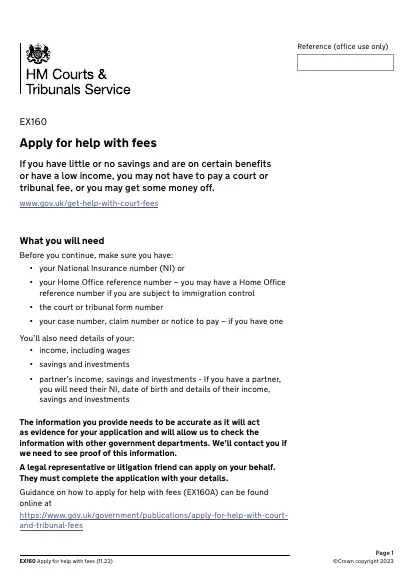
The form opens in our PDF editor with its own fields ready to type into. To download it, the filled PDF is sent to GuruPDF to prepare the file and is deleted from our servers one hour later. You can fill it in without an account; downloading the filled PDF needs a free account. A free account gets 15 credits a day, enough for one form a day.
- Country
- United Kingdom
- Edition
- EX160 (11.23)
- Pages
- 8
- Fillable fields
- 97
- Last checked at the source
- November 13, 2026
GuruPDF is an independent PDF editor, not a government agency, and is not affiliated with any government. This page explains the form in plain words; it is not legal or tax advice. Always check the official instructions before you file.
Who uses Form EX160
- People applying to a family, civil or probate court or a tribunal who cannot afford the fee
- Applicants on benefits such as income-based Jobseeker's Allowance, Income Support, Pension Credit guarantee credit or Universal Credit with low earnings
- People on a low income with little in savings, including those with children
- Anyone who paid a court or tribunal fee in the last 3 months and was eligible at the time
- Legal representatives and litigation friends applying in someone else's name
Before you start
- Your National Insurance number, or your Home Office reference number if you are subject to immigration control
- The form number of the court or tribunal application the fee is for, and any case, claim, appeal or 'notice to pay' number
- The total of your savings and investments, and your partner's if you have one
- Details of the benefits you get and your income last calendar month (or the average of the last 3 months if that is lower)
- Your partner's name, date of birth and National Insurance number, if you have a partner
- For a probate fee, the name and date of death of the person who has died
How to fill out Form EX160
Question 1: Your personal details
Enter your first and middle names, last name, address and date of birth, and an email address if you want. Give your National Insurance number, or your Home Office reference number if you have one instead. If you cannot give either, explain why in the box provided. A legal representative or litigation friend enters the applicant's details here, not their own.
Questions 2 and 3: Relationship status and your partner
Tick 'Single' or 'Married or living with someone'. The notes on the form say to choose 'Single' if you live alone, are permanently separated and not living with a new partner, or your partner has a conflicting interest in the case. If you have a partner, give their names, date of birth and National Insurance number; their savings and income are then included in later questions.
Questions 4 to 7: The fee you need help with
Question 4 asks whether you have already paid the fee; if so, give the date. For a refund the fee must have been paid in the last 3 months, and you answer questions 8 to 13 about your circumstances when you paid. Question 5 asks for the form number and name of your court or tribunal form (it is at the bottom of its first page), or a description of the fee if there is no form. Questions 6 and 7 ask for any case, claim, appeal or 'notice to pay' number, and whether it is a probate fee.
Questions 8 and 9: Savings and investments
Tick the band that matches the combined savings and investments of you and your partner, including ISAs and the value of any second home. If you tick the middle band, question 9 asks whether you or your partner are 66 or over; if not, write the exact amount. The form and guide EX160A explain how much in savings you can have, which depends on the size of the fee and your age.
Question 10: Benefits
Tick 'Yes' if you get one of the listed benefits: income-based Jobseeker's Allowance, income-related Employment and Support Allowance, Income Support, Universal Credit with earnings under the limit printed on the form, or Pension Credit guarantee credit. If you tick 'Yes', go straight to question 14; the court will check with the Department for Work and Pensions. Contribution-based JSA or ESA and Pension Credit savings credit do not count here.
Questions 11 to 13: Children and income
At question 11 say whether you have children who live with you or whom you support financially, and how many are aged 0 to 13 and 14 or older. At question 12 tick every type of income you and your partner received last calendar month, such as wages, self-employment profits, Child Benefit, maintenance, pensions, rent and gifts. Some benefits, such as Carer's Allowance, PIP and Housing Benefit, are not counted. At question 13 write the total before tax and National Insurance, and tick whether it is last month's figure or a 3-month average.
Questions 14 and 15: Declaration and representative's details
In question 14 tick the statement that applies (applicant or litigation friend, or legal representative), then sign, tick whether you are the applicant, a litigation friend or a legal representative, and date the form. A litigation friend or legal representative also fills in question 15 with their own name, address, email and, if applicable, firm and position.
After you fill it out
Send the completed form with your court or tribunal form to the court or tribunal handling your case; if the fee is already paid, send it to the court or tribunal you paid. The form says you can return it by post or email, and that it may be rejected if it arrives more than 28 days after the date you signed it. If the court needs proof of your income it will write to you; you do not need to send evidence unless asked. Each fee needs its own application. You can also apply online through the Help with Fees service, which gives you an HWF reference number to put on your court form instead.
Signing: The applicant signs and dates the declaration and statement of truth in question 14. A legal representative or litigation friend applying for someone else signs it themselves and gives their details in question 15. The form can be returned by post or email; it does not say whether a typed or electronic signature is accepted, so check with the court or tribunal if you are unsure.
Watch out for
- Send the form within 28 days of signing it, or it may be rejected and you will have to apply again.
- Each court or tribunal fee needs a separate application. An applicant and partner applying together only need one.
- If the court asks for evidence of your income, it must arrive within the time in the letter or the application is treated as abandoned.
- Giving false information can lead to criminal or civil proceedings, and the full fee becomes payable.
- Court of Protection fees use form COP44A, and Scotland and Northern Ireland have their own rules; EX160 is not for them.
Questions about Form EX160
Can I apply for Help with Fees online?
Yes. GOV.UK has an online Help with Fees service. When you finish, you get a reference number in the format HWF-XXX-XXX, which you give to the court or tribunal, for example on your application form, within 28 days.
Can I get a refund of a fee I have already paid?
Yes, if you paid the fee in the last 3 months and you were eligible for help at the time. Tick 'Yes' at question 4, give the date you paid, and answer the savings, benefits and income questions about your circumstances when you paid. Send the form to the court or tribunal you paid.
Do I have to include my partner's income and savings?
Usually yes, if you are married, in a civil partnership or living together as a couple. Guide EX160A says not to include a partner who has a conflicting interest in the case, for example the person you are divorcing, or a partner you are permanently separated from.
Do I need to send payslips or bank statements with the form?
No. EX160A says you only send evidence if the court or tribunal writes to ask for it. The information you give may be checked with other government departments, such as the Department for Work and Pensions.
What if I am refused?
You will get a letter explaining the decision. You can write to the court or tribunal by the date in the letter explaining why you disagree, with any supporting evidence. EX160A also describes applying for a fee to be reduced or waived in exceptional circumstances.
Official information
- Apply for help with court and tribunal fees: Form EX160
- Get help paying court and tribunal fees
- How to apply for help with a court or tribunal fee (EX160A)
- Find a court or tribunal
Page text last reviewed November 13, 2026.