HM Courts & Tribunals Service
Fill out Form E online
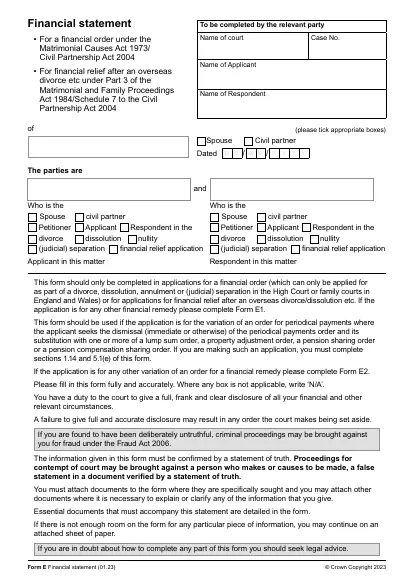
Financial statement for a financial order (Matrimonial Causes Act 1973/Civil Partnership Act 2004) / for financial relief after an overseas divorce etc (Part 3 of the Matrimonial and Family Proceedings Act 1984/Schedule 7 to the Civil Partnership Act 2004)
Form E is the financial statement that each spouse or civil partner completes when either of them has applied to the family court in England and Wales for a financial order as part of a divorce, dissolution, annulment or judicial separation, or for financial relief after an overseas divorce. It sets out your property, savings, debts, business interests, pensions and income, your future income and capital needs, and the orders you are asking for, with the documents that prove the figures attached. You must give full, frank and clear disclosure and confirm it with a statement of truth. The completed form goes to the court and a copy to the other party before the first appointment.
The form opens in our PDF editor with its own fields ready to type into. To download it, the filled PDF is sent to GuruPDF to prepare the file and is deleted from our servers one hour later. You can fill it in without an account; downloading the filled PDF needs a free account. A free account gets 15 credits a day, enough for one form a day.
- Country
- United Kingdom
- Edition
- Form E (01.23)
- Pages
- 30
- Fillable fields
- 457
- Last checked at the source
- November 13, 2026
GuruPDF is an independent PDF editor, not a government agency, and is not affiliated with any government. This page explains the form in plain words; it is not legal or tax advice. Always check the official instructions before you file.
Who uses Form E
- Both spouses or civil partners once either has applied for a financial order (usually with Form A)
- Parties applying for financial relief in England and Wales after an overseas divorce or dissolution
- A party asking to replace periodical payments with a lump sum, property adjustment or pension sharing order (a 'capitalisation' application)
- Solicitors preparing a client's disclosure in financial remedy proceedings
Before you start
- The court name and case number, and the date of the first appointment from the court's notice (Form C)
- Dates of the marriage or civil partnership, separation, and each divorce or dissolution stage
- Property valuations from the last 6 months (or your own realistic estimate), Land Registry title numbers and recent mortgage statements
- Statements covering the last 12 months for every bank, building society and National Savings account you have held in that time
- Latest statements for investments, surrender values of life policies, and details of debts, credit and store cards
- Business accounts for the last two years, pension cash equivalent (CE) valuations, your National Insurance number
- Your P60, last three payslips and any P11D, or, if self-employed, your last tax assessment (or an accountant's letter confirming your tax liability)
- A realistic monthly or yearly budget for yourself and any children living with you
How to fill out Form E
Cover page and Section 1: General information
On the cover enter the court, case number, the applicant's and respondent's names, and tick whether the parties are spouses or civil partners and each party's role. In Section 1 give your full name, date of birth, occupation, the dates of the marriage or civil partnership and separation, and the dates of the petition or application, decree nisi or conditional order and decree absolute or final order where known. Questions 1.7 to 1.16 cover any new partner, the children of the family and their health and education, child maintenance arrangements, the order to be varied (if any), other court cases between you, and who lives in your present home and on what terms.
Section 2, Parts 1 to 5: your capital
Part 1 covers the family home (2.1) and any other property (2.2), with value, mortgages, costs of sale and equity, then bank accounts held in the last 12 months (2.3), investments (2.4), life policies (2.5), money owed to you (2.6), cash over £500 (2.7) and belongings worth more than £500 such as cars and jewellery (2.8). Part 2 lists your liabilities and any Capital Gains Tax that would be due (2.9 to 2.10). Part 3 covers business interests and directorships (2.11 to 2.12), Part 4 every pension and PPF compensation entitlement except the basic State Pension, one page each (2.13), and Part 5 any other assets (2.14). Each part ends with a lettered total (A to G) and lists the documents to attach.
Section 2, Parts 6 to 10 and the summaries
Give your income: employment, one page per job (2.15), self-employment or partnership (2.16), investments (2.17), state benefits (2.18) and any other income (2.19), each with an estimate for the next 12 months (totals H to L). Sections 2.20 and 2.21 summarise your capital and income by copying the lettered totals from earlier pages; check every total yourself before you sign.
Section 3: Financial requirements
At 3.1 list your income needs and those of any children living with you or provided for by you, item by item (weekly, monthly or yearly, but consistently). At 3.2 set out reasonable future capital needs, such as a new home or car, for yourself and the children. The guidance notes say to continue on a separate, clearly numbered sheet if you run out of space.
Section 4: Other information
Describe significant changes in your assets or income in the last 12 months and expected in the next 12 months (4.1), the standard of living during the marriage or civil partnership (4.2), particular contributions to the family, which can include looking after the home and family (4.3), and any conduct you think should be taken into account (4.4), which the form says counts only in very exceptional circumstances. At 4.5 add other relevant circumstances, such as earning capacity, disability, inheritance prospects or a pre- or post-nuptial agreement, and at 4.6 what you know of a new partner's income and assets.
Section 5: Order sought
If you can at this stage, say what orders you are asking for: whether the family home should be transferred or sold, whether you see the case as one for continuing maintenance or a 'clean break', whether you seek a pension sharing, pension attachment or pension compensation order, and which property or assets you want transferred. Questions 5.2 and 5.3 cover variation of a nuptial settlement and an avoidance of disposition order. The guidance notes suggest you may want legal advice on this section.
Statement of truth and schedule of documents
Delete as appropriate, then print your full name, give your address for service and any solicitor's firm, sign and date the statement confirming the information is a full, frank, clear and accurate disclosure. Finally complete the schedule of documents, ticking each document attached (valuations, statements, accounts, pension valuations, P60, payslips and so on) and describing any others. Attach copies, not originals.
After you fill it out
The guidance notes say you must send your completed Form E to the court and a copy to the other party no later than 35 days before the first appointment; the court gives that date in its notice of a first appointment (Form C), and it may order costs against a party who misses the deadline. The GOV.UK form page says to send the completed form and all supporting documents by post to HMCTS Financial Remedy and gives the address. If you and your spouse or civil partner have agreed the financial arrangements, the notes say neither of you needs to complete Form E; the agreement goes to the court as a consent application instead. After the first appointment there is usually a financial dispute resolution (FDR) appointment, and a final hearing if you cannot agree.
Signing: The statement of truth is signed and dated by the applicant or respondent, a litigation friend or the party's solicitor, with the position held if signing for a firm or company. The form does not say whether an electronic signature is accepted.
Watch out for
- You have a duty to the court to give full, frank and clear disclosure. The form warns that a failure to do so may lead to any order being set aside, and deliberately untruthful statements may lead to criminal proceedings for fraud.
- Write 'N/A' in any box that does not apply rather than leaving it blank.
- Use the right form: Form E1 for other financial remedy applications and Form E2 for other applications to vary a financial order.
- Pension valuations must not be more than a year old at the date of the first appointment; if one is not available, attach a copy of your letter asking the scheme for it.
- Send copies of documents, not originals, and keep the originals available for inspection.
Questions about Form E
Do both of us have to fill in Form E?
Yes. The guidance notes say you and your spouse or civil partner must each fill out a separate Form E if either of you applies for a financial order or financial relief.
When is Form E due?
No later than 35 days before the first appointment, to both the court and the other party. The court sends the first appointment date on Form C (notice of a first appointment).
Do we need Form E if we have already agreed?
No. The notes say that if you have agreed the financial matters, neither of you needs to complete a Form E; you give your agreement (a consent application) to the court instead.
What documents must I attach?
The schedule at the end of the form lists them, including property valuations and mortgage statements, 12 months of bank statements, investment and policy statements, two years of business accounts, pension valuations, your P60, last three payslips and any P11D, or, if self-employed, your last tax assessment or an accountant's letter confirming your tax liability.
Can I type my answers?
Yes. HMCTS publishes Form E as a fillable PDF, along with a large-print and a Welsh version. If a box is too small, the form allows you to continue on an attached sheet.
Official information
- Form E: financial statement (GOV.UK)
- Notes to Form E
- Money and property when you divorce or separate: get the court to decide
Page text last reviewed November 13, 2026.