HM Revenue & Customs
Fill out Form IHT400 online
Inheritance Tax account
Form IHT400 is the Inheritance Tax account that executors and administrators send to HMRC when someone has died and there is Inheritance Tax to pay, or when there is no tax but the estate does not qualify as an 'excepted estate'. It records the deceased's details, the will, every asset and debt, gifts, exemptions and reliefs, and works out the tax, supported by separate schedules (IHT401 to IHT437) for things like property, bank accounts, pensions and gifts. It must be sent within 12 months of the death and before you apply for probate or confirmation. This edition (HMRC 04/26) asks about long-term UK residence for deaths after 5 April 2025 and about the 100% relief allowance for agricultural and business property.
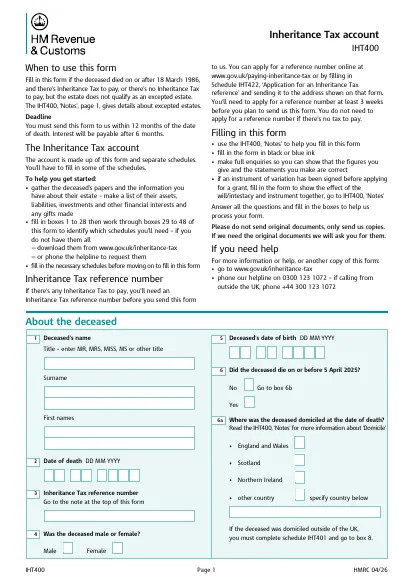
The form opens in our PDF editor with its own fields ready to type into. To download it, the filled PDF is sent to GuruPDF to prepare the file and is deleted from our servers one hour later. You can fill it in without an account; downloading the filled PDF needs a free account. A free account gets 15 credits a day, enough for one form a day.
- Country
- United Kingdom
- Edition
- HMRC 04/26
- Pages
- 19
- Fillable fields
- 563
- Last checked at the source
- November 13, 2026
GuruPDF is an independent PDF editor, not a government agency, and is not affiliated with any government. This page explains the form in plain words; it is not legal or tax advice. Always check the official instructions before you file.
Who uses Form IHT400
- Executors and administrators of an estate on which Inheritance Tax is due
- Personal representatives of an estate that is not an excepted estate, for example because of large gifts, trusts, foreign assets or an estate worth more than £3 million
- Solicitors and other agents dealing with an estate in a professional capacity
- Trustees who want to pay tax on trust assets at the same time as the grant is applied for
Before you start
- The deceased's papers: a list of their assets, debts, investments, pensions, insurance policies and any gifts made
- Values at the date of death, including professional valuations of property and valuable items where needed
- The deceased's National Insurance number, UTR (if known), date of birth, nationality and last permanent address
- A copy of the will and codicils (not the originals) and any instrument of variation
- An Inheritance Tax reference number if tax is due, applied for at least 3 weeks before you send the form (online or with IHT422)
- Details of the deceased's spouse or civil partner who died first, if you are transferring an unused nil rate band or residence nil rate band
- The schedules you need, downloaded from GOV.UK
How to fill out Form IHT400
Boxes 1 to 15: About the deceased
Enter the deceased's name, date of death, Inheritance Tax reference (if tax is due), sex and date of birth. Box 6 asks whether they died on or before 5 April 2025: if so, give their domicile at 6a; if not, say at 6b whether they were a long-term UK resident, with schedule IHT401 or IHT401a where the form directs. Box 7 is for Scottish domiciles (legitim). Boxes 8 to 15 cover marital status and the date of any marriage or civil partnership, who survived them, their last permanent address and whether they owned it, occupation, nationality, National Insurance number and UTR.
Boxes 16 to 28: Contact details and the will
Say whether anyone acted under a power of attorney (enclose a copy), give the name, address, phone and reference of the person or firm dealing with the estate, and the bank account HMRC should repay any overpaid tax to. Boxes 24 to 28 ask whether there is a will, what happened to the home named in it, and whether every asset specifically mentioned in the will is included; list any that are not, and show gifts on IHT403.
Boxes 29 to 48: Which schedules you need
Answer each Yes/No question to find the schedules you must fill in: residence nil rate band (IHT435, IHT436), transferable nil rate band (IHT402), the unused 100% relief allowance for agricultural or business property (IHT437), gifts (IHT403), joint assets (IHT404), houses and land (IHT405), bank accounts (IHT406), household goods (IHT407), pensions (IHT409), life assurance (IHT410), shares (IHT411, IHT412), business and agricultural relief (IHT413, IHT414), foreign assets (IHT417), trusts (IHT418), debts (IHT419) and others. Fill in the schedules, except IHT435 and IHT436, before going on; boxes 48a to 48c ask about successive charges relief, double taxation relief and domicile.
Boxes 49 to 96: Estate in the UK, debts and exemptions
Copy the figures from your schedules into boxes 49 to 79: column A for assets where tax cannot be paid by instalments and column B for those where it can, such as houses, land and some shares. Boxes 80 to 91 deduct mortgages, funeral expenses and other liabilities, and boxes 92 to 96 deduct exemptions and reliefs (for example spouse, civil partner or charity exemption) on assets in the deceased's sole name. Foreign assets go on IHT417, not in these boxes.
Boxes 97 to 120: Other assets and working out the tax
Add foreign assets, trust assets, nominated assets and gifts with reservation (boxes 97 to 107) to reach the total chargeable estate at box 108. If you are filling in the form yourself without a solicitor or other adviser, the form lets you tick a box asking HMRC to work out the tax for you; if there is no tax to pay, go straight to box 121. Box 109 asks about the reduced 36% rate (IHT430) and box 110 whether you will pay tax on column B assets by instalments. If the simple calculation applies, work through boxes 111 to 119 (residence nil rate band, gifts in the 7 years before death, nil rate band and transferable nil rate band, then 40%); otherwise use the IHT400 Calculation or IHT430. Box 120 asks whether you will use the Direct Payment Scheme (IHT423) to pay from the deceased's bank accounts.
Boxes 121 and 122, declaration and signatures
Tick the type of grant (probate, confirmation, letters of administration, with will annexed or other) and where you are applying (England and Wales, Scotland or Northern Ireland), list any provisional values, and tick every schedule you filled in. Read the declaration on pages 15 and 16; each person delivering the account gives their name, date of birth, National Insurance number or UTR, phone and address, and signs and dates page 16. Page 17 lets you ask for the acknowledgement and probate code by email, and the checklist on page 18 lists what to enclose.
After you fill it out
Send the form, the schedules and copies (not originals) of the will, codicils and supporting documents to HMRC at the address on the form. Tax must be paid by the end of the sixth month after the death to avoid interest, and you will normally need to start paying before the grant is issued. HMRC will send a unique code, usually within 20 working days, which you need to apply for probate in England and Wales or confirmation in Scotland; for Northern Ireland, send IHT421 with the IHT400 and HMRC returns it. HMRC looks at the account in detail after the grant, may ask further questions, and will write with its calculations. If values change later, use a corrective account.
Signing: Each person delivering the account, whether executor, intending administrator or otherwise, signs and dates page 16, and HMRC's checklist asks whether all executors have signed. The form does not say whether an electronic signature is accepted; HMRC's own version is an interactive form designed to be completed on screen and then printed.
Watch out for
- The form must reach HMRC within 12 months of the death, and interest is charged on unpaid tax after 6 months; HMRC can also charge penalties for a late or inaccurate account.
- If tax is due, apply for an Inheritance Tax reference number at least 3 weeks before you send the form.
- HMRC's version calculates some totals in Adobe Reader. Here the fields can be typed in and printed, but totals may not calculate automatically, so work out and check every total box yourself.
- Do not send original documents; HMRC asks for copies and will ask for originals if needed.
- Joint assets, foreign assets and exemptions on jointly owned assets go on their own schedules (IHT404, IHT417), not in the main boxes.
Questions about Form IHT400
Do I need to fill in IHT400?
Only if there is Inheritance Tax to pay or the estate does not count as an excepted estate. HMRC says most estates are excepted; its online Inheritance Tax checker helps you work out which applies, and GOV.UK lists when full details are needed even if no tax is due.
What is the deadline?
You must send IHT400 within 12 months of the date of death and before applying for probate. To avoid interest, Inheritance Tax must be paid by the end of the sixth month after the death.
When can I apply for probate?
After HMRC sends you a unique code, usually within 20 working days of receiving your IHT400 or your payment, whichever is later. You enter that code on your probate application (for example form PA1P).
Can I pay the tax in instalments?
On some assets, such as houses, land and certain shares (the column B assets), you can choose at box 110 to pay in 10 yearly instalments. Interest is charged on instalments.
Which notes should I use?
HMRC publishes 'Guide to completing your Inheritance Tax account' (IHT400 notes), the IHT400 Calculation, the rates and tables, and notes for each schedule on the IHT400 page on GOV.UK.
Official information
- Inheritance Tax account (IHT400) (GOV.UK)
- Guide to completing your Inheritance Tax account (IHT400 notes)
- Value the estate and report it to HMRC
- Inheritance Tax
Page text last reviewed November 13, 2026.