HM Courts & Tribunals Service
Fill out Form PA1P online
Probate application - with a will
Form PA1P is the paper application to HMCTS Probate for a grant of representation in England and Wales when the person who died left a will. Executors named in the will use it to apply for a grant of probate, and a beneficiary can use it when no executor is applying (letters of administration with will annexed). It asks about up to four applicants, the person who died, the will and any codicils, their relatives, any attorney or foreign domicile, and the Inheritance Tax forms or values you have reported to HMRC, and ends with a legal statement every applicant signs. This is the version for people applying without a probate practitioner; solicitors use a separate practitioner version. GOV.UK says it is faster to apply online if you can.
The form opens in our PDF editor with its own fields ready to type into. To download it, the filled PDF is sent to GuruPDF to prepare the file and is deleted from our servers one hour later. You can fill it in without an account; downloading the filled PDF needs a free account. A free account gets 15 credits a day, enough for one form a day.
- Country
- United Kingdom
- Edition
- PA1P (01.24), citizen applicants
- Pages
- 28
- Fillable fields
- 331
- Last checked at the source
- November 13, 2026
GuruPDF is an independent PDF editor, not a government agency, and is not affiliated with any government. This page explains the form in plain words; it is not legal or tax advice. Always check the official instructions before you file.
Who uses Form PA1P
- Executors named in the will who are applying without a solicitor or other probate practitioner
- Beneficiaries named in the will where none of the executors is applying or able to apply
- Applicants who cannot or prefer not to use the online probate service
- Attorneys applying on behalf of an executor or beneficiary (who also complete Section 5)
Before you start
- The original will and any codicils made since it (not copies), plus copies of any foreign wills
- An official copy of the death certificate or a coroner's interim certificate
- The estimated value of the estate, already reported to HMRC as required, and any HMRC letter with your unique probate code
- If you filed form IHT400, the figures from IHT421, or the IHT207 or IHT205 figures if those forms apply
- Full names as shown on each applicant's passport or driving licence, with addresses and email
- The deceased's full name, last permanent address, dates of birth and death, marital status and any other names they held assets in
- The number of surviving children and of children who died before them, and the names of any executors who are not applying and why
- A cheque payable to 'HMCTS' for the application fee and any official copies of the grant
How to fill out Form PA1P
Checklist and fees (page 1)
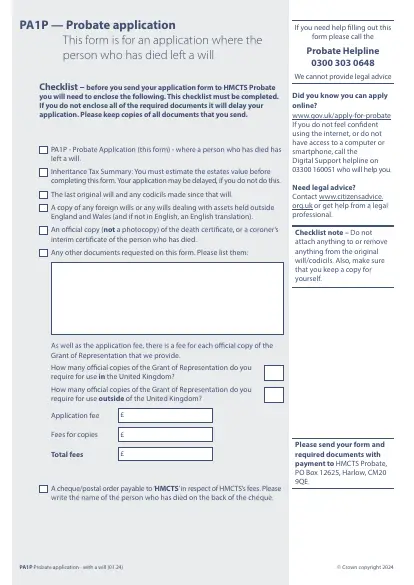
Tick each document you are enclosing: this form, the original will and codicils, copies of any foreign wills, the official death certificate and any other documents requested. Enter how many official copies of the grant you need for use in and outside the United Kingdom, and the application fee, fees for copies and total. The checklist must be completed, and you should keep copies of everything you send.
Section A: About the applicants (questions 1.1 to 1.18)
Give the title and full names of each applicant, up to four, exactly as on their formal ID; all must be over 18, only list people who want to be named on the grant, and each of them will have to sign. Say whether each name is different in the will or codicil and give that version if so. Add each applicant's address and email, and phone numbers for the first applicant, who receives all correspondence and the grant.
Section B, part 2: About the person who has died
Enter their forenames and surname as on the death certificate, permanent address, and dates of birth and death. Questions 2.6 and 2.7 ask for any other names in which they held assets. Question 2.8 asks whether they lived permanently in England and Wales (domicile), 2.9 and 2.10 their marital status with dates and the court for any divorce or separation, 2.11 the value of any foreign assets, 2.12 settled land, and 2.13 to 2.14 legally adopted relatives, which you answer only if no executor is applying.
Part 3: The will and any codicils
Give the date of the will and the dates of any codicils you are submitting (3.1 and 3.2), and say whether there were wills made outside England and Wales and whether the person married or formed a civil partnership after the will. Question 3.5 asks, only if no executor is applying, whether anyone under 18 receives a gift. At 3.6 name every executor who is not applying with reason A to F (died before, died after, power reserved, renunciation, power of attorney, lacks capacity), then confirm written notice to executors with power reserved (3.7), whether the will was separated for photocopying (3.8) and that the pages submitted are the whole will (3.9).
Parts 4 to 6: Relatives, attorneys and foreign domicile
Part 4 asks whether a spouse or civil partner survived, how many sons and daughters survived or died before them (and those children's surviving children), and each applicant's relationship to the person who died. Complete Part 5 only if you are applying as an attorney for someone, including details of any Enduring or Lasting Power of Attorney or Court of Protection deputy. Complete Part 6 only if you answered No at 2.8, giving the country of domicile, the estate in England and Wales and any entrusting document or succession certificate.
Parts 7 and 8: Inheritance Tax
Part 7 is for deaths on or after 1 January 2022, and Part 8 for earlier deaths. Say which HMRC form you completed, if any (the online IHT checker is not a form), and copy the figures it asks for: the gross, net and net qualifying values for an excepted estate (with whether you are claiming a late spouse's unused nil rate band) and the gross and net values for probate, the probate code and values from HMRC's letter after an IHT400, or the box figures from IHT421, IHT207 or IHT205. The notes say that after sending IHT400 and IHT421 to HMRC you wait 20 working days before submitting this application.
Section 9: Legal statement and signatures
Read the legal statement, which confirms the will is the last will, that you will collect the estate, keep an inventory and account for its distribution, and that you understand the consequences of untruthful evidence. Every applicant named in Section A prints their name, signs and dates it. The questionnaire after the form is about equality; you can answer 'prefer not to say' or leave its questions blank.
After you fill it out
Print the form, have every applicant sign and date it, and post the original with the original will and codicils, the official death certificate, any other documents asked for and a cheque for the fees to HMCTS Probate; the address is on the form and on GOV.UK. Probate practitioners use a different address and form. Before you apply you must have valued the estate, reported it to HMRC as required and started paying any Inheritance Tax due. The original will becomes a public document once the grant is issued and is not returned. GOV.UK says paper applications take longer than online ones; check the current fee and progress guidance on GOV.UK.
Signing: GOV.UK's instructions are to print the form and sign and date it. Every applicant named in Section A must sign the legal statement in Section 9. Executors renouncing or reserving power, or acting by attorney, may need to sign further forms such as PA15 or PA11 that HMCTS sends.
Watch out for
- Send the original will and codicils, not copies, and do not attach anything to or remove anything from them. Keep a copy for yourself.
- You must estimate the estate's value and report it to HMRC before completing this form, or the application may be delayed.
- Applicants' names must match their formal ID, such as a passport or driving licence.
- A photocopy of the will is not accepted. If the original will is lost, GOV.UK says you may be able to apply for probate with form PA13.
- The legal statement warns that criminal proceedings for fraud may be brought if the evidence given is deliberately untruthful or dishonest.
Questions about Form PA1P
Who can apply with form PA1P?
An executor named in the will, or a beneficiary named in the will if no executor is applying or able to apply. Up to four people can apply, all aged over 18. If the person did not leave a will, use form PA1A instead.
Should I apply online or by post?
You can do either. GOV.UK says it takes longer to process paper applications and recommends applying online if you can. If you apply online, you do not need to send a paper form. When more than one person applies online, every applicant must have internet access, because each one signs the legal declaration online.
Do I need to deal with Inheritance Tax first?
Yes. You must value the estate first. If it is not an excepted estate, you report it to HMRC on form IHT400, start paying any tax due, and wait for HMRC's letter with a unique probate code before applying.
How do I pay the fee?
GOV.UK says to send a cheque payable to 'HM Courts and Tribunals Service' with your documents; the form asks you to write the name of the person who died on the back. There is also a fee for each official copy of the grant. Check the current amounts on GOV.UK.
Will I get the will back?
No. GOV.UK says the original will becomes a public document once the grant is issued and HMCTS must keep it in the public records.
Official information
- Form PA1P: apply for probate by post if there is a will (GOV.UK)
- How to apply for probate by post if there is a will
- Applying for probate
- Value the estate and report it to HMRC
Page text last reviewed November 13, 2026.