U.S. Citizenship and Immigration Services
Fill out Form I-360 online
Petition for Amerasian, Widow(er), or Special Immigrant
Form I-360 is the USCIS petition used to classify a person as an Amerasian, the widow(er) of a U.S. citizen, a VAWA self-petitioner (an abused spouse, child or parent), or one of several kinds of special immigrant, such as a special immigrant juvenile, a religious worker, certain Afghan and Iraqi nationals, or a broadcaster. Some people file it for themselves; in other categories an employer, organization or relative files it for the beneficiary. Approval gives the classification; the person then applies separately for a Green Card where eligible.
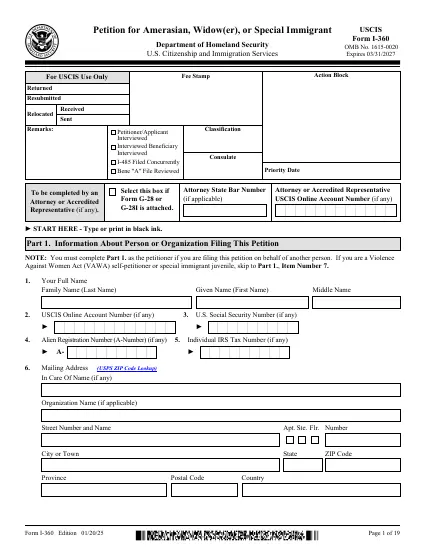
The form opens in our PDF editor with its own fields ready to type into. To download it, the filled PDF is sent to GuruPDF to prepare the file and is deleted from our servers one hour later. You can fill it in without an account; downloading the filled PDF needs a free account. A free account gets 15 credits a day, enough for one form a day.
- Country
- United States
- Edition
- Edition 01/20/25
- Pages
- 19
- Fillable fields
- 510
- Last checked at the source
- November 13, 2026
GuruPDF is an independent PDF editor, not a government agency, and is not affiliated with any government. This page explains the form in plain words; it is not legal or tax advice. Always check the official instructions before you file.
Who uses Form I-360
- Widow(er)s of U.S. citizens, who must file within two years of the spouse's death
- VAWA self-petitioners: abused spouses or children of U.S. citizens or lawful permanent residents, and abused parents of U.S. citizen sons or daughters aged 21 or older
- Special immigrant juveniles (unmarried and in the United States), who must file before their 21st birthday
- Religious workers, who may file for themselves, or the U.S. religious organizations that will employ them; the prospective employer's attestation is needed either way
- Afghan and Iraqi nationals who worked for or on behalf of the U.S. government, Amerasians, broadcasters and other special immigrant categories listed on the form
Before you start
- The classification you are requesting, chosen from the list in Part 2
- The beneficiary's name, date and country of birth, A-Number, Social Security number, and last arrival, I-94, passport and status details if in the United States
- Names, dates of birth and A-Numbers of the beneficiary's spouse and children
- Category details: the deceased spouse's information and date of death, the abuser's information and the dates you lived together, the juvenile court order, or the religious employer's attestation
- The U.S. Consulate where the beneficiary would apply for an immigrant visa if they will not adjust status in the United States
- An alternate or safe mailing address if you are a VAWA self-petitioner or special immigrant juvenile and do not want notices sent home
How to fill out Form I-360
Part 1. Information About Person or Organization Filing This Petition
Complete Part 1 as the petitioner if you file for another person: name, USCIS Online Account Number, Social Security number, A-Number, IRS tax number and mailing address (Items 1-6). USCIS says a self-petitioner skips Part 1 and gives their own details in Part 3. A VAWA self-petitioner or special immigrant juvenile goes straight to Item 7, where you may give an alternate or safe mailing address so USCIS does not send notices to your home; you must then also complete Part 3.
Part 2. Classification Requested
Select only one box, from A (Amerasian) to P (Other, with the name of the classification). B is a widow(er) of a U.S. citizen, C a special immigrant juvenile, D a religious worker (answer whether the beneficiary will work as a minister), and I, J and K the VAWA self-petitioning spouse, child and parent. The other boxes cover the Panama Canal, physicians, G-4 and NATO-6 employees, armed forces members, Afghan and Iraqi nationals, and broadcasters.
Parts 3 and 4. The beneficiary and processing information
Part 3 is the person the petition is for: name, mailing address, date and country of birth, Social Security and A-Numbers, marital status and, if in the United States, last arrival, I-94, passport and current status. In Part 4, name the U.S. Consulate if the person will apply for a visa abroad, give a foreign address (in the native alphabet if it does not use Roman letters), and answer whether other petitions are filed with this one, whether the beneficiary is in removal proceedings or has worked without permission, and whether an adjustment application is attached.
Part 5. Spouse and Children
List the beneficiary's spouse and children with their names, dates and countries of birth, relationship and A-Numbers. A self-petitioning spouse also answers whether any of the children filed separate self-petitions.
Parts 6 to 10. The section for your classification
Complete only the part that matches Part 2. Part 6 is for an Amerasian (information about the mother and father). Part 7 is for a widow(er): the deceased U.S. citizen spouse's details, date of death and how they were a citizen. Part 8 is for a special immigrant juvenile and the juvenile court's declaration or custody placement. Part 9 is the prospective employer's attestation for a religious worker, completed by the employer even when the worker files for themselves and signed in ink by an authorized official and, where applicable, by the religious denomination's representative. Part 10 is for a VAWA self-petitioner: the abuser's details, marriages, when and where you lived together, and whether you request an Employment Authorization Document.
Parts 11 and 12. Statement and signature
An individual filing for themselves completes Part 11; someone filing for another person or as an authorized signatory of an organization completes Part 12. In either, select whether you read the form in English or through an interpreter, note any preparer, give your contact details and sign and date.
Parts 13 to 15. Interpreter, preparer and additional information
An interpreter completes and signs Part 13, and a preparer Part 14. Use Part 15 for any answer that does not fit and for the explanations the form asks for, with the page, part and item number of each.
After you fill it out
Where you mail Form I-360 depends on the classification, where you live and whether you file Form I-485 at the same time; USCIS lists the addresses on its Direct Filing Addresses for Form I-360 page, and the fees, which vary by category, are on the USCIS Fee Schedule (Form G-1055). USCIS's Forms Available to File Online page currently lists online filing (by uploading a completed PDF through a USCIS online account) only for VAWA self-petitioners and their attorneys or accredited representatives. USCIS then sends a receipt notice and may ask for biometrics or more evidence. Before you file, check on the USCIS Form I-360 page that this edition is still accepted.
Signing: The petitioner signs Part 11 or Part 12 by hand, and in a religious worker petition the employer's official and the denomination's representative sign Part 9 in ink. USCIS rejects an unsigned petition and does not accept a stamped or typewritten name. A photocopy, fax or scan of the original hand-signed petition is accepted. Interpreters and preparers sign Parts 13 and 14.
Watch out for
- Select only one classification in Part 2, and complete only the matching part among Parts 6 to 10.
- A widow(er) must file no later than two years after the U.S. citizen spouse's death, and eligibility ends on remarriage before immigrating. If the spouse had already filed Form I-130, USCIS converts it, so a new I-360 is not needed.
- A special immigrant juvenile must file before turning 21. USCIS describes an in-person filing appointment for the two weeks before the 21st birthday.
- A religious worker petition must include the prospective employer's attestation in Part 9, and the denomination certification where applicable.
- If you mail the form, all pages must be from the same edition with the edition date and page numbers visible.
Questions about Form I-360
Can I file a VAWA self-petition without my abuser knowing?
Yes. USCIS says you may self-petition under VAWA without your abusive family member's knowledge or consent, and Part 1, Item 7 lets you give a safe or alternate mailing address for notices.
Does an approved I-360 give me a Green Card?
No. It gives the special immigrant, widow(er), Amerasian or VAWA classification. If you meet the other requirements, you then apply for permanent residence, for example on Form I-485 in the United States or through a visa abroad.
Do Afghan SIV applicants still file Form I-360?
It depends on when they started. USCIS says those who received Chief of Mission approval on or before July 20, 2022 still file Form I-360 with USCIS, while those who start the SIV process on or after that date seek the classification with the Department of State (Form DS-157) instead. For people in the United States whose Chief of Mission request was pending on July 20, 2022, the USCIS Form I-360 page has a chart showing which form to file.
Can I file Form I-360 online?
Only in some cases. USCIS's Forms Available to File Online page currently lists Form I-360 for VAWA self-petitioners (or their attorney or accredited representative), who upload a completed PDF through a USCIS online account. Other categories file by mail at the address on the Direct Filing Addresses for Form I-360 page.
Can a VAWA self-petitioner get a work permit?
Part 10, Item 12 lets a self-petitioner who lives in the United States request an Employment Authorization Document. The instructions say that if the self-petition is approved, USCIS issues it in category (c)(31).
Official information
- USCIS: Form I-360, Petition for Amerasian, Widow(er), or Special Immigrant
- Instructions for Form I-360 (PDF)
- USCIS Fee Schedule (Form G-1055)
Page text last reviewed November 13, 2026.
Related forms
- Form I-485Application to Register Permanent Residence or Adjust StatusUSCISFill online
- Form I-130Petition for Alien RelativeUSCISFill online
- Form I-765Application For Employment AuthorizationUSCISFill online
- Form I-601AApplication for Provisional Unlawful Presence WaiverUSCISFill online
- Form G-1145e-Notification of Application/Petition AcceptanceUSCISFill online
- Form G-28Notice of Entry of Appearance as Attorney or Accredited RepresentativeUSCISFill online