Ministry of Road Transport and Highways, Government of India
Fill out Form 1A online
Medical Certificate
Form 1A is the medical certificate under the Central Motor Vehicles Rules, 1989 that goes with an application for a learner's or driving licence when a medical check is needed. It is filled in and signed by a registered medical practitioner appointed or authorised for the purpose by the State Government, who examines the applicant's vision, hearing and limbs and certifies whether they are medically fit to hold a driving licence. Parivahan's FAQ says it is required for applicants aged 40 or more; Form 2's document list also asks for it for renewal above 40 and for a transport licence. It is a flat form: the answers are typed on its lines, then the certificate is printed, signed and sealed by hand.
This form has no fillable fields, so it opens in our PDF editor with the Text tool ready: click where an answer goes and type. To download it, the filled PDF is sent to GuruPDF to prepare the file and is deleted from our servers one hour later. You can fill it in without an account; downloading the filled PDF needs a free account. A free account gets 15 credits a day, enough for one form a day.
- Country
- India
- Pages
- 2
- Fillable fields
- Type anywhere
- Last checked at the source
- November 13, 2026
GuruPDF is an independent PDF editor, not a government agency, and is not affiliated with any government. This page explains the form in plain words; it is not legal or tax advice. Always check the official instructions before you file.
Who uses Form 1A
- Applicants for a learner's or driving licence who are 40 or older
- Applicants for a licence to drive a transport vehicle
- Licence holders above 40 renewing their driving licence
- Registered medical practitioners appointed or authorised by the State Government, who complete and sign the certificate
Before you start
- A passport-size photograph of the applicant, to be pasted in the box at the top right
- The applicant's full name, the name of their father, husband or parent, permanent address and date of birth
- The applicant's spectacles, if they wear them (question 3(a) asks whether a defect of vision is corrected by spectacles)
- The applicant's self-declaration of physical fitness (Form 1), which the certificate says is attached
- Optionally, the applicant's blood group and RH factor, if they want them noted on the licence
- For the practitioner: name, designation, registration number and seal
How to fill out Form 1A
Who fills in which part
The heading says the form is to be filled in by a registered medical practitioner appointed for the purpose by the State Government, or a person authorised by it under section 8(3). The applicant provides the details and the photograph and signs at the bottom; the practitioner answers the medical questions, signs the certificate and adds the seal. This flat form has no fields: each answer is typed beside its printed label or on its dotted line.
Items 1 to 2: the applicant
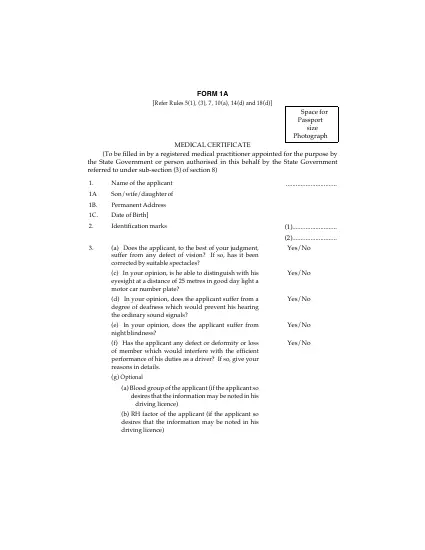
Item 1 is the applicant's name, 1A the son, wife or daughter of line, 1B the permanent address and 1C the date of birth. Item 2 has two lines for identification marks, such as a mole or scar. Paste a passport-size photograph in the space at the top right of page 1.
Item 3: vision, hearing and limbs
The practitioner answers Yes or No to each question: 3(a) any defect of vision and whether it is corrected by spectacles; 3(c) whether the applicant can read a motor car number plate at 25 metres in good daylight; 3(d) deafness that would prevent hearing ordinary sound signals; 3(e) night blindness; and 3(f) any defect, deformity or loss of a limb that would interfere with driving, with reasons in detail. The printed form has no question 3(b).
Item 3(g): blood group and RH factor (optional)
Item 3(g) is optional. It records the applicant's blood group and RH factor only if the applicant wants them noted on the driving licence. The line below states that the applicant's declaration in Form 1 about their physical fitness is attached.
Certificate of Medical Fitness
The practitioner types the applicant's name after Shri/Smt./Kum. in point (i) and certifies the examination: distant vision (ii); hearing and the condition of the arms, legs, hands and joints (iii); reaction time, side vision and glare recovery (iv), which applies only to a licence to drive goods carriages carrying dangerous or hazardous goods; and colour vision tested with a standard Ishihara chart (v). The practitioner then keeps fit or not fit in the sentence on fitness to drive a vehicle other than an adapted vehicle, and gives the reasons if the applicant is not fit.
Signatures, seal and date
The practitioner signs, gives their name and designation and registration number, and adds the seal. Note 1 says the medical officer signs across the photograph, partly on the photo and partly on the certificate. The applicant adds the date and their signature or thumb impression at the bottom of page 2. Signatures, the seal and the photograph are done by hand after printing.
After you fill it out
Print the certificate, paste the photograph, and have the practitioner sign it (partly over the photograph) and seal it; the applicant signs or puts a thumb impression. It then goes with the licence application: on Sarathi, Parivahan's licence portal, documents are uploaded against the application number (state by state), and the applicant visits the RTO on the scheduled date with the original documents. Your state transport department or RTO says exactly how the certificate is to be submitted.
Signing: The registered medical practitioner signs and seals the certificate by hand, with the signature running across the pasted photograph (Note 1). The applicant signs or puts a thumb impression at the bottom of page 2.
Watch out for
- Only a registered medical practitioner appointed or authorised by the State Government may fill in and sign the certificate, as its heading states.
- The medical officer's signature must run across the photograph, part on the photo and part on the certificate (Note 1).
- Parivahan's FAQ says Form 1A is required for applicants aged 40 or more; below 40, applicants submit the Form 1 self-declaration instead.
- Point (iv), reaction time, side vision and glare recovery, applies to a licence for goods carriages carrying dangerous or hazardous goods.
- Note 2 says a person who cannot speak but is not deaf may be given a valid certificate for a licence to drive a non-transport vehicle.
Questions about Form 1A
Who needs Form 1A?
Parivahan's FAQ says the medical certificate in Form 1A is required for applicants aged 40 or more, and that those below 40 submit Form 1, the self-declaration of physical fitness. Form 2's list of documents also asks for Form 1A when the applicant is renewing above 40 years of age or applying for a transport licence.
Is Form 1A needed for the learner's licence test?
Parivahan's FAQ answers no, unless the applicant is 40 or older: Form 1, the self-declaration, is the mandatory medical document for the learner's licence test.
Can I fill in Form 1A myself?
No. The form is to be filled in by a registered medical practitioner appointed or authorised by the State Government, who examines you and signs. You provide your details, the photograph and your signature or thumb impression.
What is the difference between Form 1 and Form 1A?
Form 1 is the applicant's own declaration about their physical fitness. Form 1A is a certificate from a registered medical practitioner after an examination; the certificate says the applicant's Form 1 declaration is attached to it.
Official information
- Downloadable forms (Parivahan, MoRTH)
- Licence and registration FAQ (Parivahan)
- Sarathi: driving licence services by state
Page text last reviewed November 13, 2026.