Internal Revenue Service
Fill out Form 8233 online
Exemption From Withholding on Compensation for Independent (and Certain Dependent) Personal Services of a Nonresident Alien Individual
Form 8233 is how a nonresident alien individual claims that some or all of their pay for personal services in the United States is exempt from federal income tax withholding under a tax treaty. It covers pay as an independent contractor and, when a treaty exemption is claimed, wages as an employee, including compensatory scholarship or fellowship income. You give it to your withholding agent, such as your employer or university, which reviews it, signs it and forwards a copy to the IRS. A new form is needed for each tax year, each withholding agent and each type of income.
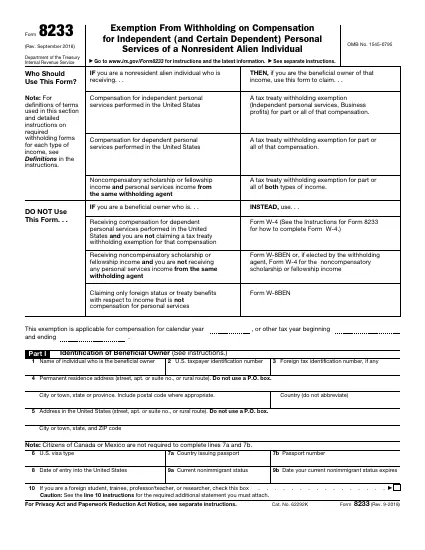
The form opens in our PDF editor with its own fields ready to type into. To download it, the filled PDF is sent to GuruPDF to prepare the file and is deleted from our servers one hour later. You can fill it in without an account; downloading the filled PDF needs a free account. A free account gets 15 credits a day, enough for one form a day.
- Country
- United States
- Edition
- Rev. September 2018
- Pages
- 2
- Fillable fields
- 51
- Last checked at the source
- November 13, 2026
GuruPDF is an independent PDF editor, not a government agency, and is not affiliated with any government. This page explains the form in plain words; it is not legal or tax advice. Always check the official instructions before you file.
Who uses Form 8233
- Nonresident alien students, trainees, professors, teachers and researchers claiming a treaty exemption on wages from a U.S. university or employer
- Nonresident alien independent contractors, consultants and visiting lecturers claiming a treaty exemption on their fees
- Nonresident aliens who also receive noncompensatory scholarship or fellowship income from the same withholding agent and claim a treaty exemption on both
- Withholding agents (employers, universities and other payers) who accept the form and complete Part IV
Before you start
- Your U.S. taxpayer identification number: your SSN, or an ITIN if you are not eligible for an SSN (or a copy of your completed Form SS-5 or W-7 if you have applied)
- Your foreign tax identification number, if your country of tax residence issued one
- Your permanent residence address abroad and your U.S. address (no P.O. boxes)
- Your visa type, passport details, date of entry and current nonimmigrant status with its expiration date (your I-94 arrival/departure record shows the entry date, status and expiration)
- The name of the tax treaty and the exact treaty article and paragraph you rely on
- A description of your services and an estimate of your total compensation from this withholding agent for the year
- For students, trainees, teachers and researchers, the additional statement required by the line 10 instructions (formats are in Publication 519, Appendix A and B)
How to fill out Form 8233
Tax year
Above Part I, enter the calendar year, or the beginning and ending dates of another tax year, for which the exemption applies. The form covers one tax year, so a new one is given each year.
Part I, lines 1 to 5: Identification of Beneficial Owner
Enter your name on line 1 and your U.S. taxpayer identification number on line 2; the instructions say a TIN must be furnished, in most cases your SSN. Line 3 is your foreign tax identification number, if any; for example, a resident of Canada enters their Social Insurance Number. Line 4 is your permanent residence address in the country where you are a tax resident, not a bank's address, P.O. box or mailing-only address. A student or researcher whose treaty only requires residence at the time of entry may give a U.S. address there. Line 5 is your U.S. address.
Part I, lines 6 to 10: visa and status
Enter your U.S. visa type on line 6, or "None". Lines 7a and 7b ask for the country that issued your passport and its number; citizens of Canada or Mexico do not complete them. Enter on line 8 the date you entered the United States for your current status, on line 9a your current nonimmigrant status and on line 9b its expiration date, or "DS" for duration of status. Check line 10 if you are a foreign student, trainee, professor or teacher, or researcher, and attach the required statement.
Part II, lines 11 and 12: compensation and the treaty claim
On line 11a, describe the services, for example "teaching at ABC University" or "consulting contract to design software". On line 11b, enter the total compensation you expect from this withholding agent for the year, estimated if needed. On lines 12a and 12b, name the treaty (for example "U.S.–Germany tax treaty") and the article and paragraph. On line 12c, write "All" if all of it is exempt or the exact exempt amount, and on line 12d your country of residence.
Part II, lines 13 and 14: scholarship income and supporting facts
Complete lines 13a to 13d only if the same withholding agent also pays you noncompensatory scholarship or fellowship income on which you claim a treaty exemption: the amount, the treaty, the article and the exempt amount. On line 14, give enough facts to justify the exemption claimed on line 12 and/or 13, so the IRS can determine the treaty benefit you are claiming.
Part III: Certification
Sign and date under penalties of perjury, certifying that you are the beneficial owner of the income, that you are not a U.S. person, and that you are, or were at or just before entry, a resident of the treaty country you named. You or your authorized agent sign.
Part IV: Withholding Agent Acceptance and Certification
Leave this part for the withholding agent. It enters its name, employer identification number, address and telephone number, and signs if it is satisfied that the exemption is warranted.
After you fill it out
Give the completed form, with any attachments, to your withholding agent, for example the payroll or international tax office of your employer or university; do not send it to the IRS yourself. If the agent is satisfied, it signs Part IV, gives you a copy, keeps one, and forwards one to the IRS within 5 days of accepting it. The agent must wait at least 10 days after mailing it to see whether the IRS objects; the exemption applies back to the first payment the form covers. If the IRS rejects the form, the agent begins withholding and may let you submit a revised form.
Signing: You, or an agent authorized to sign for you, sign and date Part III under penalties of perjury. The withholding agent signs Part IV after reviewing the form. Ask your withholding agent how it accepts the form; the IRS instructions do not address electronic signatures.
Watch out for
- The instructions caution that you must know the terms of the tax treaty between the United States and your country to complete the form properly. A form that claims a treaty benefit that does not exist, or that lacks the detail needed to check the claim, is not acceptable, and the withholding agent must then withhold; the instructions also warn against claiming benefits for a country with no ratified tax treaty.
- Complete a separate Form 8233 for each tax year, each withholding agent and each type of income.
- Spouses and dependents on secondary visas (such as F-2, J-2, H-4 or O-3) are usually not eligible for the same treaty benefits as the primary visa holder.
- An independent contractor with an office or fixed base available in the United States generally cannot claim a treaty exemption, and some treaties tax services when the stay exceeds a set number of days.
- Do not use this form for pay on which you claim no treaty exemption (use Form W-4) or for scholarship income alone (generally Form W-8BEN).
Questions about Form 8233
Who do I give Form 8233 to?
To your withholding agent, the person or organization that pays you, such as your employer or university. The agent reviews it, signs Part IV if it accepts it and forwards a copy to the IRS.
Do I need a new Form 8233 every year?
Yes. The instructions say to complete a separate form for each tax year, and to specify the year above Part I, as well as a separate form for each withholding agent and each type of income.
What if I do not have an SSN or ITIN yet?
A U.S. taxpayer identification number is required. If you have applied for an SSN or ITIN but have not received it, the instructions say you can attach a copy of your completed Form SS-5 or Form W-7 showing that a number has been applied for. If you need an ITIN only to give Form 8233 to a withholding agent, you file Form W-7 with the required documentation.
What is the difference between Form 8233 and Form W-8BEN?
Form 8233 claims a treaty exemption on pay for personal services, as an independent contractor or as an employee. Form W-8BEN is used to claim treaty benefits on other income, including noncompensatory scholarship or fellowship income when you receive no pay for services from the same withholding agent.
Is the September 2018 revision still current?
Yes. The IRS's About Form 8233 page lists Rev. September 2018 as the current form, used with instructions revised in December 2025.
Official information
- About Form 8233 (IRS)
- Instructions for Form 8233
- Publication 519, U.S. Tax Guide for Aliens
- Publication 901, U.S. Tax Treaties
Page text last reviewed November 13, 2026.
Related forms
- Form W-8BENCertificate of Foreign Status of Beneficial Owner for United States Tax Withholding and Reporting (Individuals)IRSFill online
- Form W-4Employee’s Withholding CertificateIRSFill online
- Form W-7Application for IRS Individual Taxpayer Identification NumberIRSFill online
- Form 8843Statement for Exempt Individuals and Individuals With a Medical ConditionIRSFill online
- Form 1040-NRU.S. Nonresident Alien Income Tax ReturnIRSFill online
- Form 8840Closer Connection Exception Statement for AliensIRSFill online