Internal Revenue Service
Fill out Form 8840 online
Closer Connection Exception Statement for Aliens
Form 8840 is the statement a foreign national, for example a long-stay winter visitor, files with the IRS to claim the closer connection exception to the substantial presence test. Someone who spent fewer than 183 days in the United States in the year, kept a tax home abroad, and had a closer connection to that country than to the United States is not treated as a U.S. resident for tax purposes, but only if they file this form on time. This edition is for calendar year 2026 and is filed in 2027.
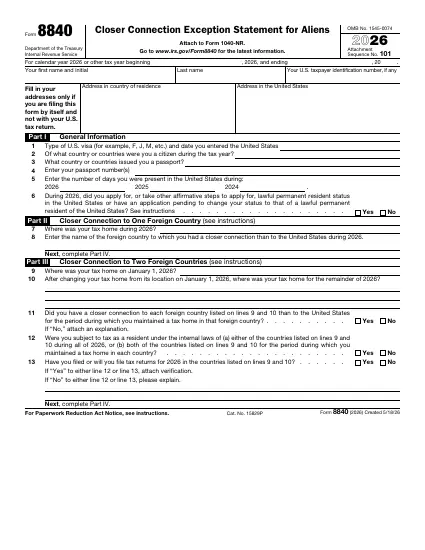
The form opens in our PDF editor with its own fields ready to type into. To download it, the filled PDF is sent to GuruPDF to prepare the file and is deleted from our servers one hour later. You can fill it in without an account; downloading the filled PDF needs a free account. A free account gets 15 credits a day, enough for one form a day.
- Country
- United States
- Edition
- Tax year 2026
- Pages
- 4
- Fillable fields
- 62
- Last checked at the source
- November 13, 2026
GuruPDF is an independent PDF editor, not a government agency, and is not affiliated with any government. This page explains the form in plain words; it is not legal or tax advice. Always check the official instructions before you file. This is the tax year 2026 version; the IRS keeps forms for earlier years.
Who uses Form 8840
- Foreign nationals who meet the substantial presence test but spent fewer than 183 days in the United States in 2026, such as long-stay winter visitors
- Visitors who kept their tax home and main ties (home, family, bank, driver's license) in one foreign country, or in two countries if they moved during the year
- Nonresident aliens filing Form 1040-NR who claim the exception
- Each spouse or family member who claims the exception, since every alien individual files a separate form
Before you start
- Your passport or passports, with the issuing country and number
- Your visa type or U.S. immigration status on the last day of the year (for example "VWP" and the country) and the date you entered the United States
- Your count of days present in the United States in 2026, 2025 and 2024
- Your U.S. taxpayer identification number, if you have one
- Your address in your country of residence and any U.S. address (needed only when filing the form by itself)
- Details of your ties abroad: permanent home, family, cars, bank accounts, driver's licenses, voter registration, where your income and investments come from, and any national health plan
How to fill out Form 8840
Top of page 1: tax year and identification
Fill in the tax year dates only if you use a tax year other than calendar year 2026. Enter your first name and initial, last name and your U.S. taxpayer identification number, if any. Fill in your address in your country of residence and your address in the United States only if you are filing the form by itself and not with your U.S. tax return.
Part I: General Information, lines 1 to 6
On line 1, enter your visa type and the date you entered the United States; without a visa, enter your immigration status on the last day of the year, for example "VWP", the Visa Waiver Program country and the entry date. Lines 2 to 4 ask for your countries of citizenship, the countries that issued your passports and the passport numbers. On line 5, enter the days you were present in the United States in 2026, 2025 and 2024. Line 6 asks whether, during 2026, you applied for or took steps toward lawful permanent resident status; if you check Yes, the instructions say you are not eligible and should not file Form 8840.
Part II: Closer Connection to One Foreign Country, lines 7 and 8
Complete Part II if you claim a closer connection to one country. Line 7 asks where your tax home was during 2026, meaning the general area of your main place of business or employment, or where you regularly live if you have none. On line 8, name the foreign country to which you had a closer connection than to the United States. Then go to Part IV. Complete Part II or Part III, not both.
Part III: Closer Connection to Two Foreign Countries, lines 9 to 13
Complete Part III only if you moved your tax home from one foreign country to another during 2026. Enter your tax home on January 1, 2026 on line 9 and your tax home for the rest of the year on line 10. Lines 11 to 13 ask whether you had a closer connection to each country for its period, whether you were taxed as a resident there, and whether you have filed or will file tax returns there. Attach an explanation for a No on line 11, verification for a Yes on line 12 or 13, and an explanation for a No on either.
Part IV: Significant Contacts With Foreign Country or Countries, lines 14 to 24
These questions show where your life was centered in 2026: the location of your regular or principal permanent home (line 14) and of any other homes available to you at all times (line 15), your family, your cars and where they were registered, your personal belongings, and up to four banks you used for routine banking (lines 16 to 20d). Lines 21 to 24 ask about business activities outside your tax home, where your driver's licenses were issued, where you were registered to vote, and which country you list as your residence on official documents.
Part IV continued: lines 25 to 30
Line 25 asks whether you have ever completed a Form W-8BEN or other W-8 form, a Form W-9, or other U.S. official forms (name them). Lines 26 to 29 ask where you kept your personal, financial and legal documents, where most of your 2026 income came from, whether you had U.S.-source income and what type, and where your investments were located; for stocks and bonds, the country of the company or debtor counts. Line 30 asks whether you qualified for a foreign national health plan. You may attach a statement with more detail on lines 14 to 30.
Sign here
Sign and date page 2 only if you are filing Form 8840 by itself, without a U.S. tax return. If you attach it to Form 1040-NR, you sign the return instead.
After you fill it out
If you are filing a 2026 Form 1040-NR, attach Form 8840 to it and mail the return by its due date, including extensions, to the address in the return's instructions. If you do not have to file a 2026 return, mail Form 8840 by itself to the IRS address printed in the form's instructions on page 4, by the due date (including extensions) for filing Form 1040-NR. Publication 519 sets that date at the 15th day of the 6th month after the tax year ends (June 15 for a calendar year) for people who received no wages subject to U.S. income tax withholding, and the 15th day of the 4th month (April 15) for those who did. Keep a copy for your records.
Signing: You sign page 2 under penalties of perjury only when you file Form 8840 by itself; when it is attached to Form 1040-NR, the signed return covers it. A Form 8840 filed by itself is mailed on paper, and its instructions do not mention electronic signatures.
Watch out for
- The instructions say that if you do not file Form 8840 on time, you cannot claim the closer connection exception and may be treated as a U.S. resident, unless you can show by clear and convincing evidence that you took reasonable steps to learn of and comply with the filing requirements.
- You are not eligible if you were in the United States 183 days or more in 2026, if you hold a green card, if you applied or took steps to apply for one, or if you had a tax home in the United States at any time during the year.
- Days you exclude as an exempt individual (such as a student or teacher) or because of a medical condition are claimed on Form 8843, not on this form.
- Use the form for the right year. This edition is for 2026; a statement for 2025 or an earlier year goes on that year's version, listed on the IRS's All Form 8840 revisions page.
- Each person files their own form. A couple who both claim the exception file two separate Forms 8840.
Questions about Form 8840
Who needs to file Form 8840?
An alien individual who meets the substantial presence test but qualifies for the closer connection exception: present in the United States fewer than 183 days in the year, with a tax home in a foreign country all year and a closer connection to that country (or to two countries) than to the United States. The form establishes the claim that you are a nonresident.
How is the substantial presence test counted?
You meet it if you were physically present in the United States at least 31 days in 2026 and 183 days over 2026, 2025 and 2024, counting all days in 2026, one third of the days in 2025 and one sixth of the days in 2024. Some days, such as days you could not leave because of a medical condition that arose in the United States, are not counted.
When is Form 8840 due?
With your Form 1040-NR if you file one, or by itself by the Form 1040-NR due date, including extensions. Publication 519 gives that date as June 15 of the next year for a calendar-year filer with no wages subject to U.S. withholding, and April 15 for one with such wages.
Do I need a U.S. taxpayer identification number?
No. The form asks for your U.S. taxpayer identification number only "if any", so you can leave it blank if you do not have one.
What if I am not eligible for the closer connection exception?
The instructions say you may still qualify for nonresident status under a tax treaty. Publication 519 explains how, and a treaty position is claimed by filing Form 8833 with Form 1040-NR.
Official information
Page text last reviewed November 13, 2026.
Related forms
- Form 8843Statement for Exempt Individuals and Individuals With a Medical ConditionIRSFill online
- Form 1040-NRU.S. Nonresident Alien Income Tax ReturnIRSFill online
- Form W-8BENCertificate of Foreign Status of Beneficial Owner for United States Tax Withholding and Reporting (Individuals)IRSFill online
- Form 8233Exemption From Withholding on Compensation for Independent (and Certain Dependent) Personal Services of a Nonresident Alien IndividualIRSFill online