Service Canada (Employment and Social Development Canada)
Fill out Form ISP-1151 online
Application for Canada Pension Plan Disability Benefits
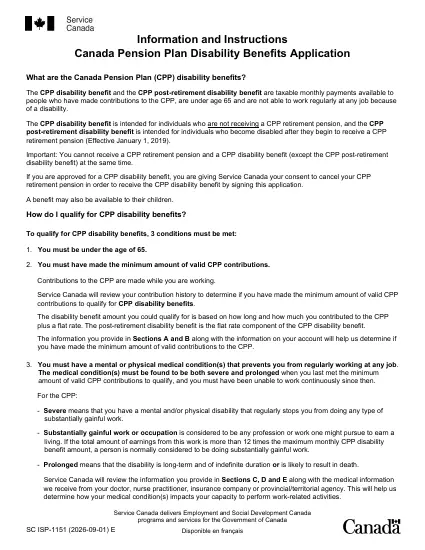
Form ISP-1151 is the paper application for Canada Pension Plan (CPP) disability benefits: the CPP disability benefit, and the CPP post-retirement disability benefit for people who became disabled after their CPP retirement pension started. Both are taxable monthly payments for people under 65 who have made enough CPP contributions and have a severe and prolonged mental or physical condition that stops them from working regularly at any job. The form asks about your contributions, your medical condition, how it limits your abilities, your doctors, your work history and your children, who may qualify for the disabled contributor's child's benefit. You mail it to Service Canada or drop it off at a Service Canada Centre, and a medical report is sent separately.
The form opens in our PDF editor with its own fields ready to type into. To download it, the filled PDF is sent to GuruPDF to prepare the file and is deleted from our servers one hour later. You can fill it in without an account; downloading the filled PDF needs a free account. A free account gets 15 credits a day, enough for one form a day.
- Country
- Canada
- Edition
- (2026-09-01)
- Pages
- 28
- Fillable fields
- 732
- Last checked at the source
- November 13, 2026
GuruPDF is an independent PDF editor, not a government agency, and is not affiliated with any government. This page explains the form in plain words; it is not legal or tax advice. Always check the official instructions before you file.
Who uses Form ISP-1151
- People under 65 who contributed to the CPP and cannot work regularly at any job because of a severe and prolonged disability
- People already receiving a CPP retirement pension who have since become disabled (the post-retirement disability benefit)
- Applicants with dependent children under 18, or 18 to 25 and in school, who may qualify for the disabled contributor's child's benefit
- Legal representatives, such as a guardian, trustee or person with power of attorney for property, applying for someone else
- People who prefer or need a paper application instead of applying online in My Service Canada Account
Before you start
- Your Social Insurance Number (it goes at the top of every page)
- The date you felt you could no longer work, and the names of your medical conditions (or a description in your own words)
- Details of hospital stays, current medications (or a pharmacy printout), and past, current and planned treatments and tests
- Names, addresses and phone numbers of your doctor or nurse practitioner and other health care providers seen in the last two years
- Your work history for the past 6 years, any Employment Insurance periods in the last two years, and your education and training
- Claim numbers for any disability benefits from an insurance company or a provincial or territorial agency, including workers' compensation
- Your children's names, dates of birth and SINs, and custodian details if a child does not live with you
- Your banking details for direct deposit, or a void cheque
How to fill out Form ISP-1151
Section A – Information about you (A1 and A2)
In A1, enter your Social Insurance Number, preferred language, an optional title, your first, middle and last names, date of birth (YYYY-MM-DD), last name at birth if different, home address, mailing address if different, telephone numbers, the best time to call and an optional email address. If you now live outside Canada, give the province or territory where you last lived. A2 asks whether you or your children ever applied for or received Quebec Pension Plan benefits.
Section B – Contributions to the CPP (B1 to B3)
These questions help Service Canada see whether you made the minimum amount of valid contributions. B1 (credit split) asks your current marital status and, if a marriage or common-law relationship ended, the dates you started and stopped living together. B2 asks for each other country where you lived or worked, with your social identification number there and the dates. B3 (child rearing provision) lists your children with their SIN, date of birth and date of entry for a child born abroad, then questions A) to D) ask whether you were the primary caregiver under age 7 and who received the Family Allowance or the Canada Child Benefit. The waiver in E) is signed by your current or former spouse or partner, not by you; Annex A at the end shows which questions to answer.
Section C – Information about your medical condition(s) (C1 to C7)
C1 asks the date (YYYY-MM) you felt you could no longer work, which may differ from your last day at work. C2 asks your main medical conditions and any others that prevent you from working. C3 asks whether you are right- or left-handed and which aids you use and how often. C4 lists hospital stays, C5 your current medications with dosage and frequency, and C6 your past, current and future treatments and tests. C7 asks about disability benefits from an insurance company or a provincial or territorial agency, with the claim number, and whether you have asked them to send your medical information to Service Canada.
Section C8 – Functional assessment
Rate your ability level on most days, from Excellent to Poor, in four blocks: A) Physical abilities, B) Behaviours and emotional abilities, C) Communication and thinking abilities and D) Other daily abilities. Rate yourself as if you are using your aids, such as a cane, hearing aid or adaptive computer equipment. If you have no limitations in a block, you can tick the box at its top instead of rating each item. After each block there is space to describe how your abilities change between good and bad days and over time; page 6 of the form shows example answers.
Section D – Information about your doctor or nurse practitioner
In D1, give the full name, type (family doctor, nurse practitioner or specialist), mailing address and phone number of the doctor or nurse practitioner who will report on your condition, and when you first and last saw them about it. In D2, list the other doctors, specialists or health care providers you have seen in the last two years for your condition, with their specialty, contact details, dates of visits and the reasons for the visits.
Section E – Information about your work (E1 to E10)
E1 asks whether you have stopped working completely and why. E2 to E4 describe your current or last main job: title, first and last day worked, employer and address, type of work, hours per day and days per week, and your duties. E5 lists other jobs in the past 6 years, including work outside Canada. E6 asks about self-employment, E7 whether your condition made you take lighter or different work, E8 whether you received regular Employment Insurance benefits in the last two years, and E9 and E10 your highest education and any technical, trade or on-the-job training.
Sections F and G – Benefits for children and payment information
In F1, say whether you have children; if not, skip to Section G. In F2, give each child's name, date of birth, SIN and relationship, whether a child aged 18 to 25 is attending school (with their address), and for a child under 18 the living arrangement and the custodian's name and address if the child does not live with you full-time. F3 asks whether Service Canada may contact the children or their custodian about the disabled contributor's child's benefit. In G1, enter your branch, institution and account numbers and the name on the account for direct deposit, or attach a void cheque.
Sections H and I – Consent and declaration
Section H is the consent for Service Canada to collect medical and other personal information about you from doctors, employers, insurers and the other parties listed; you must tick either the consent or the refusal, then enter your address, print your name, sign and date. Section I is the declaration: read the privacy notice, then sign and date. A witness fills in their details only if you sign with a mark such as an X, and a legal representative signing for you completes the separate representative block and must send legal documents proving their authority.
After you fill it out
Check the list at the end of the form: your SIN at the top of every page and added sheet, your date of birth, and signatures on the consent (Section H) and the declaration (Section I). Remove the information and instruction pages, then mail the application to the Service Canada office for your province or territory (listed in the form) or drop it off at a Service Canada Centre; from outside Canada, use the office for the province where you last lived. The medical part is separate: if an insurer or a provincial or territorial agency pays you a disability benefit, ask them to send your latest medical report; otherwise complete Sections 1 and 2 of the Medical Report (ISP-2519) and have your doctor or nurse practitioner complete the rest and send it. Do not wait for the medical report before sending the application, because the date Service Canada receives it can affect when your benefit starts. Service Canada confirms receipt, may ask for more information and then sends its decision; its CPP disability pages list current processing times.
Signing: You sign and date Section H (consent) and Section I (declaration). Service Canada asks you to sign every area that needs a signature with a pen; the fillable PDF can be saved but not submitted electronically, so type your answers, print the form and sign by hand. The form says the consent in Section H can be sent as an original, a scan, a photocopy or a fax. A witness signs only if you sign with a mark, and a legal representative signs the representative block instead of you.
Watch out for
- If you worked only in Quebec, or worked in Quebec and now live there (or lived last in Quebec before moving abroad), you apply to Retraite Québec for Quebec Pension Plan disability benefits instead.
- By signing, you consent to your CPP retirement pension being cancelled if you are approved for the CPP disability benefit, since the two cannot be paid together (the post-retirement disability benefit is the exception).
- In Section H you must choose one option; leaving it blank can delay your application, and refusing consent means a decision is made on the information already in your file.
- If you were diagnosed with a terminal illness by your doctor or nurse practitioner, Service Canada has a separate, shorter Terminal Illness Application (ISP-2530A), with its own medical attestation (ISP-2530B).
- If you do not give a child's SIN, or the child was born outside Canada, Service Canada needs a copy of a birth certificate or proof of the date of entry.
Questions about Form ISP-1151
Who qualifies for CPP disability benefits?
Service Canada lists three requirements: your age (the form says under 65; its eligibility page says between 18 and 65), enough valid CPP contributions, and a mental or physical condition that is both severe (it regularly stops you from doing any substantially gainful work) and prolonged (long-term and of indefinite duration, or likely to result in death). Its eligibility page explains how many years of contributions are needed and which provisions, such as the child rearing provision or a credit split, can help.
Can I apply online instead of using ISP-1151?
Yes. Service Canada's preferred channel is My Service Canada Account; online applicants also print, sign and upload the Consent for Service Canada to Collect Personal Information (ISP-2502). The paper or fillable form is the other option: the form says it can be saved on your computer but not submitted electronically, so it is mailed or dropped off.
Do I need a medical report?
Yes, Service Canada needs medical information. If you receive disability benefits from an insurance company or a provincial or territorial agency, you can ask them to send your latest medical report. Otherwise you complete Sections 1 and 2 of the Medical Report (ISP-2519) and your doctor or nurse practitioner completes Sections 3 to 9. Service Canada pays part of the health care professional's fee for that report.
I already get my CPP retirement pension. Can I still apply?
Yes, if you are under 65. Service Canada says you may still qualify for the disability benefit if you have received your retirement pension for less than 15 months; otherwise you may be eligible for the post-retirement disability benefit, which is considered automatically when you apply.
When would payments start if I am approved?
The form says the benefit starts four months after your disability was found to be severe and prolonged, and you may receive up to 11 months of payments retroactive from the date your application was received. That is why Service Canada asks you not to delay sending the application.
Can my children receive a benefit too?
If you qualify, your dependent children may receive the disabled contributor's child's benefit if they are under 18, or 18 to 25 and attending school full-time or part-time. Give their details in Section F of this form.
Official information
- CPP disability benefits: Apply
- CPP disability benefits: Do you qualify
- CPP disability benefits overview
- Form ISP-1151 in the Service Canada forms catalogue
Page text last reviewed November 13, 2026.