Service Canada (Employment and Social Development Canada)
Fill out Form ISP-1200 online
Application for a Canada Pension Plan Death Benefit
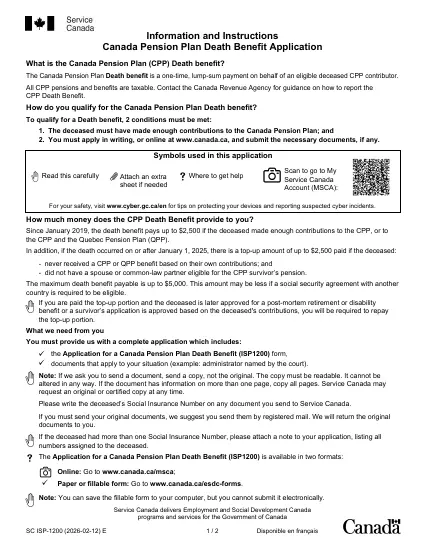
Form ISP-1200 is the paper application for the Canada Pension Plan (CPP) death benefit, a one-time, taxable lump-sum payment made on behalf of a deceased person who contributed enough to the CPP. It is paid in an order of priority: first to the estate through the executor or court-appointed administrator, then to the person or institution responsible for the funeral expenses, then to the surviving spouse or common-law partner, then to the next of kin. For deaths on or after January 1, 2025, the benefit can include a top-up when the deceased never received a CPP or QPP benefit based on their own contributions and left no spouse or partner eligible for a survivor's pension. You mail the form to Service Canada or drop it off at a Service Canada Centre.
The form opens in our PDF editor with its own fields ready to type into. To download it, the filled PDF is sent to GuruPDF to prepare the file and is deleted from our servers one hour later. You can fill it in without an account; downloading the filled PDF needs a free account. A free account gets 15 credits a day, enough for one form a day.
- Country
- Canada
- Edition
- (2026-02-12)
- Pages
- 12
- Fillable fields
- 122
- Last checked at the source
- November 13, 2026
GuruPDF is an independent PDF editor, not a government agency, and is not affiliated with any government. This page explains the form in plain words; it is not legal or tax advice. Always check the official instructions before you file.
Who uses Form ISP-1200
- The executor named in the will, or the administrator appointed by the court, applying for the estate
- The person or institution that paid for, or is responsible for paying, the funeral when there is no will or the executor has not applied within 60 days
- The surviving spouse or common-law partner, when the funeral expenses do not use up the benefit or no one higher in the order applies
- The next of kin, when no one higher in the order of priority applies
- People higher in the order who choose not to apply and sign the waiver in Section D2
Before you start
- The deceased's Social Insurance Number (or a copy of their birth certificate), date of birth and date of death
- The deceased's address at the time of death, marital status and the spouse or partner's name and phone number
- Countries outside Canada where the deceased lived or worked, with dates and their insurance number there
- Whether there is a will, and the executor's or administrator's name and address
- The total funeral expenses and the funeral services provider's name and phone number, if you paid for the funeral
- Banking details for direct deposit (an executor needs an estate account, not a personal one)
How to fill out Form ISP-1200
Section A – Information about the deceased contributor (A1 and A2)
In A1, enter the deceased's SIN, date of birth, date of death, names, name at birth, country of birth (or province if born in Canada), home address at the time of death and, if that was outside Canada, the province or territory where they last lived. Tick their marital status at death, give the name and phone number of a spouse or common-law partner, and say whether the deceased ever received or applied for CPP, Old Age Security or Quebec Pension Plan benefits, with the number used. A2 asks whether the deceased received, or was eligible for, the Family Allowance or the Canada Child Benefit for children born after December 31, 1958.
Section B – The deceased living or working in another country
In B1, say whether the deceased ever lived or worked outside Canada. If yes, list each country with the deceased's social identification number there, the dates lived and worked there (YYYY-MM) and whether a benefit was asked for or received from that country. If the deceased's CPP contributions are not enough, credits from a country with a social security agreement may help them qualify for a prorated death benefit.
Section C – C1: will, executor and funeral expenses
Page 2 of the application explains the order of priority: the estate, then the person or institution responsible for the funeral expenses, then the surviving spouse or common-law partner, then the next of kin. In C1, say whether there is a will and whether you are the executor or administrator; if not, give the executor's name, phone number and address. Then say whether you are responsible for the funeral expenses: if yes, enter the total amount, the funeral services provider's name and phone number; if not, give the name and address of the person or institution that is.
Section C – C2 and C3: how you apply and your information
In C2, choose only one role, based on the order of priority: executor or court-appointed administrator, person or institution responsible for the funeral expenses with no will or estate, surviving spouse or common-law partner who did not pay for the funeral, or next of kin (with your relationship to the deceased). In C3, enter your preferred languages, your relationship to the deceased, names, home address, phone numbers and an optional email address, plus banking details if you want direct deposit; an executor must use an estate account. Without banking details, a cheque is mailed to your address.
Section D – Tax slips and people who choose not to apply
D1 applies when there is no executor or court-appointed administrator and the deceased was receiving CPP or OAS benefits: say whether the person in C3 is responsible for the deceased's income tax return; if not, the person who will file it completes Form ISP-1202. In D2, anyone higher in the order of priority (executor, the person responsible for the funeral expenses, or the spouse or common-law partner) who chooses not to apply ticks their role, enters their name and address, and signs and dates. Service Canada may contact them to confirm.
Sections E and F – Declaration, witness and checklist
In Section E, sign in pen and date the declaration as the applicant or the applicant's representative; a representative provides power of attorney or other supporting documents. Section F is completed only if you sign with a mark, by a witness such as a friend or family member. Page 7 has the checklist and a space for extra information, with the question number for each answer.
After you fill it out
Check every required field, the funeral expense details in C1 if you apply as the person responsible for the funeral, and your signature in Section E. Write the deceased's SIN at the top of each page and on any copies you send. Mail the application to the Service Canada office listed at the end of the form for your province or territory, or drop it off at a Service Canada Centre; from outside Canada, use the office for the province where the deceased last lived. You do not need to send proof of death if Service Canada was already told of the death; the form lists acceptable documents if one is asked for, and copies are accepted. Service Canada reviews the application, contacts you if it needs more information and sends a letter with its decision. Its death benefit page lists current processing times and the online application in My Service Canada Account.
Signing: The applicant, or the applicant's representative, signs and dates Section E in pen, as the form says. Service Canada notes that the fillable form can be saved but not submitted electronically, so type the answers, print the form and sign by hand. A person who chooses not to apply signs Section D2, and a witness signs Section F only if the applicant signs with a mark.
Watch out for
- An executor or court-appointed administrator should apply within 60 days of the death; after that, Service Canada can consider other eligible applicants in the order of priority.
- When the person responsible for the funeral expenses is paid, the benefit cannot be more than the funeral expenses, and the name on the funeral contract or receipt must match the applicant's name.
- If a top-up is paid and the deceased is later approved for a retirement or disability benefit after death, or a survivor's pension is approved on the deceased's contributions, the top-up must be repaid.
- If the deceased received a Retraite Québec benefit, worked only in Quebec, or last lived in Quebec, the application goes to Retraite Québec instead.
- If the deceased had more than one SIN, attach a note listing all of them.
Questions about Form ISP-1200
Who qualifies for the CPP death benefit?
The deceased must have contributed to the CPP long enough. Service Canada's death benefit page explains the rule: at least one-third of the calendar years in their contributory period for the base CPP, and no fewer than three years, or 10 calendar years. Credits from another country with a social security agreement can help.
Who should apply: the executor, the family or the funeral home?
The estate comes first, through the executor or court-appointed administrator. If there is no estate, or the executor has not applied within 60 days, the benefit goes in order to the person or institution responsible for the funeral expenses, then the surviving spouse or common-law partner, then the next of kin.
Can I apply online?
Yes, in My Service Canada Account, where you complete the online death benefit form and upload any documents. Service Canada notes that a trustee, guardian or other legal representative can act for someone in person, by mail or by phone, but not online.
Is the death benefit taxable?
Yes. The form says all CPP benefits are taxable and refers you to the Canada Revenue Agency for how to report it; Service Canada links to the CRA's guidance on reporting death benefits. A non-resident of Canada may have Non-Resident Tax deducted.
Does this form also apply for the survivor's pension?
No. The survivor's pension and the surviving child's benefit use Form ISP-1300 or the online application. If the deceased was 70 or older and never applied for their CPP retirement pension, the form says to submit Form ISP-1000 within one year of the death.
Official information
- CPP death benefit: eligibility and how to apply
- Form ISP-1200 in the Service Canada forms catalogue
- Death benefits: preparing tax returns for someone who died (CRA)
Page text last reviewed November 13, 2026.