HM Courts & Tribunals Service
Fill out Form N1 online
Claim form (CPR Part 7)
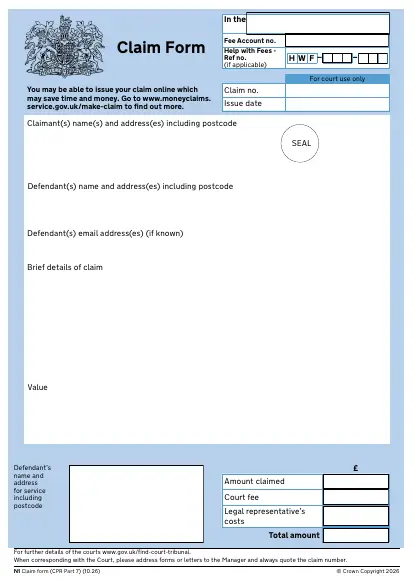
Form N1, the claim form under Part 7 of the Civil Procedure Rules, starts a court claim against a person or organisation in England and Wales. It is the paper route for a money claim (what used to be called a 'small claims court' claim) and for other civil claims. You give the parties' names and addresses, a brief description of the claim and its value, and your particulars of claim, then sign a statement of truth. GOV.UK says most money claims can be made online instead, through its online money claims services such as Money Claim Online, and the form itself points to that option; the paper N1 is for claims that cannot be made online or for people who prefer post.
The form opens in our PDF editor with its own fields ready to type into. To download it, the filled PDF is sent to GuruPDF to prepare the file and is deleted from our servers one hour later. You can fill it in without an account; downloading the filled PDF needs a free account. A free account gets 15 credits a day, enough for one form a day.
- Country
- United Kingdom
- Edition
- N1 (10.26)
- Pages
- 5
- Fillable fields
- 44
- Last checked at the source
- November 13, 2026
GuruPDF is an independent PDF editor, not a government agency, and is not affiliated with any government. This page explains the form in plain words; it is not legal or tax advice. Always check the official instructions before you file.
Who uses Form N1
- Individuals and businesses claiming money owed by a person or organisation
- Claimants who cannot use the online money claims service, for example when the amount is not known or there are 3 or more defendants
- Claimants bringing a claim for something other than money, or a claim in the High Court
- Litigation friends claiming on behalf of a child or a protected party
- Solicitors and other legal representatives issuing claims for clients
Before you start
- Your full name and address with postcode, and those of each defendant (titles for individuals, the right suffix such as 'Ltd' or 'a firm' for businesses)
- The defendant's email address, if you know it
- A short description of what the claim is about and what you want (for example payment of money)
- The amount claimed, any interest you are claiming and how you worked it out, or the value band if the amount is not fixed
- The court fee for your claim amount, or a Help with Fees reference number
- Your particulars of claim: the facts you rely on and details of any interest claimed
- Your preferred County Court hearing centre
How to fill out Form N1
Page 1: court, parties and brief details
In the heading enter the court where the claim is to be issued; the notes for claimants (N1A) say a County Court claim for money only must say 'County Court Money Claims Centre'. Add a fee account number or Help with Fees reference if you have one. Enter the claimants' and defendants' names and addresses with postcodes, the defendants' email addresses if known, and under 'Brief details of claim' a concise statement of the claim and the remedy you want. In the 'Defendant's name and address for service' box give the name and address of the defendant who will receive this copy (one claim form for each defendant).
Page 1: value and amounts
If you claim a fixed sum, enter it against 'Amount claimed'. If the amount is not fixed, write under 'Value' 'I expect to recover' followed by the band from the N1A notes, or 'I cannot say how much I expect to recover'; extra wording is needed for small personal injury or housing disrepair claims. Then fill in the court fee, any legal representative's costs (only if a legal representative was instructed) and the total amount.
Page 2: hearing centre, vulnerability and human rights
Name your preferred County Court hearing centre; the court takes it into account if the case has to be transferred for a hearing. Say whether you, or a witness for you, are vulnerable in a way the court needs to consider, and if so explain what support or adjustments you would like. Then answer whether the claim includes any issues under the Human Rights Act 1998.
Page 3: particulars of claim
Tick whether the particulars of claim are attached or to follow, or write them in the space. The N1A notes say they must include a concise statement of the facts you rely on, any claim for aggravated or exemplary damages, details of any interest claimed, and anything else the practice direction for your type of claim requires.
Page 4: statement of truth
Tick the statement that applies (you believe the facts are true, or the claimant believes them and you are authorised to sign), sign, and tick whether you sign as the claimant, a litigation friend or the claimant's legal representative. Add the date and your full name; a legal representative also gives the firm's name, and anyone signing for a firm or company gives their position. The N1A notes say a company claim is signed by a director or other officer.
Page 5: address for documents
Give the claimant's, or the legal representative's, address where documents should be sent, with postcode. Phone, DX, reference and email are optional; the form says an email address can be used by the court and the defendant to communicate with you and for service on you.
After you fill it out
GOV.UK says a paper claim for money goes to the Civil National Business Centre, with a cheque or postal order for the court fee or a letter asking to pay by card, or with your Help with Fees reference or completed EX160; the address is on GOV.UK and in the N1A notes. A High Court claim or a claim for anything other than money goes to a court office instead. N1A asks you to make copies so there is one for you, one for the court and one for each defendant. The fee depends on the amount claimed, including interest; check the current table on GOV.UK. The claim is then sent to the defendant, who must respond by a date the court gives you. If a money claim of £10,000 or less is disputed, you will be required to attend free mediation arranged by the court.
Signing: The statement of truth on page 4 is signed by the claimant, a litigation friend or the claimant's legal representative; for a company, by a director or other officer. N1A asks for black ink and block capitals if you complete the form by hand. The form does not say whether an electronic signature is accepted on a paper claim.
Watch out for
- N1A says you must think about alternative ways to settle the dispute before going to court.
- Each defendant's address must include a postcode; without one, the court will not allow the claim to be served unless a judge gives permission.
- The court fee is based on the full amount claimed, including interest; if you leave the amount claimed blank, the highest fee applies.
- Interest is not added automatically on a paper claim: GOV.UK says you usually need to work it out yourself and include it in the claim.
- The form warns that contempt of court proceedings may be brought against anyone who signs the statement of truth without an honest belief in its truth.
Questions about Form N1
Should I use form N1 or claim online?
GOV.UK says you can make a money claim online unless you do not know how much you are claiming, you are claiming for more than one person or organisation, you are claiming against 3 or more people or organisations, you or a defendant have no address in England or Wales, or the claim is against a government department. In those cases, claim by post with form N1.
Where do I send a paper N1?
A claim for money goes to the Civil National Business Centre; GOV.UK and the N1A notes give the address. A High Court claim or a claim for something other than money goes to a court office.
How much is the court fee?
It depends on how much you claim, including interest, and GOV.UK publishes the current table. If you have a low income or receive certain benefits, you may get help with fees; if you apply for help by post with form EX160, GOV.UK says to send it together with the N1.
Can I claim interest?
You may be able to, but you must include it in your claim and give details in the particulars of claim. GOV.UK says the rate is usually 8% and explains how to work it out; business-to-business late payments follow different rules.
What happens after I send the claim?
The claim, including your name and address, is sent to the defendant, who must respond by a date you will be told. If the defendant does not respond or does not pay, you can ask for judgment (form N225 for a fixed amount, N227 for an unspecified amount). If the claim is disputed, mediation or a hearing may follow.
Official information
- Form N1: claim form (CPR Part 7) (GOV.UK)
- Notes for claimant on completing a claim form (N1A)
- Make a court claim for money
- Online money claims service: check if you can use it
- Get help with court and tribunal fees
Page text last reviewed November 13, 2026.