HM Courts & Tribunals Service
Fill out Form N244 online
Application notice
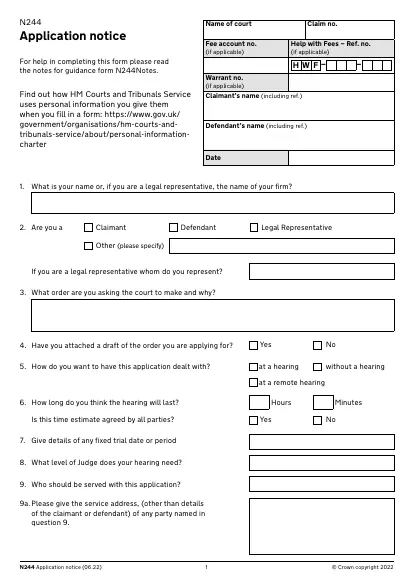
Form N244, the application notice, is how a party asks the court to make an order within a civil case that already exists in the County Court or the High Court in England and Wales. GOV.UK describes it as the form to ask a court to set aside or vary a judgment or suspend an enforcement process, and it is also used for things like asking to adjourn a hearing. You say what order you want and why, how the application should be dealt with, and what evidence you rely on, then sign a statement of truth. The completed notice goes to the court dealing with the case, with copies for each party to be served.
The form opens in our PDF editor with its own fields ready to type into. To download it, the filled PDF is sent to GuruPDF to prepare the file and is deleted from our servers one hour later. You can fill it in without an account; downloading the filled PDF needs a free account. A free account gets 15 credits a day, enough for one form a day.
- Country
- United Kingdom
- Edition
- N244 (06.22)
- Pages
- 5
- Fillable fields
- 59
- Last checked at the source
- November 13, 2026
GuruPDF is an independent PDF editor, not a government agency, and is not affiliated with any government. This page explains the form in plain words; it is not legal or tax advice. Always check the official instructions before you file.
Who uses Form N244
- A defendant asking the court to set aside a judgment entered against them (for example a default county court judgment)
- A party asking to vary a judgment or suspend enforcement, such as a warrant
- A claimant or defendant asking to adjourn a hearing or change a court order or deadline
- Legal representatives making an application on behalf of a client
- A party asking the court for a summons or order for a witness to attend, or for a judgment or order by consent
Before you start
- The name of the court and the claim number from your court papers
- The claimant's and defendant's names and references as they appear on the case
- Any warrant number, fee account number or Help with Fees reference number that applies
- A clear statement of the order you want and your reasons, and a draft order if you have prepared one
- Any fixed trial date or trial period already given to the case
- Your witness statement or the evidence you will rely on
- Form EX160 or a Help with Fees reference if you cannot afford the court fee
How to fill out Form N244
Page 1 heading: court, claim and parties
Enter the name of the court, the claim number, and the claimant's and defendant's names including references. Fill in the fee account number, the Help with Fees reference (HWF-) or the warrant number only if they apply to you. Add the date of the application.
Questions 1 to 4: who you are and what you are asking for
At question 1 give your name or, if you are a legal representative, your firm's name, and at question 2 tick whether you are the claimant, defendant, a legal representative (and whom you represent) or other. At question 3 set out the order you are asking the court to make and why; HMCTS gives examples such as 'to adjourn the hearing because…' or 'to set aside a judgment against me because…'. Question 4 asks whether you have attached a draft of the order.
Questions 5 to 8: hearing, time estimate and judge
At question 5 choose at a hearing, without a hearing or at a remote hearing. HMCTS says most applications need a hearing that you are expected to attend; the court deals with one without a hearing only where the parties agree the order or agree to that, or where the court thinks a hearing is not appropriate, and remote hearings are only available where at least one party is legally represented. At question 6 give the expected length and whether all parties agree it; if you do not know, leave it blank rather than guess. Question 7 asks for any fixed trial date or period, and question 8 for the level of judge, which matters for cases in the High Court or a District Registry (Master, District Judge or Judge).
Questions 9 and 9a: who should be served
Say who should be sent a copy of the application. At 9a give the service address of anyone named at question 9 other than the claimant or defendant, whose addresses the court already has.
Question 10: the information you rely on
Tick the attached witness statement if you are attaching one, the statement of case if you rely on your particulars of claim or defence, or the evidence set out in the box if you write your evidence on the form itself. Continue on a separate sheet if you need more space.
Question 11: vulnerability
Tell the court whether you, or a witness who will give evidence for you, are vulnerable in any way it needs to consider. If you tick Yes, explain how and what steps, support or adjustments you would like the court and the judge to consider.
Statement of truth and address for documents
Tick the statement that fits (you believe the facts in section 10 are true, or the applicant believes them and you are authorised to sign), then sign, tick whether you sign as the applicant, a litigation friend or the applicant's legal representative, and add the date and your full name. A legal representative also gives the firm's name and, if signing for a firm or company, the position held. On page 5 give the address where documents should be sent, and a phone number, DX number, reference or email address if you agree to be contacted that way.
After you fill it out
Send the application to the court dealing with your case. HMCTS's guidance asks you to check before sending that you have signed the form, enclosed the correct fee or an application for help with fees, and made enough copies of the application and supporting documents: one for each party to be served and one for the court. A court fee is usually payable depending on the type of application; check the current amount on GOV.UK. For most applications the court will list a hearing; HMCTS suggests saying in a covering letter which dates in the next 6 weeks you cannot attend. Some applications use a different form, such as domestic abuse protection orders or Commercial Court applications, so read the GOV.UK page first.
Signing: The statement of truth on page 4 is signed and dated by the applicant, a litigation friend (for a child or protected party) or the applicant's legal representative. The form does not say whether an electronic signature is accepted; ask the court if you are unsure.
Watch out for
- Only the facts in section 10 and any continuation sheets are covered by the statement of truth, and the form warns that contempt of court proceedings may be brought against anyone who signs it without an honest belief in its truth.
- Do not guess the hearing length at question 6: HMCTS says to leave it blank if you do not know.
- A remote hearing is only available where at least one party is legally represented, and the court may refuse a request for a telephone hearing.
- Some applications need a different form or extra forms, for example a domestic abuse protection order, an application to the Commercial Court (N244(CC) or N244(CCFL)), or payment out of court funds as a dissentient shareholder or after the sale of a property, which also needs the evidence of identity and declaration form BP34.
- Court staff cannot give legal advice; HMCTS points to legal aid and Citizens Advice for that.
Questions about Form N244
What is form N244 used for?
It asks the court to make an order in a civil case that is already under way. GOV.UK says it is used to ask a court to set aside or vary a judgment or suspend an enforcement process, and HMCTS's guidance gives adjourning a hearing as another example.
Is there a fee for an N244 application?
Usually, yes, and the amount depends on the type of application. HMCTS says no fee is payable for an application by consent to adjourn a hearing if the court receives it at least 14 days before the hearing. If paying would cause hardship, you may get help with fees by using form EX160 or applying online. Check the current fee on GOV.UK.
Will there be a hearing?
Most applications need a hearing and you will be expected to attend; the court allocates the date and time. It deals with an application without a hearing only if all parties agree the terms of the order, all parties agree it can be dealt with without a hearing, or the court thinks a hearing would not be appropriate.
How many copies do I need to send?
HMCTS's guidance asks for one copy of the application and supporting documents for each party to be served, plus one for the court.
Can I type the form on a computer?
Yes. HMCTS publishes N244 as a fillable PDF, and a large-print version is also available on GOV.UK.
Official information
- Form N244: application notice (GOV.UK)
- How to complete the N244 application notice
- Get help with court and tribunal fees
- Find a court or tribunal
Page text last reviewed November 13, 2026.