Income Tax Department, Government of India
Fill out Form 121 online
Declaration under section 393(6) for receipt of certain incomes without deduction of tax
Form No. 121 is the declaration you give to a bank, post office, company or other payer so that it does not deduct tax at source (TDS) from certain income, because the tax on your estimated total income for the tax year will be nil. It replaced both Form 15G and Form 15H from 1 April 2026, when the Income-tax Act, 2025 and the Income-tax Rules, 2026 took effect: one form now serves people below 60 and senior citizens alike. You fill in Part A and give it to each payer; the payer completes Part B and reports the declaration to the Income Tax Department. It is not filed with the department by you.
This form has no fillable fields, so it opens in our PDF editor with the Text tool ready: click where an answer goes and type. To download it, the filled PDF is sent to GuruPDF to prepare the file and is deleted from our servers one hour later. You can fill it in without an account; downloading the filled PDF needs a free account. A free account gets 15 credits a day, enough for one form a day.
- Country
- India
- Edition
- Income-tax Rules, 2026 (tax year 2026-27 onwards)
- Pages
- 4
- Fillable fields
- Type anywhere
- Last checked at the source
- November 13, 2026
GuruPDF is an independent PDF editor, not a government agency, and is not affiliated with any government. This page explains the form in plain words; it is not legal or tax advice. Always check the official instructions before you file.
Who uses Form 121
- Resident individuals below 60 whose tax on estimated total income is nil and whose income of these kinds stays within the maximum amount not chargeable to tax (the people who used Form 15G)
- Resident individuals aged 60 or more at any time in the tax year whose tax on estimated total income is nil (the people who used Form 15H)
- HUFs, trusts and other persons that are not a company or a firm, under the same conditions as individuals below 60
- Depositors earning interest from banks, co-operative banks or post office schemes
- People receiving dividends, mutual fund income, rent from a specified person, insurance commission, life insurance payouts or an EPF accumulated balance
- Payers such as banks, which complete Part B for each declaration they receive
Before you start
- Your PAN (Permanent Account Number), which must be valid and operative
- Your full name and full address, including PIN code, post office, district and state
- Your residential status for the tax year and, for an individual, whether you are 60 or older at any time during it
- Proof of age, if you are 60 or older (the department's FAQ lists it among the details needed)
- The tax year the declaration is for (for example 2026-27)
- The kind of income (interest, dividend, rent and so on) and how much of it you expect from this payer
- The number and total amount of any other Form 121 you have already given during this tax year
- An estimate of your total income for the tax year
- The acknowledgement numbers and returned income of the income tax returns (ITRs) you filed for the previous two tax years
How to fill out Form 121
Part A, rows 1 to 8: details of the declarant
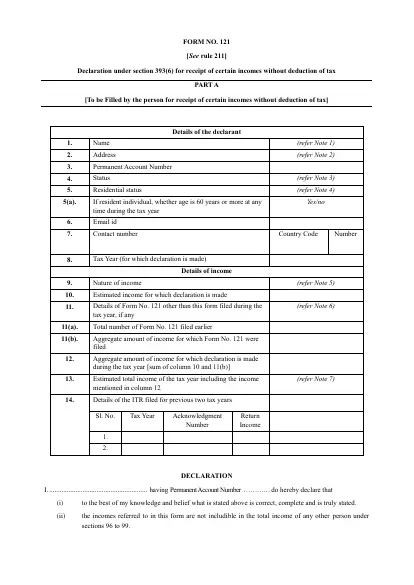
This flat form has no fields, so you type each answer next to its printed label. Row 1 is your name in full: first, middle and last name, with no abbreviations (Note 1). Row 2 is your address with country, flat or building, road, PIN code, post office, area, district and state (Note 2). Rows 3 to 5 are your PAN, your status (individual, or another person that is not a company or firm, per Note 3) and your residential status: Resident, Non-resident, or Resident but not ordinarily resident (Note 4). In row 5(a) write Yes or No to whether you are 60 or more at any time in the tax year, then give your email, your contact number with country code and, in row 8, the tax year.
Rows 9 and 10: details of income
In row 9, name the kind of income the declaration covers, using the list in Note 5: EPF accumulated balance, insurance commission, rent from a specified person, income from mutual fund units, interest on securities or deposits (bank, co-operative bank, post office or specified person), life insurance payouts, or dividend from a domestic company. In row 10, enter the amount of that income you expect for which you are making this declaration. Amounts are in rupees (Note 14).
Rows 11 to 13: other declarations and your total income
If you have already given Form 121 to other payers (or for other deposits) during the same tax year, enter how many in row 11(a) and the total income they covered in row 11(b) (Note 6). Row 12 is the sum of row 10 and row 11(b). Row 13 is your estimated total income for the whole tax year, including the amount in row 12, worked out after deductions under Chapter VIII, set-off of any house property loss and the rebate under section 156 (Notes 7 and 10).
Row 14: returns for the previous two tax years
The small table asks for the income tax returns you filed for the two previous tax years: for each, the tax year, the acknowledgement number of the return and the income you returned. These details are on the ITR acknowledgement for each year.
Declaration and signature (end of Part A)
Type your name and PAN in the opening line, and the tax year in items (iii) and (iv). Item (iii) states that tax on your estimated total income in row 13 will be nil; item (iv) states that the income in row 12 does not exceed the maximum amount not chargeable to tax, and does not apply to a resident individual aged 60 or more. Fill in the place and date and your name under the signature line. If you hand over a paper copy, print it and sign it by hand above Signature of the Declarant: the signature is not typed.
Part B: left for the payer
Leave Part B blank. It is completed by the bank or other payer that receives your declaration: its name, address, TAN, PAN and contact details, your details as received, the unique identification number it allots to the declaration, and the date of receipt, with the signature of its authorised person (Note 8).
After you fill it out
Give Part A to each payer separately: every bank, post office or company that pays you income covered by the form needs its own declaration. The department's FAQ says to give it before the income is credited or paid, preferably at the start of the tax year, either electronically through the payer's own portal where it offers one, or on paper: print the filled Part A, sign it by hand and hand it over. You do not file Form 121 with the Income Tax Department. The payer checks it, completes Part B, allots a unique identification number (UIN) and reports the declarations quarterly on the e-filing portal and in its TDS statement. Note 9 says the payer accepts the declaration where the tax on your estimated total income will be nil.
Signing: The declarant signs Part A; the payer's authorised person signs Part B. The department's FAQ describes two modes: electronic submission with digital verification on the payer's portal, or a paper declaration, which you print and sign by hand.
Watch out for
- For a tax year beginning on or after 1 April 2026 the declaration must be made in Form No. 121; Forms 15G and 15H belong to the Income-tax Rules, 1962.
- Unless you are a resident individual aged 60 or more, the payer must not accept the declaration when this kind of income paid or credited during the tax year exceeds the maximum amount not chargeable to tax (Note 11).
- A false statement in the declaration makes you liable to prosecution under section 482 (Note 12).
- A valid PAN is required; the department's FAQ says incomplete or incorrect details can make the declaration invalid.
- One declaration covers one payer: give a separate Form 121 to every payer.
Questions about Form 121
Is Form 121 the new Form 15G and Form 15H?
Yes. Under the Income-tax Rules, 2026, Form No. 121 replaced both forms from 1 April 2026. Form 15G was for individuals below 60 and other persons such as HUFs and trusts; Form 15H was for resident senior citizens. Both groups now use Form 121, and the eligibility conditions stay the same under section 393(6) of the Income-tax Act, 2025.
Who can give Form 121?
According to the department's FAQ, an individual below 60, or another person such as an HUF or trust (not a company or firm), can give it only if the tax on estimated total income for the tax year is nil and the total of these incomes does not exceed the maximum amount not chargeable to tax. An individual aged 60 or more can give it if the tax on estimated total income is nil.
Do I send Form 121 to the Income Tax Department?
No. You give Part A to the payer, such as your bank. The payer completes Part B, allots a unique identification number and reports the declaration to the department in its quarterly filings and TDS statement.
When should I submit it?
The department's FAQ says ideally before the income is credited or paid, preferably at the start of the tax year, so that tax is not deducted in the first place. If tax has already been deducted, the FAQ notes you would have to go through the refund process.
Can I submit Form 121 online?
Many payers accept it electronically on their own portals with digital verification, which the department calls the preferred method; otherwise you give a signed paper copy. The department also notes that, from 1 April 2027, Form 121 may be given electronically to a depository for income from listed securities, units or dividends held with it.
Official information
- Form No. 121 – Frequently Asked Questions (Income Tax Department)
- Income Tax Forms (2026)
- FAQs on the transition to the Income-tax Act, 2025
Page text last reviewed November 13, 2026.
Related forms
- Form 124Statement showing particulars of claims by an employee for deduction of tax under section 392(5)(b)Income Tax DepartmentType anywhere
- Form 97Form for declaration to be filed by any person (other than a company or firm) or a foreign company covered by sub-rule (2) to rule 159, who does not have a permanent account number and who enters into any transaction specified in rule 159Income Tax DepartmentType anywhere
- Form 93 (PAN application)Application for Allotment of Permanent Account Number [For an Individual being a Citizen of India]Income Tax DepartmentType anywhere