Income Tax Department, Government of India
Fill out Form 97 online
Form for declaration to be filed by any person (other than a company or firm) or a foreign company covered by sub-rule (2) to rule 159, who does not have a permanent account number and who enters into any transaction specified in rule 159
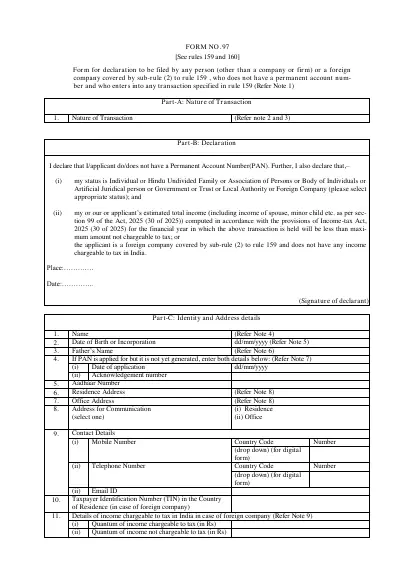
Form No. 97 is the declaration a person without a PAN (Permanent Account Number) gives when entering into one of the transactions listed in rule 159 of the Income-tax Rules, 2026, such as buying or selling property, opening certain accounts or making a time deposit. It replaced Form 60 from 1 April 2026. The form records the transaction, a declaration that you have no PAN and that your estimated total income is below the maximum amount not chargeable to tax, your identity and address, and the documents you show as proof. It is given to the bank, registrar or other person you are dealing with, who reports the declarations to the department in Form No. 98.
This form has no fillable fields, so it opens in our PDF editor with the Text tool ready: click where an answer goes and type. To download it, the filled PDF is sent to GuruPDF to prepare the file and is deleted from our servers one hour later. You can fill it in without an account; downloading the filled PDF needs a free account. A free account gets 15 credits a day, enough for one form a day.
- Country
- India
- Edition
- Income-tax Rules, 2026 (from 1 April 2026)
- Pages
- 5
- Fillable fields
- Type anywhere
- Last checked at the source
- November 13, 2026
GuruPDF is an independent PDF editor, not a government agency, and is not affiliated with any government. This page explains the form in plain words; it is not legal or tax advice. Always check the official instructions before you file.
Who uses Form 97
- Individuals, HUFs and other persons (not a company or firm) without a PAN who enter into a transaction listed in rule 159
- People who have applied for a PAN that has not yet been allotted
- Parents or guardians signing for a minor who has no PAN
- Foreign companies covered by rule 159(2) with no income chargeable to tax in India
- Banks, insurers and other persons you deal with in a listed transaction, who receive the declaration and report it in Form No. 98
Before you start
- The nature of the transaction (Note 2 lists the codes) and its date, total amount, cash part and mode of payment
- If the transaction is in joint names: how many persons are involved and your share in per cent
- Your name in full, date of birth (or incorporation) and, for an individual, your father's name
- Your Aadhaar number, residence and office addresses, mobile number and email
- If you have applied for a PAN: the date of application and acknowledgement number
- Documents for proof of identity, address and date of birth, with their numbers and issuing authority (Note 13)
How to fill out Form 97
Part A: nature of transaction
This flat form has no fields, so you type each answer next to its printed label. In item 1, enter the code of the transaction from Note 2: 01 purchase, sale, gift or joint development agreement of immovable property; 02 opening an account (other than basic savings and time deposit); 03 investment in a time deposit; 04 starting an account-based relationship with an insurer; 05 payment to a hotel, restaurant, convention centre, banquet hall or event manager; 06 sale or purchase of other goods and services.
Part B: declaration
Part B declares that you do not have a PAN. In item (i), mark your status: Individual, Hindu Undivided Family, Association of Persons, Body of Individuals, Artificial Juridical Person, Government, Trust, Local Authority or Foreign Company. Item (ii) states that your estimated total income for the financial year of the transaction, including income of a spouse or minor child as per section 99, is below the maximum amount not chargeable to tax, or that you are a foreign company with no income chargeable to tax in India. Fill in the place and date; the signature goes under it.
Part C: identity and address details
Give your name in full (Note 4), date of birth or incorporation, and, for an individual, your father's name. Item 4 is for a PAN you have applied for but not yet received: the date of application and the acknowledgement number. Note 7 says that if your estimated total income exceeds the maximum amount not chargeable to tax you should apply for a PAN, fill in item 4 and show proof of the application. Then add your Aadhaar number, residence and office addresses (Note 8), which address is for communication, and your mobile, telephone and email. Items 10 and 11 are only for a foreign company: its tax identification number abroad and its income chargeable and not chargeable to tax in India.
Part D: details of the transaction
Enter the date of the transaction, its total amount in rupees in item 2 and, in item 3, how much of it is paid in cash. In item 4, give the mode code from Note 12: 01 cash, 02 cheque, 03 card, 04 draft or banker's cheque, 05 online transfer, 06 mixed, 07 UPI, 08 others. If the transaction is in joint names, item 5 asks for the number of persons involved and your share in per cent (Note 10).
Part E: documents submitted as proof
For each of proof of identity, proof of address and proof of date of birth or incorporation, give the document code from the table in Note 13, the document's identification number, and the name and address of the authority that issued it. For example, an Aadhaar card is code 01 and counts for identity and address, while a passport (06) or driving licence (05) also counts for date of birth. These proofs are not required if you have applied for a PAN and filled in item 4 of Part C. For a minor, a parent's or guardian's documents are used and the parent or guardian signs; for an HUF, documents in the Karta's name.
Part F: verification
Type your name and your father's, mother's or husband's name in the line 'son or daughter or wife of Shri', the transaction and your capacity (self or representative assessee) in item 2, then the date and place, your name and, where relevant, your designation. Print the form and sign it by hand under Part B and Part F.
After you fill it out
Give the signed declaration, with copies of your proof documents, to the bank, insurer, registrar or business with which you enter into the transaction, at the time of the transaction. You do not file Form 97 with the Income Tax Department. The person who receives it files half-yearly statements of the declarations it received in Form No. 98. A foreign company's declaration is not accepted if it shows income chargeable to tax in item 11(i) of Part C (Note 9).
Signing: The declarant signs under Part B (declaration) and Part F (verification); for a minor, the parent or guardian signs (Note 13). On paper, print the form and sign it by hand in both places; if the bank or business receiving it has its own way to sign, follow it.
Watch out for
- Form 97 is only for people who do not have a PAN. If your estimated total income exceeds the maximum amount not chargeable to tax, Note 7 says to apply for a PAN and give the application details in item 4 of Part C.
- Before signing, make sure the information is true, correct and complete: a false statement makes the declarant liable to prosecution under section 482 (Note 1).
- Parts A to F are to be filled in for all six kinds of transaction (Note 3).
- The department notes that the transactions in rule 159(2) are not exactly the same as those that needed Form 60 under the 1962 Rules.
Questions about Form 97
Is Form 97 the new Form 60?
Yes. The department's transition FAQ says Form No. 97 under the Income-tax Act, 2025 replaces Form No. 60, for persons without a PAN who enter into a transaction specified in rule 159(2) of the Income-tax Rules, 2026. The list of transactions has changed somewhat from the old rules.
Which transactions need Form 97?
Note 2 of the form lists six: purchase, sale, gift or joint development agreement of immovable property; opening an account other than a basic savings or time deposit account; a time deposit; starting an account-based relationship with an insurer; payments to a hotel, restaurant, convention centre, banquet hall or event manager; and sale or purchase of other goods and services. Whether a particular amount needs a PAN or Form 97 is set by rule 159, so ask the bank or business you are dealing with.
When is Form 97 due?
The department's transition FAQ says the declarant gives Form 97 at the time of entering into the specified transaction. The person receiving it files Form No. 98 by 31 October for declarations received from April to September, and by 30 April of the next financial year for those received from October to March.
Do I need to attach identity documents?
Yes, unless you have applied for a PAN and filled in item 4 of Part C. Part E records the proof of identity, address and date of birth, chosen from the document table in Note 13.
Can someone sign for a minor?
Yes. Note 13 says that for a transaction in a minor's name, a parent's or guardian's documents serve as the minor's proof of identity and address, and the declaration should be signed by the parent or guardian.
Official information
- Income Tax Forms (2026)
- FAQs on the transition to the Income-tax Act, 2025 (Form 97 and Form 98)
- Apply for PAN (Income Tax Department)
Page text last reviewed November 13, 2026.
Related forms
- Form 93 (PAN application)Application for Allotment of Permanent Account Number [For an Individual being a Citizen of India]Income Tax DepartmentType anywhere
- Form 95 (PAN for foreign citizens)Application for Allotment of Permanent Account Number [For an Individual not being a Citizen of India]Income Tax DepartmentType anywhere
- Form 121Declaration under section 393(6) for receipt of certain incomes without deduction of taxIncome Tax DepartmentType anywhere