Canada Revenue Agency
Fill out Form T2125 online
Statement of Business or Professional Activities
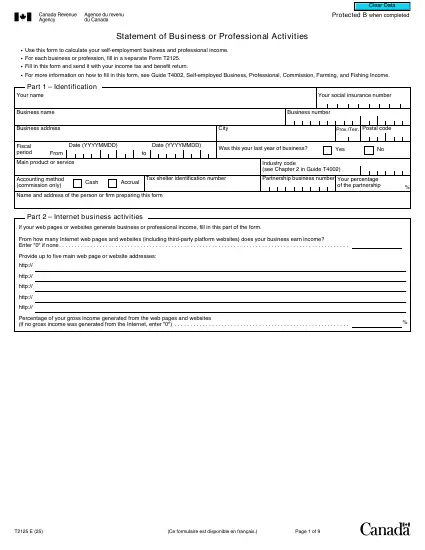
Form T2125, Statement of Business or Professional Activities, is how a self-employed person in Canada calculates the income and expenses of a business or profession for their personal tax return. This edition is for the 2025 tax year. It covers sole proprietors and partners, including freelancers, gig and platform workers, online sellers and self-employed commission agents. The net income it produces goes on lines 13500, 13700 or 13900 of your T1 return, and the form is sent with that return.
The form opens in our PDF editor with its own fields ready to type into. To download it, the filled PDF is sent to GuruPDF to prepare the file and is deleted from our servers one hour later. You can fill it in without an account; downloading the filled PDF needs a free account. A free account gets 15 credits a day, enough for one form a day.
- Country
- Canada
- Edition
- Edition 2025
- Pages
- 9
- Fillable fields
- 429
- Last checked at the source
- November 13, 2026
GuruPDF is an independent PDF editor, not a government agency, and is not affiliated with any government. This page explains the form in plain words; it is not legal or tax advice. Always check the official instructions before you file.
Who uses Form T2125
- Sole proprietors and freelancers with business income
- Self-employed professionals such as consultants, accountants or therapists
- Gig, ridesharing, accommodation-sharing and online-platform workers, and social media influencers with business income
- Self-employed commission agents
- Partners in a partnership reporting their share of income
Before you start
- Your social insurance number, business name, business number and business address
- The start and end dates of your fiscal period (generally the calendar year)
- Your six-digit industry code (NAICS); Chapter 2 of Guide T4002 explains how to choose it
- Your sales or fees for the year, including GST/HST collected or collectible, and your GST/HST records
- Receipts and records for each business expense, and your opening and closing inventory if you sell goods
- A vehicle logbook with business and total kilometres, if you claim motor vehicle expenses
- Your home's expenses and the share used for business, if you claim business-use-of-home expenses
- Your capital cost allowance (CCA) records from last year, and any T5013 slip if you are in a partnership
How to fill out Form T2125
Part 1 – Identification
Enter your name, SIN, business name, business number and business address, and the fiscal period (From and to dates, YYYYMMDD). Say whether this was your last year of business, describe your main product or service and enter your industry code. Choose the accounting method: the accrual method, or the cash method, which the form allows for commission income only. Partners enter the partnership business number and their percentage; also fill in any tax shelter identification number and the name and address of whoever prepared the form.
Part 2 – Internet business activities
If your business earns income from web pages or websites, including third-party platforms, enter how many pages and sites ("0" if none), up to five main addresses, and the percentage of your gross income they generated. Guide T4002 says this includes selling on your own site or on online marketplaces and earning from advertising or affiliate programs.
Parts 3A to 3C – Gross business or professional income
Fill in Part 3A for business income or Part 3B for professional income, not both; if you have both kinds, fill out a separate T2125 for each. Enter gross sales, commissions or fees including GST/HST (3A or 3H), subtract GST/HST, provincial sales tax, returns, allowances and discounts (3B or 3I), and add the government assistance lines if you use the quick method for GST/HST. In Part 3C, carry the result to line 8000, add reserves deducted last year (line 8290) and other income (line 8230), and get gross income on line 8299, which goes on line 13499, 13699 or 13899 of your return.
Part 3D – Cost of goods sold and gross profit
If you have business income from selling goods, enter only the business part of opening inventory (line 8300), purchases (8320), direct wage costs (8340), subcontracts (8360) and other costs (8450), then subtract closing inventory (8500). The cost of goods sold is line 8518 and your gross profit or loss is line 8519.
Part 4 – Expenses and net income before adjustments
Enter only the business part of each expense: advertising (8521), meals and entertainment (8523), bad debts, insurance, interest and bank charges, business taxes and licences, office expenses and supplies, professional fees, rent, repairs, salaries and wages, property taxes, travel, utilities, fuel, delivery, motor vehicle expenses from Chart A (9281), capital cost allowance from Area A (9936) and other expenses (9270). Total expenses go on line 9368 and net income or loss before adjustments on line 9369.
Part 5 – Your net income (loss)
Enter your share of line 9369 (or the amount from your T5013 slip), add any Canadian journalism labour tax credit allocated to you and the GST/HST rebate for partners (line 9974), and subtract other amounts from Part 6 (line 9943) to get amount 5D. Subtract business-use-of-home expenses from Part 7 (line 9945). Your net income or loss is line 9946, which goes on line 13500, 13700 or 13900 of your return.
Parts 6 to 9 – Partnership amounts, home office, partners and equity
Part 6 lists expenses a partner paid that the partnership did not reimburse. Part 7 calculates business-use-of-home expenses: heat, electricity, insurance, maintenance, mortgage interest, property taxes and other costs, minus the personal-use part, plus CCA and any amount carried forward; the claim cannot be more than amount 7N, and the rest carries forward (7O). Part 8 lists the other partners, unless the partnership files a partnership information return, and Part 9 asks for total business liabilities (9931), drawings (9932) and capital contributions (9933).
Areas A to G and Charts A to C – CCA and vehicles
Area A calculates capital cost allowance class by class, using equipment and building additions (Areas B and C, lines 9925 and 9927) and dispositions (Areas D and E, lines 9926 and 9928); Area F records land, on which no CCA can be claimed, and Area G is for associated eligible persons or partnerships sharing the immediate expensing limit. Chart A works out allowable motor vehicle expenses from business kilometres divided by total kilometres, plus business parking and supplementary insurance. Charts B and C limit interest and leasing costs for passenger vehicles.
After you fill it out
Send Form T2125 with your income tax and benefit return; if you file on paper, attach it to the return you mail. Report gross income from line 8299 and net income from line 9946 on the lines the form names. Fill out a separate T2125 for each business or profession. Guide T4002 says self-employed people and their spouses or common-law partners have until June 15, 2026 to file their 2025 return, but any balance owing is due by April 30, 2026. Keep your records and receipts in case the CRA asks to see them.
Signing: Form T2125 has no signature line. It is filed as part of your income tax and benefit return, which you sign.
Watch out for
- Fill out a separate T2125 for each business, and a separate one if you have both business and professional income.
- Farming and fishing income do not go on this form: Guide T4002 sends them to Form T2042 and Form T2121.
- Business-use-of-home expenses cannot create or increase a business loss; the unused part is carried forward.
- A loss from the disposition of a flipped property is deemed to be zero and is not reported on the return, but the form says to include the details on it.
- Totals, CCA and the charts are not guaranteed to calculate automatically: enter each amount yourself and check the arithmetic.
Questions about Form T2125
Do gig workers and online sellers use Form T2125?
Yes, if the income is business income. Guide T4002 says Part 3A includes income from ridesharing and accommodation sharing, gig economy activities, peer-to-peer sales on online platforms and social media influencer activities, including non-monetary items received in the course of the business.
When is Form T2125 due?
It is filed with your 2025 income tax and benefit return. Guide T4002 gives June 15, 2026 as the filing deadline when you or your spouse or common-law partner have self-employment income, with any balance owing due by April 30, 2026.
Can I use my own financial statements instead?
Guide T4002 says the CRA encourages you to use Form T2125 but will continue to accept other types of financial statements.
Which industry code do I enter?
Enter the six-digit North American Industry Classification System (NAICS) code that best describes your main activity. Guide T4002 explains how to choose one when your business does more than one thing; tax software provides its own list.
Can I claim my home office?
Part 7 calculates business-use-of-home expenses. The CRA allows them if the workspace is your principal place of business, or if you use it only to earn business income and regularly to meet clients, customers or patients.
Official information
- T2125 Statement of Business or Professional Activities (CRA)
- Guide T4002, Self-employed Business, Professional, Commission, Farming, and Fishing Income
- Report business income and expenses
- Business-use-of-home expenses
Page text last reviewed November 13, 2026.