Canada Revenue Agency
Fill out T1 Income Tax and Benefit Return online
T1 2025 Income Tax and Benefit Return
The T1 Income Tax and Benefit Return is the personal income tax return individuals file with the Canada Revenue Agency (CRA). This edition, form 5000-R, is for the 2025 tax year, and the CRA says it is the return for residents of Saskatchewan, Manitoba, New Brunswick, Nova Scotia and Prince Edward Island on December 31, 2025; residents of other provinces and territories use the version in their own province's tax package. You report your income from all sources, claim deductions and credits, and work out your refund or balance owing. The same return claims refundable credits such as the Canada workers benefit (line 45300).
The form opens in our PDF editor with its own fields ready to type into. To download it, the filled PDF is sent to GuruPDF to prepare the file and is deleted from our servers one hour later. You can fill it in without an account; downloading the filled PDF needs a free account. A free account gets 15 credits a day, enough for one form a day.
- Country
- Canada
- Edition
- 2025 (5000-R)
- Pages
- 8
- Fillable fields
- 286
- Last checked at the source
- November 13, 2026
GuruPDF is an independent PDF editor, not a government agency, and is not affiliated with any government. This page explains the form in plain words; it is not legal or tax advice. Always check the official instructions before you file.
Who uses T1 Income Tax and Benefit Return
- Residents of Saskatchewan, Manitoba, New Brunswick, Nova Scotia and Prince Edward Island filing a 2025 return on paper
- People who cannot or prefer not to file electronically with NETFILE certified software
- Employees, pensioners and benefit recipients reporting their 2025 slips
- Self-employed people, who attach Form T2125 or a similar statement
- Newcomers and people who left Canada in 2025 who file as residents for part of the year
- People filing a final return for someone who died
Before you start
- Your social insurance number (or temporary or individual tax number) and date of birth
- Your slips: T4, T4A, T4A(OAS), T4A(P), T4E, T5, T3, T5007, RC62, T4RSP, T4FHSA and any others you received
- Receipts for deductions and credits you claim, such as RRSP and FHSA contributions, union dues, child care, medical expenses and donations
- Your spouse's or common-law partner's SIN and net income (line 23600 of their return)
- The Form 428 for your province or territory, the Federal Worksheet and any schedules that apply (for example Schedule 3, 5, 7, 8 or 9)
- Your most recent notice of assessment, which shows amounts such as your RRSP deduction limit
- Records of tax instalments you paid in 2025
How to fill out T1 Income Tax and Benefit Return
Step 1 – Identification and other information
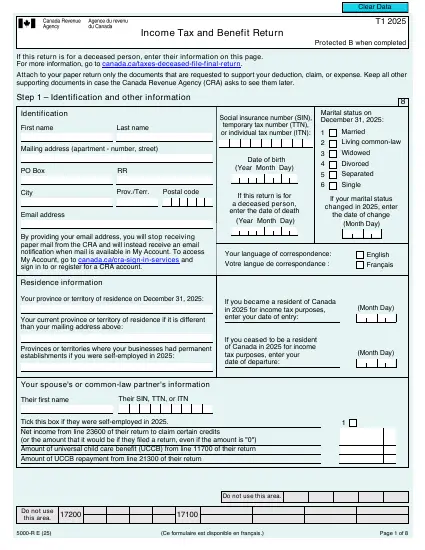
Enter your first and last name, SIN, TTN or ITN, mailing address, date of birth and your marital status on December 31, 2025 (married, living common-law, widowed, divorced, separated or single). Giving an email address means you stop receiving paper mail from the CRA and get email notices that mail is waiting in My Account. Under Residence information, enter your province or territory of residence on December 31, 2025 (this 5000-R return is only for Saskatchewan, Manitoba, New Brunswick, Nova Scotia and Prince Edward Island; if you lived anywhere else, stop and use the return in your own province's or territory's package), and dates of entry to or departure from Canada if you became or stopped being a resident in 2025. If you have a spouse or common-law partner, enter their first name, SIN and net income from line 23600 of their return.
Step 1 (continued) – Elections Canada, Indian Act and foreign property
Answer question A (Canadian citizenship) and, if you are a citizen, question B, which authorizes the CRA to give your name, address, date of birth and citizenship to Elections Canada. Tick the Indian Act box if you have exempt income, and complete Form T90. On line 26600, answer whether the total cost of your specified foreign property was more than CAN$100,000 at any time in 2025; if yes, you also file Form T1135.
Step 2 – Total income
Report income from all sources inside and outside Canada, using your slips: employment income on line 10100 (box 14 of your T4 slips), other employment income, OAS pension, CPP or QPP benefits, other pensions, EI benefits (line 11900), dividends, interest, rental income (Form T776), taxable capital gains (Schedule 3), support payments, RRSP and FHSA income and other income. Self-employment income goes on lines 13499 to 14300 as gross and net amounts, usually from Form T2125. Workers' compensation, social assistance and net federal supplements go on lines 14400 to 14600. The total is line 15000.
Step 3 – Net income
Start from line 15000 and claim the deductions that apply, such as the RPP deduction (line 20700), RRSP deduction (line 20800, with Schedule 7), FHSA deduction (line 20805), union and professional dues (line 21200), child care expenses (line 21400, Form T778), moving expenses (line 21900), support payments made, carrying charges, CPP or QPP deductions from Schedule 8 and other employment expenses (line 22900). Subtract any social benefits repayment on line 23500. The result is your net income on line 23600.
Step 4 – Taxable income
From line 23600, subtract deductions such as the Canadian Armed Forces and police deduction, security options deductions, other payments deduction, losses of other years, capital gains deductions and northern residents deductions (Form T2222). The result is your taxable income on line 26000.
Step 5 – Federal tax
In Part A, use the column that matches your line 26000 amount to calculate federal tax on taxable income. In Part B, claim your federal non-refundable tax credits, starting with the basic personal amount (line 30000), the age amount, amounts for a spouse or dependants (Schedule 5), CPP and EI amounts, the Canada employment amount, pension income amount, disability amount, tuition (Schedule 11), medical expenses and donations (Schedule 9); the total is line 35000. Part C subtracts these and other credits to give your net federal tax on line 42000.
Step 6 – Refund or balance owing
Add CPP and EI amounts payable on self-employment, any social benefits repayment and your provincial or territorial tax from your Form 428 (line 42800) to get total payable on line 43500. Then subtract total credits on line 48200: income tax deducted from your slips (line 43700), CPP or EI overpayments, the Canada workers benefit (Schedule 6), instalments paid and provincial credits. If the result is negative, enter it as a refund on line 48400; if positive, it is a balance owing on line 48500, which the form says is due no later than April 30, 2026.
Certification and tax professional
Sign the certification, and enter your telephone number and the date. If a tax professional completed the return, tick whether a fee was charged (line 49000) and enter their name, telephone number and EFILE number (line 48900). Leave the areas marked "Do not use this area" blank.
After you fill it out
Print the return, sign it, and send it with your Form 428, the schedules and forms you completed, and the documents the CRA asks for, such as copies of your slips. The CRA says the only way to send a paper return is by mail, to the tax centre for where you live (see the CRA's page on where to mail your paper T1 return), using a separate envelope for each person. The CRA then sends you a notice of assessment with your refund or balance owing. Keep your supporting documents for six years. If you notice a mistake after filing, do not file a second return: wait for your notice of assessment and then ask for a change.
Signing: You sign the certification on page 8 of the return you mail. The T1 return is not on the CRA's list of forms that accept an electronic signature, so print it and sign it by hand. Returns sent with NETFILE or EFILE software are certified through that software instead of this form.
Watch out for
- This 5000-R return is only for people who lived in Saskatchewan, Manitoba, New Brunswick, Nova Scotia or Prince Edward Island on December 31, 2025. Residents of Ontario, Alberta, British Columbia, Newfoundland and Labrador, Quebec and the territories, and non-residents, use the return in their own tax package on the CRA's "Get a T1 income tax package" page.
- The form says to complete and attach your provincial or territorial Form 428 even if the result is "0"; it is not part of this PDF.
- The form warns of substantial penalties for not filing Form T1135 on time if your specified foreign property cost more than CAN$100,000 at any time in the year.
- Calculated lines and totals are not guaranteed to fill in automatically: enter every amount, including totals, yourself and check the arithmetic before you print.
- If you have a balance owing, paying after the due date leads to interest; the CRA's due dates page lists the dates.
Questions about T1 Income Tax and Benefit Return
Which T1 return should I use?
Use the income tax package for the province or territory where you lived on December 31, 2025. The CRA's 5000-R page says this return is for residents of Saskatchewan, Manitoba, New Brunswick, Nova Scotia and Prince Edward Island. Ontario, Alberta, British Columbia, Newfoundland and Labrador, Quebec and each territory have their own version, and non-residents and deemed residents use the "Outside Canada" package; all of them are listed on the CRA's "Get a T1 income tax package" page.
When is the 2025 return due?
The CRA lists April 30, 2026 as the filing and payment deadline for most people. If you or your spouse or common-law partner were self-employed, the filing deadline is June 15, 2026, but any balance owing is still due by April 30, 2026.
Can I email or upload a paper return?
No. The CRA says the only way to send a paper return is by mail. To file electronically, use NETFILE certified tax software, which does not use this PDF.
What if I made a mistake on my return?
Do not file another return for the same year. Wait for your notice of assessment, then ask for a change with Change my return in your CRA account, the ReFILE service in certified software, or Form T1-ADJ by mail.
I live in Quebec. Is this my return?
No. Quebec residents use the federal income tax package for residents of Quebec, which covers federal tax only, and also file a separate provincial return with Revenu Québec.
Official information
- 5000-R Income Tax and Benefit Return (CRA)
- Get a T1 income tax package (all provinces and territories)
- Federal income tax and benefit information for 2025
- Filing a paper tax return
- Where to mail your paper T1 return
Page text last reviewed November 13, 2026.
Related forms
- Form T2125Statement of Business or Professional ActivitiesCRAFill online
- Form T2200Declaration of Conditions of EmploymentCRAFill online
- Form T1-ADJT1 Adjustment RequestCRAFill online
- Form TD12026 Personal Tax Credits ReturnCRAFill online
- Form RC66Canada Child Benefit ApplicationCRAFill online
- Form T2201Disability Tax Credit CertificateCRAFill online