Canada Revenue Agency
Fill out Form RC66 online
Canada Child Benefit Application
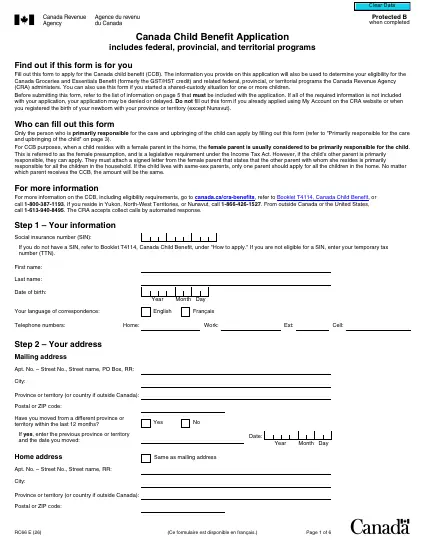
Form RC66 is the paper application for the Canada child benefit (CCB), a monthly payment the Canada Revenue Agency (CRA) makes to families caring for children under 18. The CRA also uses the information to decide eligibility for the Canada Groceries and Essentials Benefit (formerly the GST/HST credit) and related federal, provincial and territorial programs, so you do not apply for those separately. Only the person primarily responsible for the care and upbringing of the child fills it out, and it is also used when a shared-custody situation starts. This is the 2026 version of the form (RC66 E (26)), mailed to your CRA tax centre.
The form opens in our PDF editor with its own fields ready to type into. To download it, the filled PDF is sent to GuruPDF to prepare the file and is deleted from our servers one hour later. You can fill it in without an account; downloading the filled PDF needs a free account. A free account gets 15 credits a day, enough for one form a day.
- Country
- Canada
- Edition
- Edition 2026
- Pages
- 6
- Fillable fields
- 79
- Last checked at the source
- November 13, 2026
GuruPDF is an independent PDF editor, not a government agency, and is not affiliated with any government. This page explains the form in plain words; it is not legal or tax advice. Always check the official instructions before you file.
Who uses Form RC66
- Parents of a newborn who did not apply when registering the birth or online in their CRA account
- A person who starts caring for a child, or whose child comes back to live with them
- Parents who begin, end or change a shared-custody arrangement
- Newcomers to Canada and returning residents with children who meet the CCB eligibility rules (together with Form RC66SCH)
- A parent who is primarily responsible for the children when the female parent in the home is not, with her signed letter
- Anyone who is unable to apply online in their CRA account or through birth registration
Before you start
- Your social insurance number (SIN), or your temporary tax number (TTN) if you are not eligible for a SIN
- Your spouse's or common-law partner's SIN (or TTN), name and date of birth, if you have one
- The date your current marital status began
- Each child's name, date of birth, city and province, territory or country of birth
- The date each child started living with you more than 60% of the time, or 40% to 60% of the time
- Proof of birth for any child the CRA has never paid benefits for
- Form RC66SCH if you or your spouse or partner have not been a Canadian citizen for the last 12 months, or became a newcomer or returned to Canada in the last two years
- Form RC66-1 (or a separate sheet) if you are applying for more than two children
How to fill out Form RC66
Step 1 – Your information
Enter your social insurance number (SIN), first name, last name and date of birth (year, month, day). If you are not eligible for a SIN, enter your temporary tax number (TTN) instead. Choose English or Français as your language of correspondence and give your home, work and cell telephone numbers.
Step 2 – Your address
Enter your mailing address: apartment and street number, street name, PO box or rural route, city, province or territory (or country if outside Canada) and postal or ZIP code. Answer whether you moved from a different province or territory within the last 12 months; if yes, enter the previous province or territory and the date you moved. Tick "Same as mailing address" or enter your home address separately.
Step 3 – Your marital status
Select one status: married, living common-law, separated, widowed, divorced or single. The form defines each one; for example, you count as separated only after living apart for at least 90 days because the relationship broke down. Enter the date the status began (leave it blank if you have always been single). If you are married or living common-law, enter your spouse's or partner's SIN, name and date of birth, their address if it differs from yours, and tick the box if they are a non-resident of Canada.
Steps 4 and 5 – Citizenship status and newcomers
Step 4 asks whether you, and your spouse or common-law partner, have been Canadian citizens for the last 12 months. Step 5 asks whether either of you became a newcomer to Canada, or returned after an absence of at least six months, within the last two years. If you answer no in Step 4 or yes in Step 5, you also have to fill out Form RC66SCH, Status in Canada and Income Information, and send it with this form.
Step 6 – Information about the child(ren)
For each child, enter the first name, last name, gender, date of birth, city of birth and province, territory or country of birth. Answer whether the child lives with you more than 60% of the time; if yes, enter the date that started or tick "Since birth". If not, select either 40% to 60% of the time (shared custody, with the start date) or less than 40% of the time, which the CRA does not consider eligible. The form has room for two children; use Form RC66-1 or a separate sheet for more, and do not list a child you already applied for unless the child returned to your care or the share of time changed.
Step 7 – Signature
Sign and date the form to certify that the information on it and in any attached document is correct and complete. The form notes that making a false statement is a serious offence.
After you fill it out
Check the "What to attach to this form" list on page 5, then make a copy of the form and your documents for your records and mail everything to the CRA tax centre that serves your area (the chart on page 6 of the form and the CRA's how-to-apply page show which one). Do not send this form if you already applied in your CRA account or when you registered your newborn's birth. Once the CRA processes the application it sends you a CCB notice showing whether you are eligible, how much you will get and what information it used. To keep receiving payments, you and your spouse or common-law partner must file a tax return every year, even with no income. The form has no banking section; the CRA's direct deposit page explains how to get payments into your account.
Signing: You, the applicant, sign and date Step 7. The CRA receives this form on paper by mail, and it is not on the CRA's list of forms that accept an electronic signature, so print the completed form and sign it by hand before you send it. If the other parent is applying because they are primarily responsible for the children, attach a letter signed by the female parent saying so (not needed when both parents are of the same sex).
Watch out for
- Only the person primarily responsible for the child's care and upbringing can apply. When a child lives with a female parent, the law presumes she is that person; the other parent can apply only with her signed letter. Same-sex parents send one application for all the children.
- Proof of birth is required for any child the CRA has never paid benefits for, and the CRA says an application missing required information may be denied or delayed.
- Applying for a period that began more than 11 months ago needs extra documents for the whole period: proof of birth, at least three proofs that you lived in Canada, at least three proofs that you were primarily responsible for the child, and proof of citizenship or immigration status.
- Documents in a language other than English or French need a copy of the original together with an acceptable English or French translation.
- The CRA's page for this form says newcomers with children should now apply for the Canada Groceries and Essentials Benefit with Form RC151 when they arrive in Canada, and only those who meet the Canada child benefit eligibility rules should use Form RC66.
- If your spouse or common-law partner is a non-resident of Canada, the CRA also needs their income for each year they were a non-resident (Form CTB9).
Questions about Form RC66
Do I have to use Form RC66 to apply for the CCB?
No. The CRA lists two other ways: applying when you register your newborn's birth with your province or territory (not available in Nunavut), or applying online in your CRA account. Form RC66 is for people who cannot use those, and you should not send it if you already applied one of those ways.
Who should apply when both parents live with the child?
The female parent is presumed to be primarily responsible for all the children in the home and should apply. If the other parent is primarily responsible, they apply and attach a signed letter from the female parent. If the child lives with same-sex parents, one parent applies for all the children. The CRA says the amount is the same whichever parent receives it.
What is shared custody for the CCB?
The CRA considers you to be in shared custody if the child lives with you 40% to 60% of the time and the rest of the time with another person, generally at a different address. You select that option in Step 6 and give the date it started. If the child lives with you less than 40% of the time, the CRA does not consider you eligible for that child.
When do I need Form RC66SCH?
When you or your spouse or common-law partner have not been a Canadian citizen for the last 12 months, or when either of you became a newcomer to Canada or returned after an absence of at least six months within the last two years. It goes in the same envelope as Form RC66.
Do I need to keep doing anything after I am approved?
Yes. The form says you need to file your tax return on time every year so the CRA can calculate your payments, even if you had no income, and your spouse or common-law partner must do the same. If you stop filing, your payments stop. You also need to keep your personal information up to date with the CRA.
Official information
- Form RC66 (CRA)
- Canada child benefit: How to apply
- Canada child benefit: Who can apply
- Supporting documents for child benefits
- Form RC66SCH, Status in Canada and Income Information
Page text last reviewed November 13, 2026.