Canada Revenue Agency
Fill out Form T2201 online
Disability Tax Credit Certificate
Form T2201 is the paper application for the disability tax credit (DTC), a non-refundable tax credit that helps people with a severe and prolonged impairment in physical or mental functions, or their supporting family members, reduce the income tax they may have to pay. It has two parts: Part A is filled out and signed by the person with the disability or their legal representative, and Part B is filled out and certified by a medical practitioner. The CRA decides eligibility from the practitioner's information and sends a notice of determination. This is the 2023 version (T2201 E (23)); the CRA says paper applications must use version 23e or 23f, and since September 8, 2026 it no longer accepts versions from before 2023.
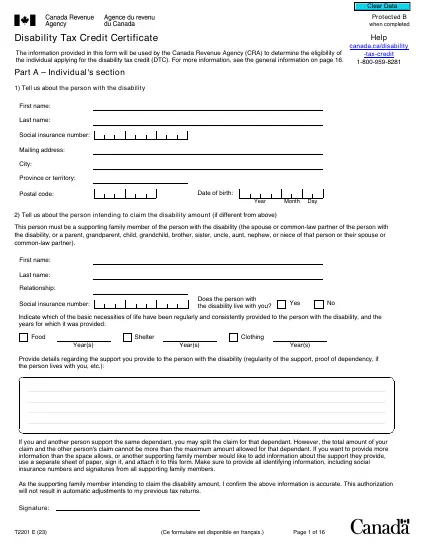
The form opens in our PDF editor with its own fields ready to type into. To download it, the filled PDF is sent to GuruPDF to prepare the file and is deleted from our servers one hour later. You can fill it in without an account; downloading the filled PDF needs a free account. A free account gets 15 credits a day, enough for one form a day.
- Country
- Canada
- Edition
- Edition 2023
- Pages
- 16
- Fillable fields
- 411
- Last checked at the source
- November 13, 2026
GuruPDF is an independent PDF editor, not a government agency, and is not affiliated with any government. This page explains the form in plain words; it is not legal or tax advice. Always check the official instructions before you file.
Who uses Form T2201
- People with a severe and prolonged impairment who want the CRA to decide whether they are eligible for the DTC
- Parents or legal guardians applying for a child under 18
- Legal representatives applying for a person with a disability
- Supporting family members who intend to claim the disability amount for a dependant
- Medical practitioners who fill out and certify Part B for a patient
Before you start
- The name, social insurance number, mailing address and date of birth of the person with the disability
- If a family member will claim the disability amount: their name, SIN, relationship and the years they provided food, shelter or clothing
- Your decision on whether the CRA should adjust previous tax returns if the credit is approved
- A medical practitioner who can certify the impairment (for example a medical doctor or nurse practitioner for any impairment, an optometrist for vision, an audiologist for hearing)
- Any legal documents showing that a legal representative may act for the person, if they have not already been sent to the CRA
How to fill out Form T2201
Part A, question 1 – Tell us about the person with the disability
Enter the first name, last name, social insurance number, mailing address, city, province or territory, postal code and date of birth of the person with the disability. The CRA says every one of these fields must be filled in, or the application may be returned.
Part A, question 2 – The person intending to claim the disability amount
Fill this in only if someone other than the person with the disability intends to claim the amount. That person must be a supporting family member, such as a spouse or common-law partner, parent, grandparent, child, sibling, aunt, uncle, niece or nephew. Enter their name, relationship and SIN, whether the person with the disability lives with them, which basic necessities (food, shelter, clothing) they provided and for which years, and details of the support. They sign this section; another supporting family member can add a signed separate sheet.
Part A, question 3 – Previous tax return adjustments
Answer whether you are the person with the disability or their legal representative (or legal guardian, if the person is under 18). Then choose whether, if the credit is approved, the CRA should adjust previous tax returns for all applicable years. If you answer no to the first question, or more than one person is claiming the amount, the form says to send a Form T1-ADJ for each year or a letter with the details instead.
Part A, question 4 – Individual's authorization (mandatory)
The person with the disability or their legal representative (or legal guardian for a person under 18) signs here, enters a telephone number and dates it. By signing, they certify the information, allow their medical practitioners to give the CRA information from their records, and authorize the return adjustments chosen in question 3. The CRA will not process the form without this signature.
Part B – Medical practitioner's section
Give the form to a medical practitioner, who fills out only the impairment sections that apply: vision, speaking, hearing, walking, eliminating (bowel or bladder functions), feeding, dressing, mental functions necessary for everyday life, the cumulative effect of significant limitations, and life-sustaining therapy. Most sections ask for the diagnosis, examples of how the impairment limits the patient, when it began and whether it has lasted or is expected to last at least 12 months. Part B is for the practitioner only; the CRA will not process it if the applicant fills it out.
Certification (mandatory)
On the last page, the medical practitioner enters the years the person has been their patient, says whether they have medical information on file for those years, ticks their practitioner type, and signs and dates the certification with their printed name, address and telephone number. The licence or registration number is optional.
After you fill it out
Make a copy for your records, then mail the complete form, Part A and Part B together, to a CRA tax centre listed on the form or on the CRA's how-to-apply page. Either you or the medical practitioner can mail it. You can send it at any time of year; the CRA suggests sending it before you file your tax return to avoid a delay in your assessment. Since July 14, 2026, the CRA does not accept DTC applications through "Submit documents" in your CRA account, so a scanned or PDF copy cannot be uploaded there. The CRA reviews the application and sends a notice of determination with its decision. The CRA also offers a digital application, where you fill out Part A in your CRA account or by phone and your practitioner completes Part B online; both parts must use the same method.
Signing: Part A, question 4 is signed by the person with the disability, or by their legal representative (or legal guardian if the person is under 18). A supporting family member claiming the amount also signs question 2. The medical practitioner signs the Certification in Part B. The CRA returns forms whose signatures are not handwritten, so print the form and sign it with a pen.
Watch out for
- The CRA does not accept paper versions of Form T2201 older than 2023; use the current version.
- Part A and Part B must be sent together and by the same method. Parts received separately are not treated as a complete application.
- The CRA returns applications with a missing or non-handwritten signature in Part A or Part B, or with the SIN, name, address or date of birth missing.
- Do not upload the form through "Submit documents" in your CRA account: since July 14, 2026, DTC applications must go through the digital application or by mail. "Submit documents" is only for extra information the CRA asks for on an existing case.
- You are responsible for any fee the medical practitioner charges to fill out the form. The "Validate and Print" button on the last page works only in Adobe Acrobat; the fields can still be typed in and the form printed.
Questions about Form T2201
Who decides whether I get the disability tax credit?
The CRA. Your medical practitioner provides information about the effects of your impairment, but does not decide eligibility. Eligibility is based on how the impairment restricts you, not on the condition itself, and not on your ability to work.
Which medical practitioners can fill out Part B?
A medical doctor or nurse practitioner can certify any impairment. An optometrist can certify vision, an audiologist hearing, a speech-language pathologist speaking, a psychologist mental functions, a physiotherapist walking, and an occupational therapist walking, feeding and dressing.
When should I send Form T2201?
At any time of year. The CRA reviews a DTC application before assessing a tax return sent with it, so it suggests submitting the DTC application before you file your return to avoid a possible delay.
Can the CRA apply the credit to past years?
Yes, if you ask for it in Part A, question 3 and you are the person with the disability or their legal representative (or legal guardian). If someone else is claiming the amount, or more than one person is, a Form T1-ADJ for each year or a letter is needed instead.
Can I type my signature on the PDF?
No. The CRA lists signatures that are not handwritten, including cursive typefaces, among the reasons it returns an application. Type the answers, print the form and sign it by hand.
Official information
- Form T2201 (CRA)
- Disability tax credit: How to apply
- Disability tax credit: Who is eligible
- Guide RC4064, Disability-Related Information
Page text last reviewed November 13, 2026.