Canada Revenue Agency
Fill out T1 Schedule 3 online
T1-2025 Schedule 3 Capital Gains or Losses
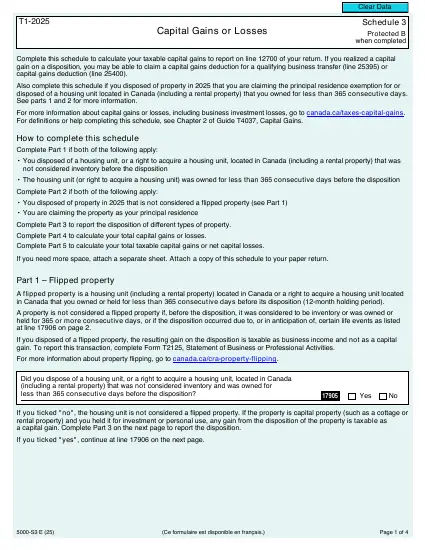
Schedule 3 of the T1 return is where you calculate your taxable capital gains or net capital loss for the 2025 tax year. You list what you sold or were considered to have sold, such as shares, mutual fund units, crypto-assets, real estate or bonds, add capital gains from your slips, and apply the inclusion rate; a positive result goes on line 12700 of your return. You also complete it when you sold a property you claim as your principal residence, or a housing unit in Canada you owned for less than 365 consecutive days. If you file on paper, you attach a copy to your return.
The form opens in our PDF editor with its own fields ready to type into. To download it, the filled PDF is sent to GuruPDF to prepare the file and is deleted from our servers one hour later. You can fill it in without an account; downloading the filled PDF needs a free account. A free account gets 15 credits a day, enough for one form a day.
- Country
- Canada
- Edition
- 2025 (5000-S3)
- Pages
- 4
- Fillable fields
- 122
- Last checked at the source
- November 13, 2026
GuruPDF is an independent PDF editor, not a government agency, and is not affiliated with any government. This page explains the form in plain words; it is not legal or tax advice. Always check the official instructions before you file.
Who uses T1 Schedule 3
- People who sold publicly traded shares, mutual fund units or other securities in 2025
- People who sold or disposed of crypto-assets
- Owners who sold real estate such as a cottage or a rental property
- People who sold their home and claim the principal residence exemption
- People with capital gains or losses on T3, T5, T5013 or T4PS slips
- People who sold a housing unit in Canada they owned for less than 365 consecutive days
Before you start
- Your T5008 slips or account statements for securities you sold, and any T3, T5, T5013 and T4PS slips
- For each property sold: the year you acquired it, the proceeds of disposition, the adjusted cost base and your selling costs (outlays and expenses)
- Form T2091(IND) if you sold a property you are designating as your principal residence
- Any unapplied listed personal property losses from other years
- Form T2017 if you are claiming or including a capital gains reserve
- Guide T4037, Capital Gains, which Chapter 2 of the schedule refers you to for definitions
How to fill out T1 Schedule 3
Part 1 – Flipped property
At line 17905, answer whether you disposed of a housing unit in Canada (including a rental property), or a right to acquire one, that was not inventory and that you owned for less than 365 consecutive days. If you tick no, the property is not flipped property and you report any gain in Part 3. If you tick yes, go to line 17906 on page 2 and tick any life event the disposition was due to or made in anticipation of, such as a death, a marriage breakdown, a serious illness, an eligible relocation, an involuntary job loss, insolvency or the destruction of the property. If one applies, the property is not flipped property: complete Part 2 if you claim the principal residence exemption, otherwise Part 3. If none applies, the gain is business income: report it on Form T2125 instead of this schedule.
Part 2 – Principal residence
If you disposed of a property in 2025 that is not flipped property and you claim it as your principal residence, tick one box at line 17900: box 1 if you designate it for all the years you owned it, or all but one; box 2 if for some but not all of those years; box 3 if you designate more than one property for some or all of the years you owned them. You also complete Form T2091(IND), or Form T1255 for a deceased person.
Part 3 – Total gains or losses on dispositions (shares, bonds and crypto-assets)
Each property type has five columns: (1) year acquired, (2) proceeds of disposition, (3) adjusted cost base, (4) outlays and expenses, and (5) gain or loss, which is column 2 minus columns 3 and 4. Show losses in brackets. Report qualified small business corporation shares with the number and name of the corporation and class of shares (lines 10699 and 10700), publicly traded shares, mutual fund units and other shares (lines 13199 and 13200), bonds, debentures and promissory notes with face value, maturity date and issuer (lines 15199 and 15300), and crypto-assets with a description and the number of units sold (lines 15200 and 15301).
Part 3 – Total gains or losses on dispositions (real estate and other property)
Report qualified farm or fishing property (lines 10999 and 11000) and its mortgage foreclosures and conditional sales repossessions (lines 12399 and 12400), real estate, depreciable property and other properties with the address or legal description and province or territory (lines 13599 and 13800), and other foreclosures and repossessions (lines 15499 and 15500). Personal-use property is reported as a gain only (line 15800), with a full description. For listed personal property, subtract unapplied losses of other years and enter the net gain only on line 15900. Add lines 1 to 10 to get line 11.
Part 4 – Total capital gains or losses
Start from line 11 and subtract any capital gains deferral for eligible small business corporation shares (line 16100). Add capital gains or losses from your T5, T5013 and T4PS slips (line 17400) and from your T3 slips (line 17600), and subtract any capital loss from a reduction in your business investment loss (line 17800). The result is line 19100. Add or deduct reserves from Form T2017 on line 19200 to reach your total capital gains or losses on line 19700.
Part 5 – Total taxable capital gains or net capital losses
Multiply line 22 by the 50% inclusion rate printed on line 23, then add capital gains from certain dispositions of a partnership interest subject to a 100% inclusion rate (line 19890). The total on line 19900 is your taxable capital gains or net capital loss for 2025. If it is positive, enter it on line 12700 of your return. If it is negative, do not enter it on line 12700: read the box "If you have a net capital loss" at the end of the schedule.
After you fill it out
If you file a paper return, attach a copy of Schedule 3 (and Form T2091(IND) if you sold your principal residence) to your T1 return and mail it as the CRA instructs for paper returns. Electronic filers enter the same information in their certified tax software. Keep your records of purchase and sale in case the CRA asks for them. If you have a net capital loss, it appears on your 2025 notice of assessment or reassessment.
Signing: Schedule 3 has no signature line. You sign the certification on the T1 return it is attached to.
Watch out for
- A gain on flipped property (a housing unit owned for less than 365 consecutive days, unless a listed life event applies) is business income reported on Form T2125, not a capital gain.
- Since the 2016 tax year, the CRA only allows the principal residence exemption if you report the sale and the designation on your return. If you forget, ask the CRA to amend that year's return; a late designation is accepted in certain circumstances, but a penalty may apply.
- A loss on personal-use property, such as your home, cannot be claimed. Listed personal property losses can only be applied against listed personal property gains.
- Do not report a net capital loss on line 12700 of your return.
- If you were not a resident of Canada for the entire time you owned a designated property, the period of non-residence may reduce or eliminate the principal residence exemption.
Questions about T1 Schedule 3
Do I report the sale of my home if it was always my principal residence?
Yes. Tick box 1 at line 17900 in Part 2 and complete Section 1 of Form T2091(IND). Form T2091(IND) says you then do not need to report any gain amount on Schedule 3 for that property, but the CRA only allows the exemption if the sale and the designation are reported on your return.
Where do I report crypto-assets?
In Part 3, in the Crypto-assets section: enter a description, the number of units sold, and the five columns, with total proceeds on line 15200 and the total gain or loss on line 15301.
What happens to a net capital loss?
The schedule says you can carry a 2025 net capital loss forward indefinitely and apply it against taxable capital gains in a future year. To apply it against taxable capital gains reported on your 2022, 2023 or 2024 return, complete Form T1A, Request for Loss Carryback.
How do I work out the adjusted cost base of shares I bought several times?
The CRA says that if you buy and sell the same type of property, such as units of one mutual fund trust or one company's publicly traded shares, over a period of time, you calculate the average cost of each property in the group at the time of each purchase.
What if I already filed and forgot a sale?
You must wait until you receive your notice of assessment. Then ask for a change to your 2025 return with Change my return in your CRA account (My Account), with the ReFILE service of certified tax software if you filed with one, or with Form T1-ADJ by mail.
Official information
- 5000-S3 Schedule 3 – Capital Gains or Losses (CRA)
- Completing Schedule 3
- Line 12700 – Taxable capital gains
- Guide T4037, Capital Gains
- Principal residence (CRA)
Page text last reviewed November 13, 2026.
Related forms
- T1 Income Tax and Benefit ReturnT1 2025 Income Tax and Benefit ReturnCRAFill online
- Form T2091(IND)Designation of a Property as a Principal Residence by an Individual (Other than a Personal Trust)CRAFill online
- Form T2125Statement of Business or Professional ActivitiesCRAFill online
- T1 Schedule 9T1-2025 Schedule 9 Donations and GiftsCRAFill online
- Form T1-ADJT1 Adjustment RequestCRAFill online