Canada Revenue Agency
Fill out Form T2091(IND) online
Designation of a Property as a Principal Residence by an Individual (Other than a Personal Trust)
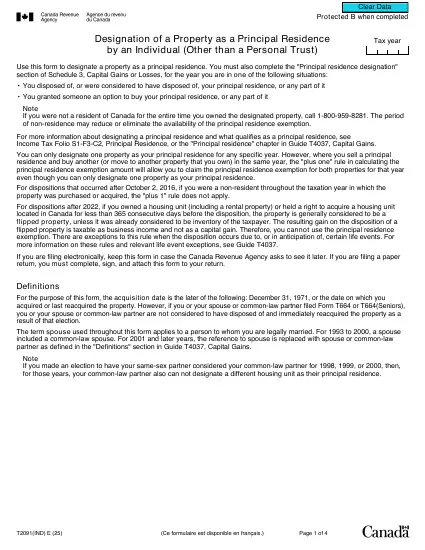
Form T2091(IND) is how an individual designates a property, such as a house, cottage or condominium, as their principal residence when they sell it, are considered to have sold it, or grant someone an option to buy it. Section 1 describes the property and designates the years it was your principal residence; Section 2 calculates the part of the capital gain that is not covered by the principal residence exemption, which then goes on Schedule 3. You complete it together with the principal residence part of Schedule 3 for the year of the sale. This is the 2025 edition.
The form opens in our PDF editor with its own fields ready to type into. To download it, the filled PDF is sent to GuruPDF to prepare the file and is deleted from our servers one hour later. You can fill it in without an account; downloading the filled PDF needs a free account. A free account gets 15 credits a day, enough for one form a day.
- Country
- Canada
- Edition
- 2025
- Pages
- 4
- Fillable fields
- 78
- Last checked at the source
- November 13, 2026
GuruPDF is an independent PDF editor, not a government agency, and is not affiliated with any government. This page explains the form in plain words; it is not legal or tax advice. Always check the official instructions before you file.
Who uses Form T2091(IND)
- People who sold their home in the tax year and claim the principal residence exemption
- People considered to have sold all or part of their home, for example when they changed it to a rental or business property
- Owners of a cottage or second home designating it for some of the years they owned it
- People who sold more than one property that was at some time their principal residence (one form per property)
- People who granted someone an option to buy their principal residence
Before you start
- The property's address and the year you acquired it
- The proceeds of disposition, and only your share if you owned the property jointly or used part of it to earn income
- The number of tax years you owned it after the acquisition date and the number you are designating
- For Section 2: the adjusted cost base, your selling costs (outlays and expenses) and any capital improvements
- For property owned before 1982: its adjusted cost base and fair market value on December 31, 1981
- Form T664 or T664(Seniors) details and Form T2091(IND)-WS if you or your spouse made the 1994 capital gains election for this property
- Schedule 3 of your T1 return, where you tick box 1, 2 or 3 at line 17900
How to fill out Form T2091(IND)
Page 1 – When to use the form and key rules
Read the rules at the top: you can only designate one property as your principal residence for any year, but the "plus one" rule lets you claim the exemption for both properties in a year you sell one home and buy another. The rule does not apply to dispositions after October 2, 2016, if you were a non-resident throughout the year you acquired the property. A housing unit owned for less than 365 consecutive days is generally flipped property, whose gain is business income and not eligible for the exemption. The acquisition date is December 31, 1971, or the date you acquired or last reacquired the property, whichever is later.
How to complete this form
If you ticked box 1 at line 17900 of Schedule 3 (the property was your principal residence for all the years you owned it, or all but one), you only complete Section 1 and do not report a gain on Schedule 3 for this property. If you ticked box 2 or 3, you also complete Section 2 – Calculation of the capital gain. Complete a separate form for each property you sold.
Section 1 – Description of property
Enter the street address, city, province or territory, postal code and country, the year of acquisition, and the proceeds of disposition. If the property was jointly owned, enter only your share of the proceeds; if part was used for commercial or rental purposes, enter only the share for the part you used as your principal residence.
Section 1 – Designation and signature
Print your name, then enter the number of tax years ending after the acquisition date that you designate: after 1981 on line 1, after 1971 and before 1982 on line 2, and the total on line 3. The text confirms that for years after 1981 no one in your family unit (spouse or common-law partner, or unmarried children under 18) designated another property, and for years before 1982 that you did not designate another one. If the property was designated for Form T664 or T664(Seniors), include those years. Sign and enter your social insurance number and the date.
Section 2, Part 1 – Calculation of the capital gain
Lines 4 to 13 collect the figures: years designated, years owned after 1981 and after 1971 but before 1982, proceeds, outlays and expenses, the adjusted cost base (without any increase from a T664 election), and for older property the cost base and fair market value on December 31, 1981, and later adjustments. Lines 14 to 18 give the capital gain before the exemption. Lines 19 to 23 calculate the exemption: the gain multiplied by the years designated plus one, divided by the years owned. Line 24 is the net capital gain.
Section 2, Parts 2 to 4 – Pre-1982 property, total and T664 reduction
Complete Part 2 only if the property is one of two or more properties qualifying as principal residences that a family member owned on December 31, 1981, and continuously afterwards; it splits the gain into a pre-1982 gain (area A), a post-1981 gain (B) and any post-1981 loss (C), with the net in area D. Part 3 (line 54) is the total capital gain: the lesser of line 53 and line 24 if you did Part 2, otherwise line 24. Complete Part 4 only if a T664 or T664(Seniors) election was filed for this property, subtracting the reduction from Form T2091(IND)-WS. Enter the final amount on line 15800 of Schedule 3.
After you fill it out
If you file a paper return, the form says you must complete, sign and attach it to your return for the year, together with Schedule 3 (where you tick box 1, 2 or 3 at line 17900). If you file electronically, report the designation in your software and keep the signed form in case the CRA asks to see it later. If you forget to designate in the year of the sale, the CRA says it is very important to ask it to amend that year's return; it will accept a late designation in certain circumstances, but a penalty may apply.
Signing: You sign the designation in Section 1 and enter your social insurance number and the date. For a paper return the form must be signed and attached; it is not on the CRA's list of forms that accept an electronic signature, so print it and sign it by hand. Electronic filers keep the signed form.
Watch out for
- Since the 2016 tax year, the CRA only allows the principal residence exemption if you report the sale and the designation on your return for the year of the sale.
- Only one property can be designated per year for the family unit (you, your spouse or common-law partner, and your unmarried children under 18).
- A home sold less than 365 consecutive days after you acquired it is generally flipped property: the gain is business income and the exemption cannot be used, unless one of the listed life events applies.
- If you were not a resident of Canada for the whole time you owned the property, the form says the period of non-residence may reduce or eliminate the exemption, and asks you to call the CRA.
- A loss on the sale of your home cannot be claimed, because it is personal-use property.
Questions about Form T2091(IND)
Do I need this form if my home was my principal residence the whole time?
Yes. Tick box 1 at line 17900 of Schedule 3 and complete Section 1 of Form T2091(IND). You do not report any gain on Schedule 3 for that property, but the sale and designation must still be reported.
What is the "plus one" rule?
In the exemption formula (line 20), one year is added to the number of years designated. This lets you claim the exemption for both homes in a year you sell one and buy another, even though only one can be designated for that year. It does not apply to dispositions after October 2, 2016, if you were a non-resident throughout the year you acquired the property.
I sold two properties this year. Do I need one form or two?
Two. The form says to complete a separate form for each property you sold, and the CRA says to show each property that was at some time your principal residence on its own T2091(IND).
I forgot to report the sale of my home. What now?
The CRA says to ask it to amend your return for the year of the sale. It accepts a late designation in certain circumstances, but a penalty may apply.
Part of my home was rented out. How do I report the sale?
The CRA says to split the selling price and the adjusted cost base between the part used as your principal residence and the part used to earn income, for example by square metres or number of rooms. On this form, enter only the proceeds for the part you used as your principal residence; the gain on the rented part is reported on line 13800 of Schedule 3.
Official information
- T2091(IND) Designation of a Property as a Principal Residence by an Individual (CRA)
- Principal residence (CRA)
- T2091(IND)-WS Principal Residence Worksheet
- Income Tax Folio S1-F3-C2, Principal Residence
- Guide T4037, Capital Gains
Page text last reviewed November 13, 2026.